
Last Updated: September 10, 2026
For most Perth homeowners with a structurally sound slab, concrete resurfacing wins on upfront cost, speed and minimal disruption, while paving suits new builds or badly damaged surfaces. This guide from Spray Pave Pro breaks down the concrete resurfacing vs paving decision across cost, durability, maintenance and resale so you can choose with confidence.
Resurfacing is the process of applying a new decorative or protective layer over an existing concrete slab, whereas paving involves laying individual units such as clay bricks or concrete pavers on a prepared base. The distinction matters because one restores what you already own, and the other replaces it entirely.
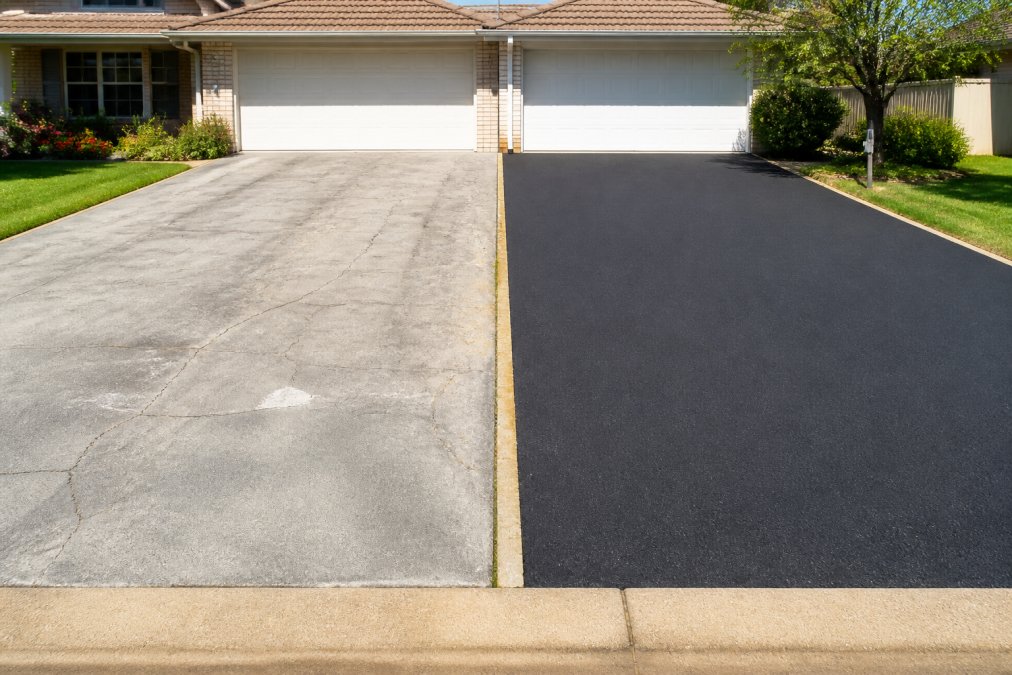
| Factor | Concrete Resurfacing | Paving |
|---|---|---|
| Upfront cost | Lower, reuses existing slab | Higher, new base and units |
| Installation time | Days, not weeks | Longer, excavation required |
| Maintenance | Reseal periodically | Re-sand joints, manage weeds |
| Damage repair | Patch and recoat | Replace individual units |
| Best for | Sound, cracked or stained slabs | New builds, failed slabs |
| Aesthetic range | Stencils, colours, epoxy flake | Broad texture and colour choice |
Local conditions decide which surface actually lasts. Perth's combination of intense summer heat and reactive clay soils punishes poor preparation, so the choice between resurfacing and paving often comes down to how well each option handles movement and thermal stress.
Concrete expands and contracts with temperature swings, and coatings must flex with it or crack (cement.org). UV-stable sealers and resurfacing compounds resist fading and chalking far better than untreated concrete.
Reactive clay swells when wet and shrinks when dry, which is why subsidence is a genuine concern on many Perth blocks. A resurfaced slab that has already settled is generally stable. New paving laid over unstable ground can shift and become uneven unless the base is properly compacted.
Spray-on concrete cost per square metre depends on surface area, existing slab condition, preparation required and your chosen finish, so pricing is always quoted per project rather than fixed. Spray Pave Pro provides free quotes so you get an accurate figure for your specific driveway or patio.
As a general guide, most Perth homeowners should expect resurfacing to sit in the lower band of the two options because it reuses the existing slab rather than paying for demolition, disposal and a new compacted base. Paving carries those three costs on top of the units themselves, which is why a like-for-like paved driveway typically quotes higher than a resurfaced one of the same area. Treat any figure you see online as a starting point only, the final number is set by the slab, not the brochure.
A paving quote is not just pavers. It bundles removal and disposal of the old surface, excavation to depth, supply and compaction of the base course, bedding sand, the units, cutting, joint sand and sealing. Each of those is a separate line item, which is why paving quotes vary so widely between contractors. Resurfacing collapses most of that into preparation plus coating, which is the structural reason it usually lands lower.
Ask every contractor for the same four things in writing: the preparation method, the products specified, the number of coats, and the cure time before the surface can be driven on. A cheap quote that skips moisture testing or specifies a single thin coat is not a cheaper job, it is a shorter-lived one. Be wary of any operator quoting a flat rate without inspecting the slab first.
For current pricing, request a quote directly so the figure reflects your slab, your access and your chosen finish.
Structural integrity determines whether resurfacing is even an option. A resurfacing compound is a protective and decorative layer, not a structural fix, so the underlying concrete slab must be sound and load-bearing before any coating goes down.
Where the slab is intact, a professionally applied system with proper curing time delivers strong long-term performance. Where the slab is heaving, crumbling or hollow, no coating will hold. That is the point at which paving, or full replacement, becomes the honest recommendation.
Maintenance requirements for pavers are ongoing: joint sand washes out, weeds grow between units, and individual pavers can stain or shift. Resurfaced concrete needs less routine work, mainly periodic cleaning and resealing to protect the surface finish.
Pavers win on one point: a single damaged unit can be lifted and replaced. A resurfaced slab is a continuous surface, so damage is repaired by patching and recoating rather than swapping a brick. For most homeowners wanting low maintenance, a sealed resurfaced surface is the easier long-term proposition.
Non-slip pool surfacing options matter most around wet areas, where slip resistance is a safety requirement rather than a preference. Epoxy flooring with an added grip aggregate and textured resurfacing finishes both raise friction underfoot while staying comfortable to walk on barefoot.
A glossy finish looks sharp but becomes treacherous when wet. The fix is a textured topcoat or a non-slip additive mixed into the sealer, which keeps the surface safe without turning it abrasive. Colour sealing lets you match the pool surround to the home while keeping that grip.
Safe Work Australia's guidance on managing slip hazards sets out the duty to manage slip risks in workplaces, which is worth reviewing for commercial pool and hospitality areas.
Installation speed favours resurfacing by a wide margin. A resurfaced driveway is typically completed in days with minimal excavation, while paving involves removing the old surface, preparing a new base and laying units, which stretches over a longer period.
DIY resurfacing is where many projects fail. Surface preparation, moisture testing and correct curing time are unforgiving, and a coating applied over a damp or poorly cleaned slab peels within a season. Professional application also carries a workmanship guarantee that a weekend DIY job simply cannot match.
Most comparisons stop at cost and colour. The three factors below are where the decision actually gets made, and where the local angle matters most.
Resurfacing generally has the lighter footprint because it reuses the existing slab. There is no demolition, no skip bin of broken concrete to landfill, and no new base course to quarry, cart and compact (the EPA). The trade-off is that a sealed resurfaced surface is largely impermeable, so stormwater runs off rather than soaking in.
Paving consumes more raw material and generates disposal waste, but it can be laid with permeable joints or on a permeable base so water drains between the units. On a block where runoff is already a problem, that permeability can be the deciding factor. The honest framing is: resurfacing wins on embodied waste, paving can win on drainage, and the right answer depends on your site, not the material.
Resurfacing keeps the existing slab lines and levels, so the design palette is applied rather than structural: stencilled patterns, coloured sealers, exposed-aggregate finishes and epoxy flake. Paving offers a wider structural palette because the units themselves come in different sizes, thicknesses and textures, and you can mix them to create bands, borders and herringbone layouts.
If you want to change the shape, level or footprint of the surface, paving is the only one of the two that can do it. If you want to change how the existing surface looks without moving it, resurfacing is faster and cheaper.
Curb appeal is the first thing a buyer registers, and the driveway or front path is the largest single hard surface they see before they reach the door. A restored, well-sealed surface reads as a maintained home; a stained, cracked or weed-infested one reads as deferred maintenance, and buyers price that in.
The practical point for sellers is that a resurfaced driveway is one of the cheaper ways to lift that first impression, because it improves the surface without the disruption and cost of a full paving job. Paving can add more if it is part of a broader landscaping upgrade, but on its own it is a bigger spend for a similar first-impression gain. Neither is a guaranteed valuation multiplier, the effect depends on the rest of the property, but a tired surface is a reliable negative, and fixing it is a reliable positive.
Perth's sandy soils and reactive clay pockets behave differently from the compacted ground assumed in generic advice. Sandy soil drains quickly but can shift under a poorly prepared base, while reactive clay swells and shrinks with moisture and stresses whatever sits on top. That is why the same surface can perform well on one block and fail on the next. Before choosing between resurfacing and paving, it is worth understanding which soil profile your block sits on, it will influence both the preparation method and how long the finished surface holds its levels.
Spray Pave Pro's 23 years of experience and 100% satisfaction guarantee mean the finish is applied to last, not just to photograph well on day one. As customer Suzzane put it, after obtaining several quotes, I settled on this company because they were reasonable with a low price tag that fit within reach!
Pricing depends on the size of the area, the condition of the existing slab, and the finish you choose, so a site visit is needed for an accurate figure. Resurfacing generally costs less than removing and repouring concrete or laying new pavers because there is no demolition or disposal. For a current spray-on concrete cost per square metre, request a free quote from Spray Pave Pro.
It is a good idea when the existing slab is structurally sound but looks worn, stained or lightly cracked. Resurfacing restores the surface, improves slip resistance and adds colour without demolition. If the slab has deep structural cracks, movement or subsidence, a specialist should assess it first. Spray Pave Pro offers a 100% satisfaction guarantee and over 23 years of experience assessing driveways before work begins.
Both last well when installed correctly. Pavers handle ground movement better because individual units can flex and be replaced if damaged, but joint sand can wash out and weeds can grow between units. Spray-on concrete creates a seamless, sealed surface with good load-bearing capacity when the substrate is sound. In Perth's heat and reactive soils, the deciding factor is usually how well the base has been prepared.
Paving is slower because each unit is laid, cut and jointed by hand, and a typical driveway can take several days to over a week. Concrete resurfacing is faster: surface preparation, crack repair, coating and sealing are often completed in one to three days, depending on the area and curing time. Spray Pave Pro is known for quick installation, which suits busy households and businesses that cannot close for long.
Both improve curb appeal, and a clean, well-finished surface helps buyers see the property as maintained. Resurfacing is the lower-cost way to achieve a fresh look before listing, while new paving suits a full landscape redesign. Either way, keep receipts and note the products used, because documented work reassures buyers during inspection.
