
Last Updated: September 27, 2026
Epoxy flooring alternatives for commercial kitchens exist because standard epoxy has a specific weakness: it cannot handle thermal shock. According to Safe Work Australia's guidance on managing risks in food premises, slips and trips remain among the most common workplace injuries, and a wet kitchen floor is where that risk concentrates.
Standard epoxy is rigid. When a 90°C washdown hits a 20°C floor, the coating expands faster than the concrete beneath it. That stress builds at the bond line until the floor peels.
Four factors decide whether an alternative will last:
Get these four right and the floor outlasts the fit-out. Get them wrong and you're resurfacing again in two years.
| Material | Thermal Shock | Chemical Resistance | Best For | Relative Cost |
|---|---|---|---|---|
| Polyurethane cement | Excellent | Excellent | Wet, high-heat zones | Higher upfront |
| Commercial vinyl | Moderate | Moderate | Budget renovations, front-of-house | Lowest upfront |
| High-build resin (HBE) | Good | Very good | Aesthetic + industrial mix | Mid-range |
| Resin flooring systems | Very good | Excellent | Large-scale food facilities | Project-quoted |
The table shows the trade-off clearly: nothing wins on every line. The right choice depends on where in the kitchen the floor sits and how it's used.
Polyurethane cement flooring is a high-performance system built for the extreme temperature swings in commercial kitchens. It handles hot water washdowns, food acids, and heavy equipment traffic without the cracking that plagues standard epoxy.
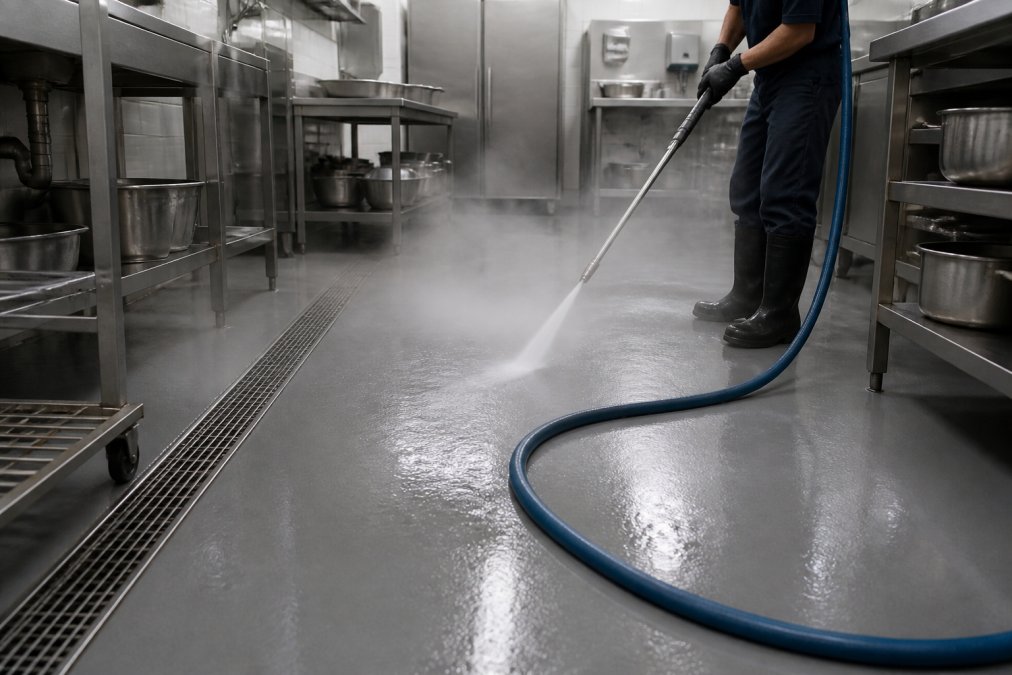
The short answer: anywhere the floor meets heat and water at the same time.
Urethane cement costs more upfront and needs professional installation because of its curing requirements. For a dry storage area or front-of-house, it's overkill. Save it for the wet zones where it earns its keep.
Commercial vinyl flooring is the most affordable epoxy alternative for kitchens where the budget is tight. It's water-resistant, available in slip-resistant textures, and quick to install.
High-build epoxy (HBE) systems are applied at a much greater film thickness than standard decorative epoxy, typically built up in multiple coats with aggregate broadcast between layers, rather than a single thin seal coat. That extra build is the whole point: a thicker resin matrix absorbs impact, bridges minor substrate imperfections, and takes far longer to wear through under trolley traffic and dropped equipment than a 200-300 micron decorative coating.
A high-build system is not one product, it is a build-up. A typical specification includes a primer, a base coat, a broadcast layer of graded aggregate (silica or quartz) for grip and body, and one or more seal coats. The result is a floor that behaves more like a thin screed than a paint film.
That build-up is what delivers the performance gains:
Against standard epoxy, high-build wins on almost every durability metric. It resists impact, abrasion, and chemical attack better, and it lasts longer in food preparation environments where the floor is cleaned daily with degreasers and sanitisers.
The most common specification error is applying a high-build system everywhere in a kitchen when only part of the space needs it. A zone-by-zone approach, urethane cement in the washdown and dishwash areas, high-build resin in prep, plating, and front-of-house, usually delivers the same service life for a lower total spend than a single premium system across the whole floor.
The slip resistance standards AS 4586 set out how floor surfaces are classified for slip risk in Australia. If your kitchen floor doesn't meet the right classification for its use, you're exposed to both safety incidents and compliance problems.
AS 4586 classifies flooring by test results, and the classification you need depends on the area. A dry storage room and a wet dishwashing zone have very different requirements.
The wetter and greasier the zone, the higher the slip resistance classification it needs. This is where a lot of generic flooring advice fails: it treats the whole kitchen as one surface when the requirements differ from corner to corner.
Commercial kitchen flooring maintenance requirements vary sharply by material, and they affect your long-term costs more than the install price does.
| Material | Daily Care | Deep Clean | Typical Repair |
|---|---|---|---|
| Urethane cement | Damp mop, degreaser | Periodic scrub | Patch with same system |
| Commercial vinyl | Sweep, mop | Machine scrub | Replace tiles or sections |
| High-build resin | Damp mop | Degreaser scrub | Localised recoat |
| Standard epoxy | Damp mop | Careful scrub | Often full resurface |
Most comparison guides stop at the install quote. That is the smallest number in the decision. The three factors below decide whether a floor is genuinely good value over its service life, and almost no competitor article covers them in any depth.
A cheap floor that needs replacing in two years costs more than an expensive one that lasts ten. The problem is that most quotes only show the install figure, so the comparison never happens.
A commercial kitchen floor will get damaged. A dropped knife, a dragged oven, a chemical spill left overnight. The question is not whether damage happens, it is whether you can patch a section or whether you must close the kitchen and resurface the lot.
How each material behaves:
Hard resin floors reflect sound. In a busy kitchen with dozens of staff, stainless steel benches, and extraction running, that reflection turns the room into a noise box. Over a shift, the effect is fatigue, raised voices, and more communication errors.
Polyurethane cement is the most durable option for wet, high-traffic commercial kitchens. It handles thermal shock from hot water washdowns, resists food acids, oils and cleaning chemicals, and forms a seamless, non-porous surface that will not harbour bacteria. High-build resin systems also perform well where thermal extremes are less severe. Standard epoxy is the weakest of these in wet kitchens because it can crack when temperatures swing quickly, which makes it a poor fit for dishwashing and cooking zones.
Polyurethane cement, commercial vinyl, high-build resin systems and trowel-applied resin flooring all work as alternatives. Urethane cement suits extreme temperature swings and heavy chemical exposure. Vinyl suits front-of-house and budget renovations where upfront cost matters most. High-build resin sits between the two, offering a thicker protective layer than standard epoxy without the full cost of urethane cement. The right pick depends on your kitchen's heat, grease and traffic profile.
Polyurethane cement outperforms standard epoxy on thermal shock, chemical resistance and impact resistance, which is why it is common in commercial kitchens and food processing plants. Epoxy cures to a hard, glossy finish that cleans easily but can crack when hit with rapid temperature changes. Urethane cement flexes with those swings instead. The trade-off is cost and installation complexity, since urethane cement needs professional application and a longer curing window.
AS 4586 sets out how slip resistance is measured and classified in Australia. Wet and greasy kitchen zones need a higher classification than dry storage areas, and your local health department regulations may impose extra requirements. When you get quotes, ask for the AS 4586 classification of the proposed finish, not just the product name. A coating that meets the standard on paper can still fail in practice if the wrong profile or application method is used.
Downtime depends on the system. Vinyl is the fastest, often installed in a day or two. High-build resin systems typically need two to four days including curing. Urethane cement takes longer because of substrate preparation and curing requirements, so plan for several days to a week of partial or full closure. Ask your installer for a written schedule with cure times before you commit, and factor in when the kitchen can safely reopen for food preparation.
