
Last Updated: September 24, 2026
Choosing the best low maintenance for non-slip pool surfacing comes down to one trade-off: how much ongoing work you accept for grip, comfort and looks. Spray Pave Pro has spent 23 years resurfacing concrete around pools. Below is a comparison of six options, followed by detail on each.
| Option | Maintenance Level | Slip Resistance | Best For |
|---|---|---|---|
| Spray Pave Pro resurfacing | Low | High, textured | Cracked or stained existing concrete |
| Tanzite Stone Decks | Low | High | Stone-look upgrades |
| Polysplash Rubber | Low | Very high | Families with young children |
| Porcelain Pavers | Very low | High (R-rated) | Long-term value |
| Acrylic Elastomeric Coating | Medium | Medium-high | Budget concrete resurfacing |
| Broom-Finished Concrete | Very low | Medium | New pool builds |
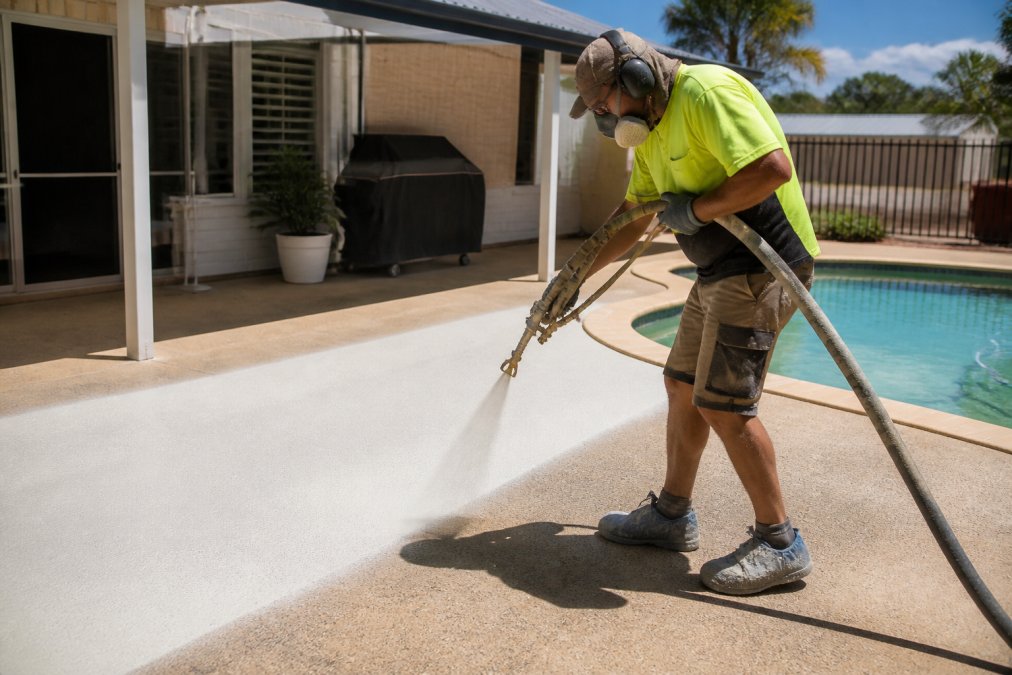
Spray Pave Pro is a concrete resurfacing specialist that transforms worn pool surrounds with spray-on concrete, high-pressure cleaning and professional sealing, backed by 23 years of experience and a 100% satisfaction guarantee.
Tanzite Stone Decks is a composite stone decking system built for pool surrounds. Its engineered stone resists water absorption, and the textured profile provides grip without exposed aggregate's roughness.
Polysplash is a rubberised safety surface for wet areas and the softest option here. Its porous design drains water quickly, and the cushioning reduces impact if someone falls near the pool edge.
Porcelain pavers are high-density, vitrified tiles made for outdoor use and the lowest-maintenance surface here. The non-porous face resists staining and mould and never needs sealing.
Acrylic elastomeric coating is a textured, liquid-applied finish applied straight over existing concrete. It is the most affordable way to resurface a sound slab, and its flexible formula bridges minor cracks.
Broom-finished concrete is created by dragging a stiff broom across the surface while it cures, leaving fine grooves that improve grip. It is the cheapest option upfront and needs almost no maintenance.
Slip resistance for pool surrounds in Australia is governed by two standards. AS 1926.1 sets barrier and safety requirements for swimming pool surrounds, and AS 4586 sets out how slip resistance is classified and tested. If an installer cannot tell you which classification their finished surface achieves under AS 4586, that is a red flag.
AS 4586 recognises two main wet tests for pedestrian surfaces:
| Classification | Test | Typical use around a pool |
|---|---|---|
| R10-R11 | Wet pendulum | Minimum for general wet areas |
| R12-R13 | Wet pendulum | Pool decks, ramps, steps |
| A | Wet barefoot ramp | Pool surrounds, shallow water zones |
| B | Wet barefoot ramp | Pool surrounds, sloping entries |
| C | Wet barefoot ramp | Steep ramps and pool steps |
A product can carry an R-rating and an A/B/C classification at once, they measure different things. For a residential pool deck, look for at least R11 under the wet pendulum test and A or B under the wet barefoot ramp test. Higher ratings mean more grip but also more texture, affecting comfort and cleaning.
Slip ratings apply to the installed surface, not the tin. A coating that tests R12 in a laboratory can drop to R9 once thinned, over-broomed or worn. Two mechanisms cause this:
Slip resistance is not static, it degrades with chemical exposure. Pool surrounds are constantly splashed with chlorinated water, salt water and pH-balancing chemicals, and surfaces respond differently:
AS 4586 slip resistance classification
How to clean non-slip pool surfaces comes down to one rule: never scrub textured finishes with anything abrasive. A stiff brush and mild detergent lift most dirt, and a low-pressure rinse clears the grooves.
Non-slip pool deck coating cost depends on three things: surface area, the existing slab's condition, and the finish you choose. Resurfacing an existing deck costs less than laying new pavers, no demolition, disposal or sub-base work.
Rather than quote a single rate that will not apply to your deck, it helps to understand the order of magnitude. From lowest to highest upfront cost:
Spray Pave Pro provides free quotes, so you can get a figure for your actual deck rather than a generic rate. Ask for the quote to list the finish, the slip classification of the cured surface, and the resealing interval so you can compare the lifetime cost, not just the day-one price.
The best non-slip pool surfacing depends on your priorities. Porcelain pavers offer the lowest maintenance because they are non-porous and resist algae growth. Rubberised surfaces provide the best grip and cushioning for families with children. Acrylic elastomeric coatings are the most affordable way to resurface existing concrete. Each option meets slip resistance standards for pool surrounds when installed correctly by a professional.
Regular cleaning is the main task. Sweep debris weekly and wash the surface with a mild detergent and a stiff brush to prevent algae growth. For textured coatings, a low-pressure hose works better than a high-pressure cleaner, which can damage the surface profile. Resealing frequency depends on the material: acrylic coatings may need recoating every two to three years, while porcelain pavers and rubberised surfaces need no sealing at all.
Acrylic elastomeric coating is typically the most affordable resurfacing option for existing concrete pool decks. It is a liquid-applied product that bridges minor cracks and provides a textured, heat-reflective finish. Broom-finished concrete is cost-effective for new builds but cannot be applied over an existing slab. For a precise non-slip pool deck coating cost for your specific pool surround, request a quote from a resurfacing specialist.
Acrylic elastomeric coatings have heat-reflective properties that keep the surface cooler in direct sun compared with plain concrete or dark stone. Porcelain pavers also stay relatively cool because they do not absorb as much heat. Rubberised surfaces can warm up in full sun but remain comfortable due to their cushioning. Light-coloured finishes consistently perform better than dark tones for heat retention.
Resealing depends on the material. Acrylic elastomeric coatings generally need recoating every two to three years to maintain optimal slip resistance and colour. Concrete sealers may need reapplication annually in high-traffic or chemically exposed areas. Porcelain pavers and rubberised surfacing do not require sealing. Check with your installer for a maintenance schedule specific to your pool surround and local climate.
