
Last Updated: September 13, 2026
Choosing the best sealers for spray on concrete comes down to matching the formula to the surface, the finish you want, and how much traffic the slab takes. This guide from Spray Pave Pro breaks down solvent versus water-based options, four proven products, and the spray technique that separates a ten-year coating from a one-year failure.
Concrete sealer is a protective coating or penetrating treatment applied to a concrete substrate to resist water, salt, oil, and UV damage while extending the surface's service life.
The table below summarises the four products covered in this guide before we examine each in detail.
| Product | Type | Finish | Best For |
|---|---|---|---|
| Foundation Armor AR350 | Solvent-based acrylic | Satin wet-look | Decorative driveways |
| Foundation Armor SX5000WB | Water-based silane-siloxane | Natural, invisible | Exposed aggregate, pavers |
| Ghostshield Siloxa-Tek 8500 | Water-based penetrating | Matte, natural | High-traffic, oil-prone areas |
| Super Seal 30 | High-solids acrylic | High-gloss | Stamped concrete |
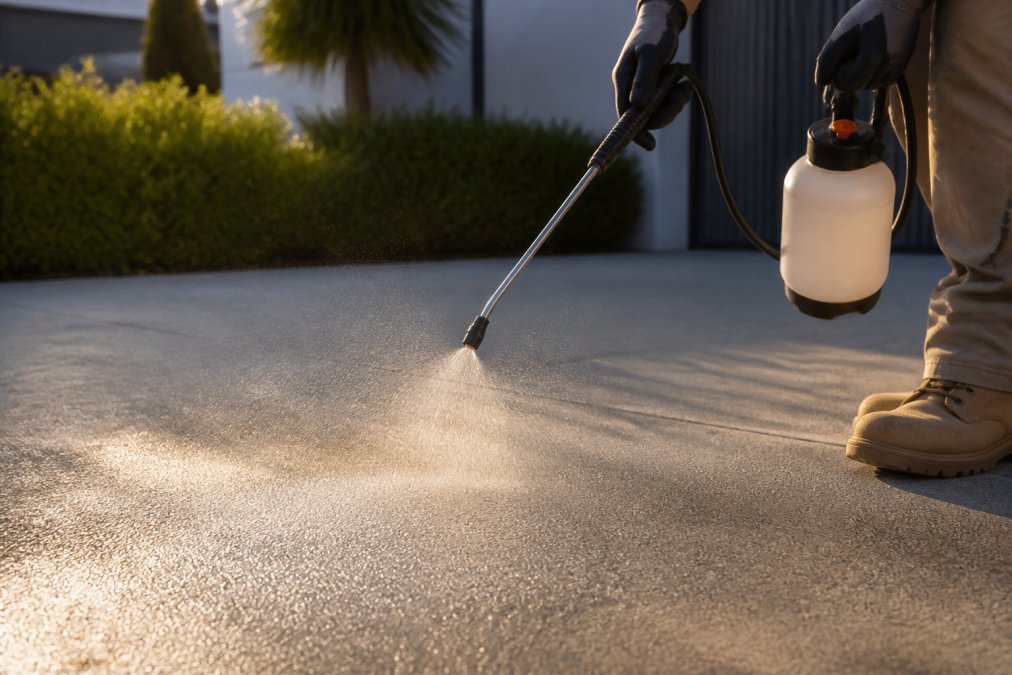
Solvent-based sealers cure faster and produce a richer wet-look finish, while water-based formulas carry lower VOC levels, dry with less odour, and suit surfaces where a natural appearance matters more than shine. The right choice depends on your finish goal, ventilation, and the sealer's re-coat window.
VOC compliance matters here. Water-based products generally meet stricter volatile organic compound limits, which makes them the practical default for occupied homes and commercial premises where fumes are a concern.
Solvent-based acrylics like AR350 flash off quickly and bond aggressively to porous concrete, but they demand solvent-safe spray equipment and proper ventilation. Water-based penetrating sealers such as SX5000WB soak into the substrate and react within the pores rather than sitting on top.
A common mistake is assuming one type is universally superior. It isn't. For a stamped concrete patio where colour depth is the priority, solvent-based wins. For a driveway that must stay slip-resistant when wet, a non-film-forming water-based sealer is the safer call.
Spray compatibility is not universal. Some sealers are formulated for airless sprayers and pump sprayers, while others clog fine nozzles or flash off before they reach the surface. The four products below are all designed with spray application in mind, but each demands different equipment and technique.
A solvent-based acrylic sealer built for a wet-look finish, AR350 enhances colour while forming a breathable film. It resists UV light and chemicals, and it sprays cleanly through compatible equipment. Best for decorative and spray-on concrete where aesthetic depth matters. The trade-off: solvent handling requires care.
Spray equipment notes: AR350's solvent carrier demands solvent-resistant seals, hoses, and gaskets. Standard pump sprayers with Viton or PTFE seals work well; natural rubber components degrade quickly. An airless sprayer with a tip size between 0.015 and 0.017 inches at 1,500-2,000 psi delivers an even mist without atomising too finely, which can cause overspray drift. Keep the wand moving; solvent-based acrylics tack up fast, and a stationary pass leaves lap marks that cure into visible ridges.
This water-based penetrating sealer uses a silane-siloxane formula to reduce water and salt absorption without changing the surface appearance. Non-film-forming and low-VOC, it maintains a natural look and won't make the slab slippery. The limitation is obvious: no gloss, no colour enhancement.
Spray equipment notes: SX5000WB is thin, similar in viscosity to water, so it sprays through most pump sprayers with a fan nozzle. The risk here is over-application, not clogging. Because it penetrates rather than films, excess product pools in low spots and cures as a white residue. Use a lower pressure setting and maintain a consistent walking pace. A tip size between 0.011 and 0.013 inches on an airless unit works, but reduce pressure to avoid splashing.
An industrial-grade penetrating sealer offering hydrophobic and oleophobic properties, meaning it repels both water and oil. It resists mould and mildew while remaining breathable. For high-traffic areas prone to oil staining, this is the strongest performer in the group. It costs more than standard acrylics.
Spray equipment notes: This product is formulated for spray application but requires thorough agitation before and during use, as silane-siloxane blends separate over time. A pump sprayer with a Viton seal kit handles it well. Clean the sprayer immediately after use; once the silane begins to react, it leaves a gummy residue that clogs nozzles and lines. Do not let it sit in the sprayer between coats.
A high-solids acrylic delivering a high-gloss finish with UV resistance to prevent yellowing. It sprays well and suits stamped and spray-on concrete that needs a vibrant, polished look. The catch: high gloss can become slippery when wet, so consider a slip-resistant additive on pool surrounds.
Spray equipment notes: High-solids acrylics are thicker and demand an airless sprayer with a larger tip size between 0.017 and 0.021 inches and higher pressure, typically 2,000-2,500 psi. Pump sprayers struggle with the viscosity and produce an uneven, spitting pattern. Keep the nozzle 25-30 cm from the surface and overlap each pass by 50 per cent to avoid striping. Re-coat within the manufacturer's window; once the first coat cures fully, the second coat may not bond and can delaminate.
Sealing spray on concrete correctly requires a clean, dry, properly prepared substrate and a sprayer matched to the sealer's viscosity. Rushing preparation is the single biggest reason coatings fail early. This section covers the full process, including the safety and equipment details most guides skip.
Surface preparation determines adhesion. Concrete porosity varies, and a dirty or damp slab will reject the sealer.
For solvent-based products, use solvent-resistant seals and hoses. Water-based sealers are gentler on standard pump sprayer components.
Equipment matching by sealer type:
| Sealer Type | Recommended Sprayer | Tip Size | Pressure |
|---|---|---|---|
| Solvent-based acrylic | Airless or pump with solvent-safe seals | 0.015-0.017 inch | 1,500-2,000 psi |
| Water-based penetrating | Pump sprayer or low-pressure airless | 0.011-0.013 inch | 800-1,200 psi |
| High-solids acrylic | Airless only | 0.017-0.021 inch | 2,000-2,500 psi |
Aerosolised solvent-based sealers present inhalation and flammability hazards that water-based products do not. The fine mist can carry solvent vapour well beyond the immediate work area, and ignition sources, including pilot lights, power tools, and vehicle exhausts, must be eliminated before spraying begins (WorkSafe guidance on hazardous chemicals(https://www.worksafe.qld.gov.au/safety-and-prevention/hazards/hazardous-chemicals/specific-hazchem-risks/controlling-fire-and-explosion-risks)).
Minimum PPE for solvent-based spray application:
For water-based sealers, a dust mask and safety glasses are usually sufficient, but ventilation remains important. Spray outdoors or with cross-flow ventilation. Never spray solvent-based products in a closed garage; vapour accumulation can reach flammable concentrations.
Apply in even, overlapping passes, keeping the nozzle a consistent distance from the surface. Work in manageable sections so you maintain a wet edge and avoid lap marks.
The re-coat window depends on the formula. Solvent-based sealers typically accept a second coat sooner than water-based products, but always follow the manufacturer's stated interval. Applying too early traps solvent and causes blushing, a cloudy white haze across the finish.
Climate timing: In hot, dry conditions above 30°C, solvent-based sealers can flash off before levelling, leaving streaks. Spray early morning when the slab is cool and humidity is higher. In humid coastal conditions, water-based sealers need longer to cure between coats; extend the re-coat window by 50 per cent if relative humidity is above 70 per cent. Avoid spraying if rain is forecast within 24 hours for water-based products or 12 hours for solvent-based.
A quality concrete sealer lasts between two and five years on exterior surfaces, with penetrating sealers often outlasting film-forming acrylics because they don't wear away as a surface layer. Longevity depends on traffic, UV exposure, and re-coat timing.
Driveways under constant vehicle traffic degrade faster than patios. High-gloss film-forming sealers show wear as dull patches and scratches, while penetrating sealers fade gradually and are harder to spot until water stops beading. Re-coat before the surface stops repelling water, not after stains appear.
Most sealer failures trace back to four errors: inadequate surface preparation, spraying in the wrong climate conditions, applying too thick, and skipping the re-coat window. Each has a visible symptom and a fix.
| Problem | Likely Cause | Fix |
|---|---|---|
| Blushing (white haze) | Moisture trapped under film | Strip and reapply in dry conditions |
| Delamination | Dirty or damp substrate | Pressure-clean, dry, and re-coat |
| Uneven finish | Overlapping passes too slowly | Maintain wet edge, even speed |
| Slippery surface | High-gloss film when wet | Add slip-resistant aggregate |
Climate matters more than most guides admit. In hot, dry conditions, solvent-based sealers can flash off before levelling, leaving streaks. In humid coastal conditions, water-based sealers need longer to cure. Spraying early morning or late afternoon avoids the worst of both.
Professional sealing delivers a more consistent finish and a longer service life because it pairs the right sealer with the right spray equipment and climate timing. DIY kits rarely account for concrete porosity, moisture content, or VOC-compliant product selection.
Spray Pave Pro brings over 23 years of experience to concrete resurfacing and sealing across residential and commercial properties. The team handles surface preparation, selects the correct sealer for the substrate and finish goal, and applies it with professional spray equipment for an even, durable result. A 100% satisfaction guarantee backs the work, and customers consistently note the professionalism and speed of the process.
As one customer, Rob, put it: "We are so pleased with the work that was done by this team. They were professional and quick during their visit, which made for an easy process overall!"
For homeowners preparing to sell, a properly sealed driveway or patio improves curb appeal and protects the surface against staining during the sales period. For facility managers, professional sealing reduces long-term maintenance and keeps floors easier to clean.
Yes, many concrete sealers are formulated for spray application. Solvent-based acrylics and water-based penetrating sealers work well with airless sprayers or pump sprayers. Always check the product label for spray compatibility. For best results, use the correct tip size and maintain consistent pressure to avoid uneven coverage. Spraying is faster than rolling for large areas like driveways and patios.
Solvent-based sealers often provide a wet-look finish and deeper colour enhancement but require careful handling due to fumes and flammability. Water-based sealers are low in VOCs, easier to clean up, and ideal for natural-look protection. Water-based penetrating sealers like silane-siloxane formulas resist water without changing the surface appearance. Your choice depends on the finish you want and the surface type.
Resealing frequency depends on the sealer type and traffic. Acrylic sealers typically need reapplication every 1 to 3 years, while penetrating silane-siloxane sealers can last 5 to 10 years. High-traffic driveways or pool areas may require more frequent recoating. Test by dripping water on the surface: if it absorbs instead of beading, it is time to reseal.
Penetrating silane-siloxane sealers offer the best waterproofing because they chemically bond inside the concrete pores and become hydrophobic. They do not form a surface film, so they will not peel or blister. For exterior driveways and pool surrounds, a breathable penetrating sealer prevents water ingress while allowing moisture vapour to escape, reducing damage from freeze-thaw cycles and salt exposure.
Sealing concrete yourself is achievable, but the margin for error is narrow, and a failed coat costs more to fix than to prevent. Spray Pave Pro delivers durable, high-quality sealing and resurfacing backed by more than two decades of hands-on work, a 100% satisfaction guarantee, and a team that handles preparation through to the final coat. Get a free quote from Spray Pave Pro and protect your concrete with a finish built to last.
