
Last Updated: September 5, 2026
Choosing a flooring system for a commercial facility is a decision measured in decades, not seasons. Commercial concrete flooring installation in Perth demands an understanding of substrate conditions, traffic loads, and compliance requirements that residential work rarely touches. For property managers juggling tenant expectations and maintenance budgets, the technical details matter more than aesthetics.
At Spray Pave Pro, we have spent over 23 years resurfacing and protecting commercial concrete across Perth. The most common mistake we see is treating floor selection as a cosmetic choice when it is actually an engineering decision. A floor that suits a retail showroom will fail within months in a workshop environment.
This guide breaks down the two dominant systems, how Australian standards shape your obligations, and what the installation process actually involves. Commercial concrete flooring installation is a significant capital outlay, so getting the specification right the first time protects your asset value and avoids costly rework.
The choice between polished concrete and epoxy flooring comes down to how the facility operates. Polished concrete is mechanically ground and hardened, creating a dense, reflective surface that performs well in high-traffic retail and showroom environments. Epoxy flooring is a applied coating system that bonds to the slab, offering superior chemical resistance and seamless hygiene for industrial and food-service settings.
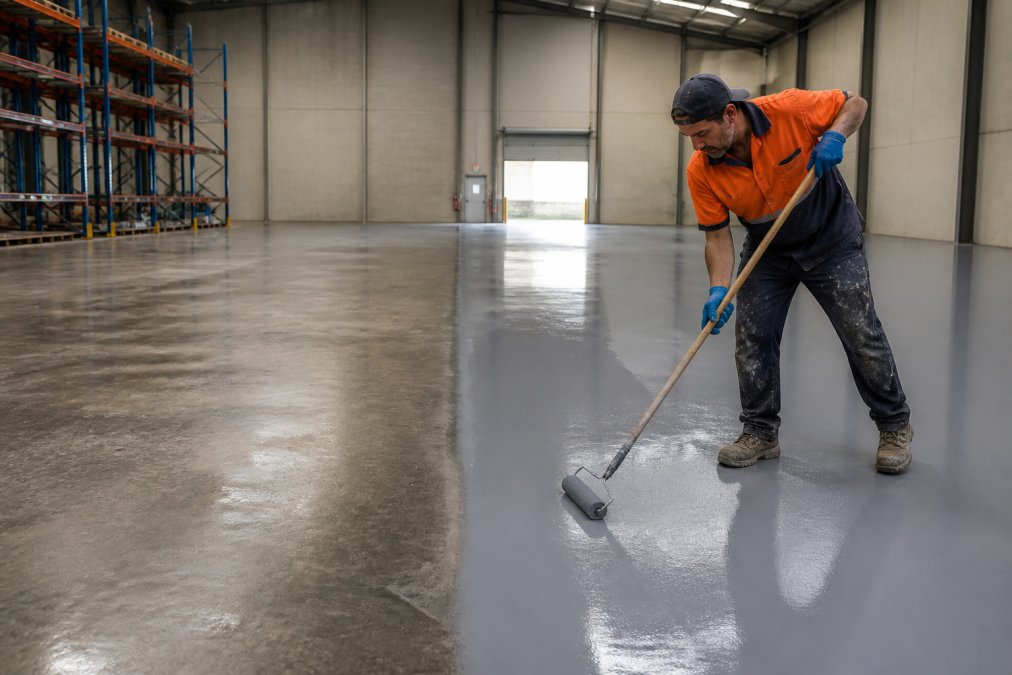
Polished concrete suits facilities where aesthetics and low maintenance are priorities, such as offices, showrooms, and hospitality venues. The mechanical polishing process densifies the surface, which reduces dusting and makes ongoing cleaning straightforward. This approach also eliminates the need for sacrificial coatings that eventually wear away.
Epoxy systems excel where the floor faces chemicals, heavy point loads, or strict hygiene requirements. Warehouse flooring with epoxy protection resists oil penetration, and the seamless finish prevents bacterial harbourage. When considering polished concrete vs epoxy flooring, the deciding factor is typically whether your facility needs impact and chemical resistance or simply a durable, attractive surface.
Commercial epoxy flooring cost in Perth varies widely because every slab tells a different story. Pricing depends on the substrate condition, the chosen system thickness, and the preparation required. A floor with contamination, spalling, or moisture issues will need additional grinding and priming before any coating is applied.
Most commercial quotes are calculated on a square metre basis, but the headline rate rarely tells the full picture. The critical cost drivers include:
Property managers should treat unusually low quotes with caution. Surface preparation accounts for a large share of any commercial epoxy flooring cost, and skipping proper grinding is the fastest route to premature coating failure. Many businesses find that investing in thorough floor preparation upfront delivers a dramatically longer service life than chasing the cheapest rate.
Slip resistance is not a matter of opinion; it is a quantifiable performance criterion defined by Australian Standards and enforced through the National Construction Code (NCC). For any commercial concrete flooring installation in Perth, specifying a floor without understanding its slip resistance classification is a liability risk that property managers cannot afford to take.
The primary technical reference is AS 4586:2013, Slip resistance classification of new pedestrian surface materials (standards.org.au). This standard defines the test methods and classification system used to rate a surface's slip resistance. The most common method for concrete and coated floors is the wet pendulum test, which measures the frictional force between a rubber slider and the surface under controlled wet conditions. The result is expressed as a Pendulum Test Value (PTV).
The NCC references AS 4586 to mandate minimum slip resistance classifications for different areas within a building. The required classification is not uniform; it is determined by the 'wet area' or 'dry area' designation and the specific traffic conditions. For example:
A common misconception is that a 'non-slip' additive is all that is required. In practice, the final PTV of a coated concrete floor depends on the interaction between the aggregate type and size, the coating's resin system, and the application method. A textured epoxy with a fine silica additive might achieve a PTV of 35, while a coarser aggregate system could reach 45 or higher. The only way to know is to test the finished surface.
Beyond the initial specification, the obligation does not end. Under Australian workplace health and safety law, the person conducting a business or undertaking (PCBU) has a duty to maintain a safe workplace. This means the slip resistance of a floor must be maintained over its service life. Polished concrete, for instance, can become more slippery as the surface is honed to a higher gloss. A maintenance regime that includes periodic re-testing or the application of a surface treatment may be necessary to retain the required classification.
Engaging a contractor who can demonstrate a working knowledge of AS 4586 and the NCC is not just about ticking a box. It is about transferring the risk of a slip-and-fall claim from the building owner to the specifier. A contractor who cannot articulate the difference between a PTV of 35 and 45 for your specific facility type is not equipped to certify the floor's performance.
The commercial concrete flooring installation process follows a predictable sequence, but the quality of each stage determines the lifespan of the finished floor. It begins with a thorough substrate assessment, including moisture testing and checking for contamination or existing coatings that could compromise adhesion.
Project timeline management is a major concern for operating facilities. Many businesses find that scheduling installation over a weekend or during a shutdown minimises disruption, but this requires the coating system to cure within that window. A quality contractor will manage the timeline around your operations rather than forcing a schedule that compromises the installation.
The decision between a polished concrete floor and an epoxy or polyurethane coating system is ultimately a financial one, but the true cost is not the installation invoice. It is the total cost of ownership over the floor's service life. For a commercial facility in Perth, this lifecycle cost analysis must account for cleaning labour, maintenance products, downtime for recoating, and the frequency of full replacement.
A typical lifecycle cost model for a warehouse or industrial facility runs over a 10-year horizon. Consider two scenarios:
Scenario A: Polished Concrete
Scenario B: Epoxy Coating System
The break-even point is not universal. A polished concrete floor in a low-abrasion retail environment may never need more than a burnishing pass. The same floor in a workshop with steel-wheeled trolleys may show wear patterns that require more aggressive maintenance. Conversely, a high-build epoxy system in a chemical storage area will outperform polished concrete, which is susceptible to acid attack.
Environmental impact is no longer a secondary consideration for commercial tenders. Polished concrete has a clear advantage in that it utilises the existing slab, eliminating the need for additional coating materials and reducing waste. It also contributes to thermal mass, which can reduce heating and cooling loads in conditioned spaces.
For coated systems, the environmental story has improved significantly. Modern epoxy and polyurethane formulations are available with low volatile organic compound (VOC) content, which reduces indoor air quality impacts during and after installation (the EPA). The Green Building Council of Australia's Green Star rating tool recognises low-VOC flooring systems, and specifying these products can contribute to a building's sustainability certification (gbca.org.au). Additionally, some manufacturers now offer bio-based polyurethane systems that replace a portion of the petrochemical content with renewable materials.
A less obvious environmental factor is the floor's contribution to lighting efficiency. A polished concrete floor with a high gloss finish reflects light more effectively than a dark, stained or worn surface. This can reduce the number of light fixtures required in a warehouse or showroom, lowering both capital costs and ongoing energy consumption. When evaluating lifecycle costs, the lighting energy savings from a reflective floor surface can be a meaningful line item that is often overlooked.
Selecting the right commercial concrete flooring installation in Perth requires balancing upfront cost against decades of maintenance, compliance, and operational performance. The choice between polished concrete and a coated epoxy or polyurethane system should be driven by how your facility is used, not by what looks best in a brochure.
Spray Pave Pro brings over 23 years of experience to commercial projects across Perth, backed by a 100% satisfaction guarantee and a team known for professional, low-disruption installation. Our cost-effective approach delivers high-durability floors that are easier to clean and maintain, transforming tired concrete into an asset that serves your business for years.
Get a free quote from Spray Pave Pro and secure a floor that meets Australian standards, suits your traffic load, and protects your investment for the long term.
Project timelines vary with the size of the area and the chosen system. A detailed schedule is provided after the initial site assessment and quote. This minimises downtime for your operation.
Commercial epoxy flooring cost in Perth depends on the substrate condition, the number of coating layers, and the square metre area. Polished concrete often has a higher upfront cost but offers a longer lifecycle with lower maintenance. Epoxy may be more cost-effective initially, especially for areas needing high chemical resistance. Request a detailed quote to compare exact figures for your project.
In Australia, slip resistance is assessed under AS 4586, which classifies surface roughness and wet slip potential. The National Construction Code (NCC) requires commercial floors in wet areas to meet specific slip resistance classifications. A professional installer will verify the substrate and apply appropriate surface finishes, such as aggregate exposure or anti-slip additives, to achieve compliance.
Yes. A properly installed concrete slab with surface hardening and a suitable industrial coating can withstand significant point loads and continuous traffic. The system must be specified based on the substrate assessment and intended use. This includes evaluating concrete footings and slab thickness before installation to ensure long-term durability without cracking.
This article was written using GrandRanker
