
Last Updated: October 6, 2026
Concrete driveway restoration is the process of repairing and resurfacing an existing concrete slab rather than replacing it. For most homeowners weighing enhance curb appeal vs low maintenance for concrete driveway restoration, you rarely get both at full strength.
The good news is that modern restoration gives you a middle path. According to CSIRO's research on concrete durability and surface performance, the life of a concrete surface depends heavily on how well it sheds water and resists UV exposure, which is exactly what a good resurfacing system controls.
Concrete driveway resurfacing means applying a new decorative or protective layer over your existing slab instead of demolishing and repouring it. Replacement means heavy machinery, weeks of disruption and a much larger bill.
The process starts with assessment. We check for structural cracks, movement, and drainage problems, because a coating will not fix a slab that is failing underneath.
Preparation decides how long the finish lasts. High-pressure cleaning strips away dirt, old sealers and loose material. Cracks and spalls are then filled with repair mortars before any overlay goes down.
Skip this step and you are coating a surface that is already moving, the single most common reason a resurfaced driveway fails early.
A properly prepared and applied resurfaced driveway typically lasts 10 to 15 years with basic care, and many exceed that with regular sealing.
Spray-on concrete driveway finishes are textured coatings that mimic exposed aggregate, slate or sandstone at a fraction of the cost. If kerb appeal is your goal, this is where restoration earns its keep.
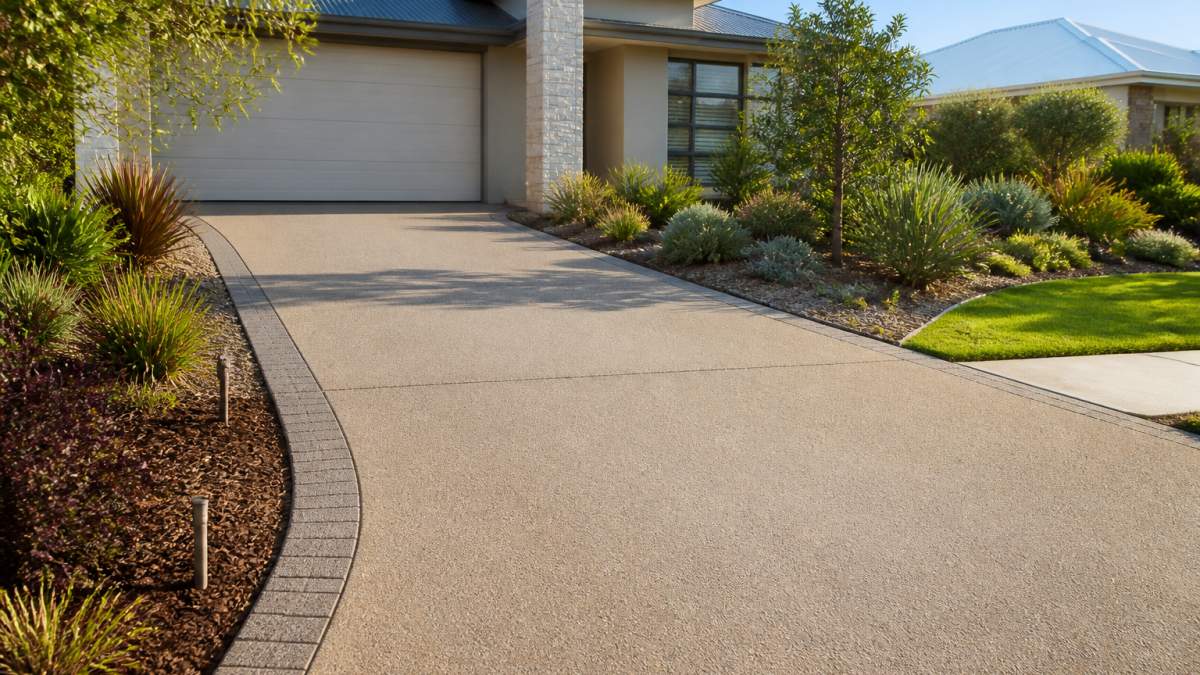
First impressions form fast. A cracked, stained slab pulls down the whole facade, while a clean, evenly coloured surface makes the same house look maintained.
Exposed aggregate remains the classic choice: it hides dust and tyre marks and offers natural slip resistance, suiting families and wet weather.
Decorative concrete broadens the palette: stamped concrete imitates pavers or stone, while coloured concrete matches your brickwork or render.
Warm neutrals and earthy tones work with most local facades. Lighter colours reflect heat better, which matters on a west-facing driveway that bakes all afternoon.
Texture is not just cosmetic: a slightly rougher profile improves grip underfoot and under tyres, worth considering if your driveway slopes.
Low-maintenance finishes reduce how often you clean, seal and weed, but no outdoor concrete surface is truly maintenance-free. The gap between finishes is about frequency and trigger points, not elimination. Here is a realistic schedule by finish.
Three mechanisms drive upkeep:
Weeding is the wildcard. Weeds appear where water and organic matter collect, expansion joints, control joints, the driveway-to-garden-bed boundary, and the apron where the driveway meets the street. A sound sealer and clean, well-filled joints do most of the work; if weeds keep returning, the cause is usually an opened joint or a damp drainage line, not the finish itself.
A five-minute walk-over twice a year catches almost everything:
| Finish | Cleaning Frequency | Resealing Interval | Inspection Trigger | Best For |
|---|---|---|---|---|
| Sealed smooth concrete | Monthly wash | Every 2-4 years | Water no longer beads | Minimal upkeep |
| Spray-on textured overlay | Quarterly wash | Every 2-3 years | Chalking or colour fade | Balanced look and care |
| Exposed aggregate | Annual pressure clean | Every 2-3 years | Dirt no longer lifts | Hiding marks |
| Stamped decorative | Monthly sweep and rinse | Every 2-3 years | Grooves holding debris | Maximum kerb appeal |
Concrete driveway sealing and maintenance is the single biggest factor in how long your finish looks new. Sealer forms a barrier against water, oil, UV and staining, the difference between a surface that ages gracefully and one that greys out.
Resealing is not a wipe-on job. The surface must be cleaned, dried and checked for damage first, because trapping moisture under a new coat causes peeling.
Timing depends on traffic, sun exposure and sealer type, so your installer should give a realistic interval rather than a blanket figure.
Concrete driveway repair versus resurfacing comes down to what is wrong with the slab. Repair targets isolated defects; resurfacing renews the whole surface and hides widespread cosmetic damage.
Choose repair for localised problems, a few cracks, a chipped edge, one stained section. Choose resurfacing when damage is spread across the driveway, the colour has faded unevenly, or you want a different look entirely.
Restoration is not always the answer.
For everything else, resurfacing is usually the faster and more affordable route.
Cost per square metre varies with finish, preparation and job size, so a responsible quote is always driveway-specific. What you can compare is the cost structure and how it behaves over the surface's life, where the curb appeal versus low maintenance decision is actually made.
Upfront price alone is misleading; compare total cost of ownership over the expected service life:
A finish that costs more upfront but reseals less often and lasts longer can beat a cheaper finish that needs resealing sooner, and the reverse is also true. The crossover point depends on how long you plan to stay and how much sun and traffic the driveway sees.
A restored driveway helps at inspection time. It lifts kerb appeal, and buyers read a maintained exterior as a maintained home. Treat it as presentation rather than a guaranteed return, it makes the property easier to sell and supports the asking price, but it is not a renovation you should expect to profit from.
| Your priority | Best-fit finish | Why |
|---|---|---|
| Maximum kerb appeal, willing to reseal | Stamped decorative or spray-on textured | Strong visual impact; reseal every 2-3 years |
| Balanced look and upkeep | Spray-on textured overlay | Good appearance with moderate care |
| Lowest ongoing effort | Sealed smooth concrete | Fewest reseals; simplest cleaning |
| Hiding marks and tyre dust | Exposed aggregate | Texture masks dirt; annual pressure clean |
| Selling within a year | Spray-on textured | Fast visual lift with modest upkeep |
If the slab has sunk, heaved or broken into moving sections, an overlay will crack with it. If water pools against the slab, drainage must be solved first. If the top layer is failing across the whole surface, replacement may be the better spend.
The curb appeal versus low maintenance trade-off is real, but it is not a coin flip. Appearance-led finishes ask for more cleaning and resealing; low-maintenance finishes give years of easy ownership with a quieter look.
Spray Pave Pro has spent 23 years resurfacing driveways and patios across Perth, and we back every job with a 100% satisfaction guarantee.
Get a free quote from Spray Pave Pro and find out which finish best matches your priority.
A sealed decorative concrete driveway with a smooth or lightly textured finish is generally easiest to maintain. It resists stains and needs only regular sweeping, occasional washing and resealing every few years. Exposed aggregate and resin-bound stone look good but trap more dirt, so they need more frequent cleaning. For the least ongoing work, choose a sealed finish and keep up with the resealing schedule.
Most restored concrete driveways need resealing every two to five years, depending on the finish and how much traffic and weather exposure it gets. A high-quality sealer applied over a properly prepared surface can last longer than a thin coat. If you notice water soaking in rather than beading, or the colour fading, it is time to reseal. Regular resealing protects the surface and helps it last 10 to 15 years.
Yes, if the cracks are surface-level or limited to a few areas, resurfacing can work well. A resurfacing specialist will clean out the cracks, fill them with repair materials, and apply a surface overlay to create a fresh finish. However, if the cracks are widespread, deep, or caused by structural movement in the slab, resurfacing alone may not last. In those cases, repair or replacement is the better option.
Spray-on concrete is a practical choice for an existing driveway because it can be applied directly over a prepared surface, covering stains, minor cracks and uneven colour. It gives you a wide range of colours and textures, from plain to decorative concrete, and it is faster to install than a full replacement. The key is proper surface preparation and sealing, which determines how long the finish lasts. Ask for a quote to see if your driveway is suitable.
