
Last Updated: September 15, 2026
The difference between concrete sealing and coating comes down to where the product sits: a sealer works inside the concrete, while a coating sits on top of it. Spray Pave Pro has spent 23 years resurfacing driveways, patios and pool surrounds, and this is the question we hear most often. Getting it wrong costs money twice: once for the product that fails, and again to strip it off.
Concrete sealing applies a protective material that penetrates the concrete's pores or forms a thin surface film to repel water, stains and chloride ingress. A concrete coating is a thicker, film-forming layer, typically epoxy, polyurethane or polyaspartic, that bonds to the surface and becomes the new wearing surface. One protects the slab you have; the other replaces its appearance entirely.
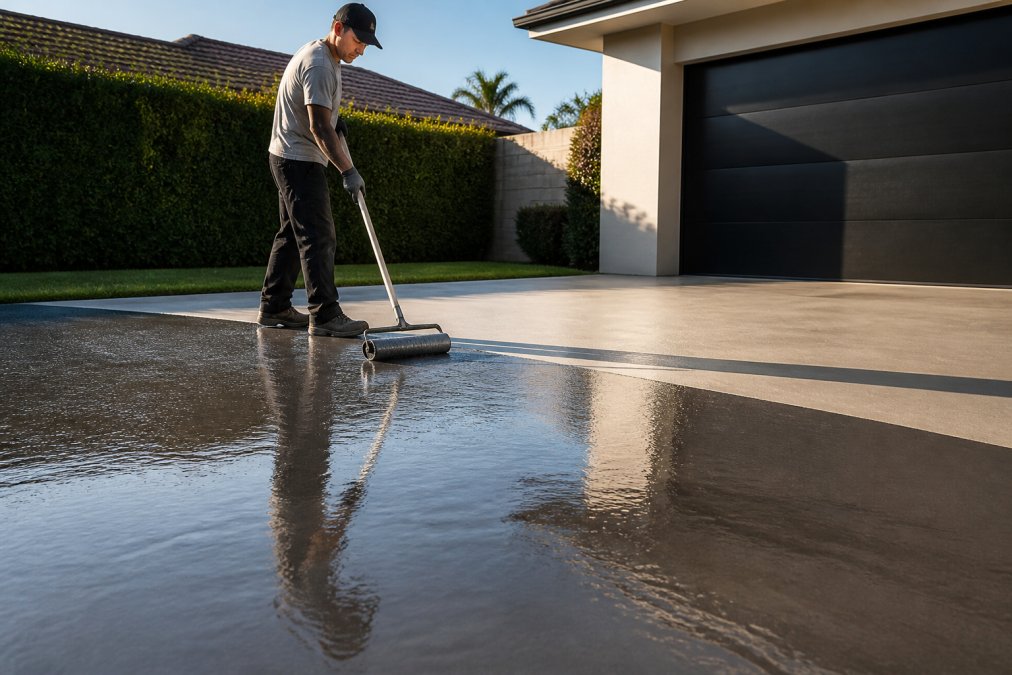
A concrete sealer slows moisture, salt and stain penetration without changing the slab's texture. Penetrating sealers soak into the pores and react chemically within them; topical sealers leave a thin film on top. A penetrating sealer leaves no gloss and cannot peel. A topical acrylic or solvent-based sealer gives a low sheen and is easier to recoat, but wears in high-traffic areas and needs reapplying every few years.
A concrete coating is a resin-based layer that bonds to the substrate and becomes the visible, load-bearing surface. Epoxy, polyurethane and polyaspartic systems are common, applied at several times the thickness of a sealer. Coatings hide imperfections, deliver a decorative finish and resist chemicals and abrasion far better than any sealer. The trade-off: a coating depends entirely on bond strength, so a damp or poorly prepared slab makes it delaminate and lift in sheets.
Penetrating products absorb into the concrete pores and react with free lime, blocking moisture vapour transmission from within. Film-forming products, whether a topical sealer or a full coating, create a membrane across the surface. That distinction drives everything else: a penetrating sealer cannot peel, but will not hide a crack or give a gloss finish. A film-forming coating delivers aesthetic appeal and chemical resistance, but only as long as the bond holds.
| Feature | Penetrating Sealer | Topical Sealer | Epoxy / Polyaspartic Coating |
|---|---|---|---|
| Where it sits | Inside the pores | Thin film on top | Thick bonded layer |
| Typical lifespan | 5-10 years | 1-3 years | 5-15 years |
| Appearance | Natural, no gloss | Low sheen | Gloss, colour, flake |
| Slip resistance | Unchanged | Can become slick | Additive required |
| Best for | Driveways, pavers | Light foot traffic | Garages, commercial floors |
Lifespan figures are quoted as if they were properties of the product. They are not. They are outcomes of four variables: product chemistry, slab preparation, surface exposure and maintenance.
Chemistry. A penetrating silane or siloxane sealer reacts within the pores and is consumed slowly by UV and water cycling; it has nothing on the surface to abrade away. A topical acrylic sealer is a thin film that wears under traffic and chalks under UV. Epoxy is hard and chemically resistant but degrades under UV, making it an indoor product in most specifications. Polyaspartic and polyurethane coatings resist UV yellowing and tolerate cold application, which is why they dominate outdoor coating work.
Preparation. This is the single largest variable. A coating applied to a diamond-ground slab with an open profile will outlast an identical coating over a damp, contaminated or previously sealed surface by years, not months. A sealer applied to a dirty slab will bead water for one season and then stop.
Exposure. Hot tyre pick-up is the classic coating killer on driveways: warm rubber grabs a softening epoxy or polyaspartic topcoat and lifts it. De-icing salt, pool chlorine and constant moisture accelerate the breakdown of any film-forming product. Full sun breaks down epoxy and cheap acrylics.
Maintenance. A coating cleaned with a pH-neutral product will outlast one cleaned with aggressive degreasers. A sealer reapplied on schedule never reaches failure; one left until water stops beading is already failing.
| Product | Typical lifespan | Main failure mode |
|---|---|---|
| Penetrating silane/siloxane sealer | 5-10 years | Gradual loss of water repellency |
| Topical acrylic sealer | 1-3 years | Wear, scuffing, UV chalking |
| Epoxy coating (indoor) | 5-15 years | Abrasion, UV yellowing if exposed |
| Polyaspartic / polyurethane coating | 5-15 years | Hot tyre pick-up, impact damage |
Treat these as planning ranges, not guarantees. A north-facing driveway with hot tyres sits at the bottom of the coating range; a shaded, well-drained patio sits at the top of the sealer range.
Most comparison articles treat climate as an afterthought. It is often the deciding factor.
Freeze-thaw cycles. Where a slab repeatedly freezes and thaws, water soaked into the concrete expands as it turns to ice and spalls the surface. A penetrating sealer that blocks liquid water ingress while letting the slab breathe is safer, because it reduces the water available to freeze without trapping vapour. A fully sealed film-forming coating can trap moisture beneath it and blister or delaminate through the freeze-thaw season unless a moisture-tolerant system is specified.
High-UV exposure. In hot, sun-exposed regions, epoxy is the wrong outdoor choice, it chalks and yellows.
| Task | Penetrating sealer | Topical sealer | Epoxy / polyaspartic coating |
|---|---|---|---|
| Routine cleaning | Sweep, occasional hose | Sweep, gentle hose | Sweep, pH-neutral cleaner |
| Reapplication interval | 5-10 years | 1-3 years | Not reapplied; repaired |
| Repair method | Re-spray affected area | Recoat whole slab | Patch and blend, or full regrind |
| Stripping required? | No | Sometimes | Yes, before any recoat |
| Typical failure mode | Gradual water absorption | Wear and scuffing | Delamination, hot tyre pick-up |
Work through these in order:
Sealers penetrate into the concrete pores to block moisture and dust without changing the surface look, while coatings sit on top as a film that adds colour, texture and a protective layer. Sealers are usually cheaper and faster to apply, but coatings offer more design options and better resistance to chemicals and abrasion. The right choice depends on whether you want invisible protection or a decorative, thicker finish.
A penetrating sealer and a film-forming sealer require reapplication at intervals that depend on traffic and exposure. Epoxy or polyaspartic coatings generally last five to ten years or more if the concrete surface preparation is done correctly. Longevity depends on UV exposure, traffic, cleaning products and how well the concrete was prepared before application.
Coatings usually win for pool surrounds because they can be finished with a textured aggregate or grip additive that stays effective when wet. A penetrating sealer does not change the surface profile, so it relies on the concrete's existing texture for slip resistance. For the best low maintenance for non-slip pool surfacing, look for a coating system that includes a UV-stable topcoat and a graded non-slip additive.
No, a coating will not bond properly to a surface that still has sealer on it, and it may peel or delaminate within months. The old sealer must be removed first, often by grinding or chemical stripping, before any coating goes down. This is why concrete surface preparation for coatings is so important, and why it is worth confirming what was previously applied before planning a recoat.
For driveways, workshop floors and commercial entries, a coating generally handles high-traffic areas better because its thicker film resists abrasion, oil and hot tyre pick-up. A sealer is still a good option for low-traffic paths or as a temporary protectant. If the concrete has cracks or surface imperfections, a coating can also hide them, while a sealer will not.
Choosing between sealing and coating is really a question about how you use the surface and how long you want to wait before touching it again. Spray Pave Pro brings 23 years of resurfacing experience, a 100% satisfaction guarantee and a team that prepares properly the first time, which is what separates a finish that lasts from one that lifts. Get a free quote from Spray Pave Pro and find out which system your concrete actually needs.
