
Last Updated: September 11, 2026
Cleaning stained concrete starts with the right kit, not the strongest chemical. At Spray Pave Pro, we've spent 23 years transforming residential and commercial properties with superior workmanship, and the jobs that go wrong almost always skipped this step. Knowing how to clean stained concrete properly comes down to preparation, and that means gathering the correct tools and safety gear before a single drop of cleaner touches the slab.
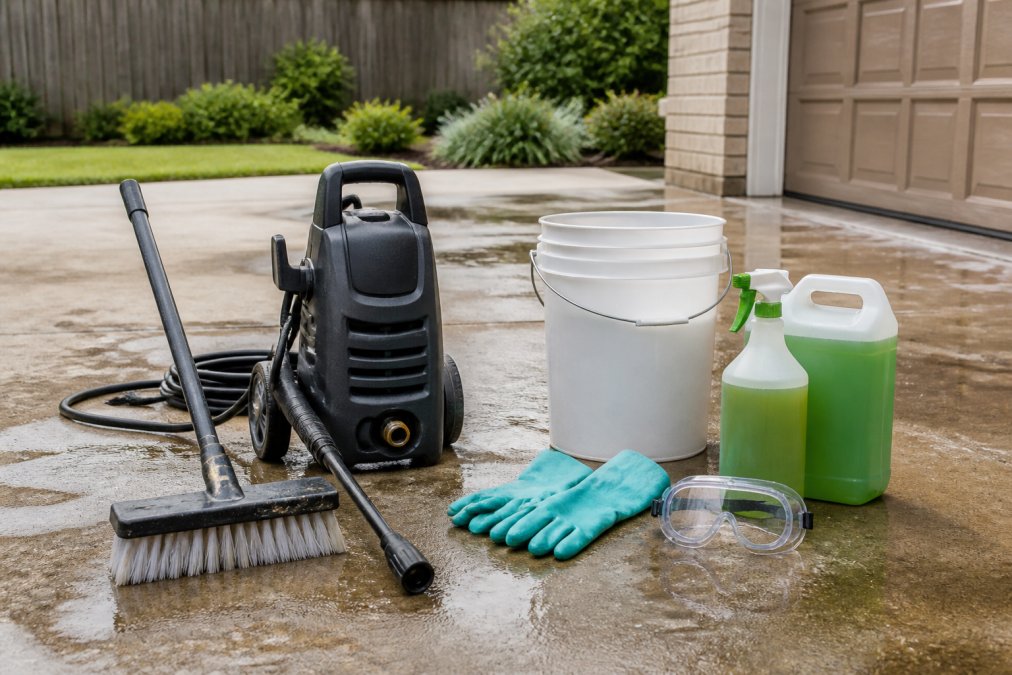
The essentials are straightforward:
A pressure washer is the workhorse here, but it needs a nozzle you can control. More on that below.
Concrete cleaners can burn skin and eyes (the CDC). Always wear safety goggles, chemical-resistant gloves, and long sleeves. Work in ventilated areas, never mix cleaners unless the label says to, and keep pets and children away until the surface is rinsed thoroughly and dry.
The single biggest mistake we see is treating every mark the same way. Concrete is a porous surface, so whatever spills on it soaks in, and the right approach depends entirely on what you're dealing with. Match the cleaner to the stain, not the other way around.
Start by answering three questions: what colour is the mark, is it on the surface or below it, and does it feel greasy, chalky, or crusty? Those three answers narrow the field before you open a single bottle.
| Stain Type | How to Recognise It | Best Approach | Typical Dwell Time |
|---|---|---|---|
| Oil and grease | Dark, greasy patch; darkens when wet | Alkaline degreaser, then poultice for set-in marks | 10-15 minutes |
| Rust | Orange-brown, often below downpipes or outdoor furniture | Oxalic acid or a dedicated rust remover | 5-10 minutes |
| Algae and moss | Green or black film, slippery when wet, common in shade | Oxygen bleach (sodium percarbonate) plus scrubbing | 15-20 minutes |
| Organic (leaves, tannins, mulch) | Brown or black leaf-shaped shadow | Oxygen bleach | 15-20 minutes |
| Efflorescence | White, chalky bloom that brushes off as powder | Dry brush first, then a mild acid wash | 3-5 minutes |
| Paint and coatings | Solid film with a defined edge | Chemical paint stripper or a poultice | Per label |
| Fertiliser and salt | Pale, patchy discolouration near garden beds | Dilute acid wash, then rinse | 3-5 minutes |
A note on the bleach column: oxygen bleach (sodium percarbonate) is the correct choice for algae, moss and organic staining. It releases oxygen as it breaks down and is far kinder to surrounding garden beds than chlorine bleach (sodium hypochlorite). Chlorine bleach works, but it will kill lawn edges and can discolour coloured or stamped concrete, so reserve it for plain grey slabs where nothing nearby will suffer.
Always test on a hidden patch first. Apply your chosen cleaner to a small area, wait the full dwell time, and rinse. This tells you how the substrate and any existing sealer react before you commit to the whole slab. It takes five minutes and saves a lot of regret.
Pay particular attention to coloured, stamped or exposed-aggregate concrete. Acidic cleaners will dull oxide pigments, and aggressive pressure will erode the release agent that gives stamped concrete its texture (cement.org). If your test patch lightens or the surface feels rougher after rinsing, stop and switch to a pH-neutral cleaner.
A few quick diagnostics save money and wasted effort:
Getting this diagnosis right is the difference between a stain that lifts in one pass and one that gets scrubbed three times and never budges.
Household staples handle light surface grime well. They will not lift deep oil-based stains or rust oxidation, and expecting them to is where most DIY attempts fail. Use them for maintenance, not rescue jobs.
What makes a cleaner 'natural' is really just its chemistry. Vinegar is a weak acid (acetic acid), baking soda is a mild alkali (sodium bicarbonate), and oxygen bleach is an oxidiser. Each works on a different class of stain, and using the wrong one is why natural methods get a bad reputation.
White vinegar (diluted 1:1 with water) suits mild mineral staining, hard-water film and light efflorescence. It is acidic, so it will not touch oil. Leave it for 5-10 minutes, scrub, and rinse. Do not use it on coloured concrete without testing, as acid dulls oxide pigments.
Baking soda paste (3 parts baking soda to 1 part water) is a gentle abrasive and mild alkali. It lifts light grease and food stains from patios and garage floors. Spread it 5 mm thick, leave 15-20 minutes, then scrub with a stiff brush and rinse. It is safe on sealed surfaces.
Oxygen bleach (sodium percarbonate, mixed per the label, typically 1-2 tablespoons per litre of warm water) is the strongest genuinely 'natural' option. It releases oxygen bubbles that lift organic staining, algae and moss, and it breaks down into soda ash and water. It is the right choice for shaded driveways, north-facing paths and anywhere green film keeps returning.
Dishwashing liquid (a few drops in a bucket of warm water) is a surfactant, not a cleaner. It helps water penetrate and lifts surface dirt, but it will not break down oil that has soaked in.
If a stain has been there for months, or it's oil, rust, or paint, natural methods will only lighten it. At that point, move to a commercial cleaner matched to the stain type. Repeated scrubbing with a weak solution can actually drive a stain deeper into the porous surface.
A quick rule of thumb: if two rounds of the appropriate natural cleaner have not visibly improved the stain, stop. You are now spending more time than a commercial product would take, and you risk abrading the surface with repeated scrubbing.
Natural cleaners are not automatically safe to rinse into the stormwater system. Vinegar and oxygen bleach break down quickly, but they still carry dissolved dirt, oil residue and mineral salts into waterways. Where you can, rinse onto a lawn or garden bed rather than a driveway drain, and use the minimum volume of water that does the job. Oxygen bleach is the better choice near garden beds because it does not carry the chlorine load that sodium hypochlorite does.
If you are cleaning a large area, work in sections and let each section dry before rinsing the next. This keeps runoff manageable and stops you flooding the same patch of garden with every bucket.
Choosing between cleaners is really a question of pH balance. Get that right and most stains lift without drama. Get it wrong and you can etch the surface or leave a residue that attracts new dirt.
Acidic solutions dissolve mineral-based stains like rust and calcium deposits. Alkaline cleaners break down grease and oil. The two do opposite jobs, so never combine them. A common mistake is reaching for the strongest acid available; hydrochloric acid is aggressive and rarely necessary for a domestic driveway.
Follow the label's dilution ratio exactly. Concentrated cleaner does not work faster, it just risks surface etching and wastes product. Mix small batches, apply with a pump sprayer, and let the cleaner dwell for the recommended time before scrubbing.
Oil is the most common stain on driveways, and it needs a different method from surface cleaning. A poultice pulls the oil out of the concrete rather than just wiping the top. This is an approach often used on stubborn marks.
Set-in oil may need two or three poultice cycles. For very old marks, a commercial degreaser applied before the poultice helps break the oil down first. If the stain still won't lift, the oil may have penetrated past the point where cleaning works, and resurfacing becomes the more sensible option.
A pressure washer removes grime fast, but used carelessly it damages the very surface you're trying to restore. The goal is to clean the concrete, not strip it. Pressure cleaning is a tool, and like any tool it has a right setting and a wrong one.
Use a 25-degree or 40-degree nozzle for general cleaning. Keep the wand moving and hold it at a consistent distance. A rotating turbo nozzle suits tough stains but should be used with care on decorative or stamped concrete.
Surface etching happens when too much pressure strips the top layer of the slab, leaving a rough, dull patch that shows every mark. On stamped or exposed-aggregate surfaces, drop the pressure and increase your distance. If you're unsure, test on a hidden area first.
Stains that survive a cleaning attempt usually point to one of three causes: the wrong cleaner, a failed sealer, or a stain that's soaked too deep. Diagnosing which one saves you from repeating the same failed method.
If stains return within weeks, the sealer has likely worn through and the porous surface is exposed again. Reapplying a quality concrete sealer after cleaning stops new stains from soaking in. If you've had a sealer fail within a year, the preparation before sealing was probably the problem.
Efflorescence is a white, chalky bloom of mineral salts that rises to the surface as moisture moves through the slab (cement.org). Brush it off dry first, then treat with a mild acidic cleaner. Sealing once the slab is fully dry helps prevent it returning. Calcium deposits on pool surrounds and patios respond to the same approach.
Cleaning is a cycle, not a one-off job. Surfaces that are cleaned and resealed on schedule stay easier to clean and hold their appearance far longer. This is where most homeowners fall behind.
Sweep or hose driveways monthly, and deep clean every six to twelve months depending on traffic and weather. Reseal every two to three years on a driveway, and more often on pool surrounds that stay wet. Check the sealer annually by dripping water on the surface: if it soaks in rather than beading, it's time to reseal.
What you rinse off your concrete ends up in the stormwater system. Runoff carrying degreasers, acids, or bleach can harm waterways and garden beds. Rinse onto a lawn or garden where possible, use the minimum product needed, and never let chemical runoff flow directly into drains. This is a gap most cleaning guides skip, and it matters.
The best cleaner depends on the stain. For general grime, a mix of warm water and mild detergent works well. Oil stains respond to a poultice made from an absorbent material like cat litter or sawdust and a solvent. Rust needs an acidic cleaner, while algae calls for an oxygen bleach solution. Always test on a small area first and follow the product label for dilution and dwell time.
Start by removing all surface dirt with a stiff-bristled brush and a suitable cleaner. For deep stains, use a poultice or a commercial degreaser. Once clean, apply a quality concrete sealer to protect the surface and enhance its appearance. If stains persist or the concrete is heavily damaged, professional resurfacing or spray-on concrete can help enhance its appearance and utility.
Bleach works well on organic stains like algae and mildew because it kills the spores. Vinegar is a mild acid that can help with mineral deposits and light rust, but it may etch concrete if left too long. For most household cleaning, start with a pH-neutral cleaner. Use bleach only in well-ventilated areas and never mix it with vinegar or other acids.
Yes, if used incorrectly. Too much pressure or holding the nozzle too close can etch the surface, widen cracks, and strip sealers. Use a pressure washer rated under 3000 psi and keep the nozzle at least 30 centimetres from the surface. For decorative or stamped concrete, reduce pressure further and use a fan tip. Always test a small hidden area first.
Cleaning stained concrete is manageable with the right approach, but some stains and worn surfaces are past what DIY methods can fix. That's where Spray Pave Pro comes in. With 23 years of experience, our team handles high-pressure cleaning, professional sealing, and spray-on concrete resurfacing that transforms old, stained surfaces into durable, low-maintenance finishes. Get a free quote from Spray Pave Pro and restore your concrete the right way.
