
Last Updated: September 18, 2026
Choosing between industrial epoxy flooring vs polished concrete comes down to one question: do you need a protective barrier, or a hardened surface? Epoxy adds a resin coating on top of the slab; polished concrete grinds and densifies the slab itself. That difference drives everything else, from chemical resistance to repair costs.
This guide from Spray Pave Pro covers how each system is built, what drives epoxy flooring cost per square metre, slip resistance standards, and where moisture and hybrid systems change the decision.
| Factor | Epoxy Flooring | Polished Concrete |
|---|---|---|
| Build-up | Applied coating, 2-4mm | Ground and densified slab |
| Chemical resistance | High | Moderate |
| Crack hiding | Good | Limited |
| Recoating needed | Yes, periodically | Rarely |
| Best for | Chemical, food, workshop areas | Warehouses, showrooms, large spans |
A durable epoxy floor is mostly preparation. Contractors high-pressure clean, then diamond grind to open the concrete's pores so the resin bonds. Skipping this is the most common cause of delamination.
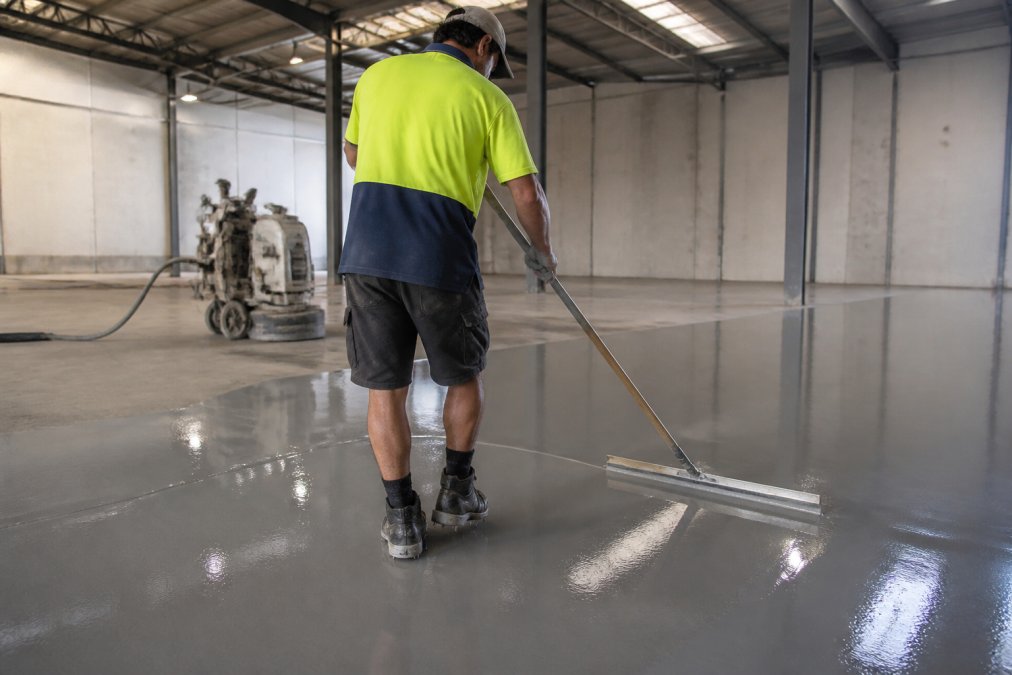
From there, the build typically runs:
Polished concrete is created by grinding an existing slab through progressively finer diamond tooling, then applying a chemical densifier to harden the surface. The result: no coating to peel, flake or delaminate.
Epoxy flooring cost per square metre is not a single number, and any contractor quoting one from a photo is guessing. Price moves with slab condition, system thickness, preparation and finish, and the installed price is only the first line in a longer calculation.
The main cost drivers:
Because every slab is different, a fixed per-square-metre figure is misleading. A site inspection, including moisture testing, is the only reliable way to price a job. Request a free quote based on an actual assessment of your surface.
Initial installation price is the least useful figure, because the two systems fail and are maintained differently. A more honest comparison is total cost of ownership (TCO) over a realistic service life, say ten years in a working facility.
| Cost line | Epoxy flooring | Polished concrete |
|---|---|---|
| Initial installation | Higher, multi-layer system, more materials | Lower to moderate, grinding and densifying only |
| Routine cleaning | Neutral-pH cleaner, prompt spill response | Dust mop or auto-scrubber, neutral cleaner |
| Periodic maintenance | Recoat of high-traffic zones every few years | Re-burnish to restore gloss; occasional re-seal on honed finishes |
| Repair | Sectional patching, cheap per event, more frequent | Rare, but expensive and specialist when needed |
| Failure risk | Delamination if moisture untested; blistering | Minimal, no film to fail |
| End of life | Full removal and re-lay at end of service life | Re-grind and re-polish, or leave as-is |
You cannot calculate a real TCO from a blog post, but you can ask the right questions before committing:
Slip resistance is measured, not assumed. Industrial flooring is assessed against Australian Standard AS 4586, which classifies surface slip resistance, and the National Construction Code sets minimum classifications for different areas. Wet areas and ramps carry stricter requirements than dry warehouse floors.
Polished concrete maintenance is genuinely low-effort, its biggest operational advantage. With no coating, there is nothing to reapply, peel or touch up: a daily dust mop or auto-scrubber keeps the surface clean, and a neutral-pH cleaner handles most marks.
| Frequency | Task |
|---|---|
| Daily | Dust mop or auto-scrub high-traffic areas |
| Weekly | Damp mop with neutral cleaner |
| Quarterly | Check for stains, re-burnish if gloss drops |
| Annually | Review sealer or guard on honed finishes |
Two factors decide more failed floors than any finish choice: moisture and repairability. Most guides treat both as footnotes, yet they determine whether a system lasts five years or fifteen.
Concrete is porous and permanently wicks moisture from the ground beneath it, which moves upward as vapour, moisture vapour transmission (MVT). When a resin coating is applied over a slab still releasing vapour, pressure builds beneath the film with nowhere to go, causing blistering, bubbling and eventually delamination.
Where readings are too high, the options are:
Repairability splits the two systems cleanly, and matters most where forklifts, pallet jacks and dropped loads are routine.
Hybrid flooring systems increasingly bridge the gap, and most comparison articles ignore them entirely. The logic: take the durability and low maintenance of a densified, mechanically prepared slab, then add a thin protective layer only where it earns its place.
Common hybrid configurations include:
CSIRO research on concrete durability and surface treatment
Polished concrete usually carries the lower upfront cost because it works with the existing slab and skips the resin materials. Epoxy flooring costs more per square metre once you add diamond grinding, moisture testing, primer, base coat and topcoat. Over a 10 to 15 year window, polished concrete often wins on total cost of ownership because it needs no re-coating, while epoxy needs periodic refreshing in high-traffic areas. Request a site-specific quote to compare properly.
Epoxy is sensitive to moisture vapour transmission from the slab. If the concrete has not been properly tested and primed, the coating can blister or delaminate. It also needs curing time before heavy traffic, can be slippery when wet unless non-slip aggregate is added, and may yellow under strong UV exposure if the wrong topcoat is used. Periodic re-coating every 10 to 15 years adds to the lifecycle cost.
Epoxy can be made more slip-resistant because you can broadcast aggregate or add non-slip particles into the topcoat, reaching a higher coefficient of friction than a standard polished finish. Polished concrete can also be treated with densifiers and anti-slip additives, but a high-gloss polished surface is naturally slicker when wet. For wash-down areas or food processing, a textured epoxy system is usually the safer choice.
Both options work on existing slabs, but the prep is different. Epoxy requires diamond grinding or shot blasting to open the concrete porosity, plus moisture testing and crack repair. Polished concrete needs a multi-stage diamond grinding process and a densifier to harden the surface. If the slab has deep structural cracks, polished concrete will not hide them, while epoxy can bridge minor imperfections with a high-build base coat.
