
Last Updated: October 25, 2026
Quick Summary
The best decorative concrete finishes for Perth driveways are exposed aggregate for grip and low maintenance, coloured concrete for matching your home's facade, and spray-on concrete for resurfacing worn but sound slabs. Exposed aggregate is the local favourite because its textured surface grips well in wet weather and needs no annual reseal.
Choosing among the best decorative concrete finishes for driveways Perth homeowners actually shortlist comes down to three things: how much grip the surface gives back in the wet, how well it hides tyre marks, and what it costs to keep looking sharp. This guide compares seven finishes side by side, with the trade-offs most guides skip.
Decorative concrete is concrete whose surface has been coloured, textured, exposed or mechanically finished to change how it looks and performs, rather than left as plain grey slab. The finish you choose changes slip resistance, heat behaviour, maintenance and repairability, not just kerb appeal.
Below, we break down each finish, what it suits, and where it falls short.
| Finish | Grip Level | Hides Tyre Marks | Maintenance | Best For |
|---|---|---|---|---|
| Exposed aggregate | High | Well | Low | Family driveways, sloped blocks |
| Coloured concrete | Medium | Moderate | Low | Matching a home's facade |
| Honed/polished | Low when wet | Poorly | Moderate | Modern, sheltered entries |
| Stencil concrete | Medium-high | Moderate | Low | Period and character homes |
| Spray-on concrete | Medium-high | Well | Low | Resurfacing worn slabs |
| Resurfaced overlay | Varies | Well | Low | Cracked or stained existing concrete |
| Sealed finish | Improves grip | Well | Regular resealing | All finishes above |
Exposed aggregate is the finish most Perth homeowners land on first, and for good reason.
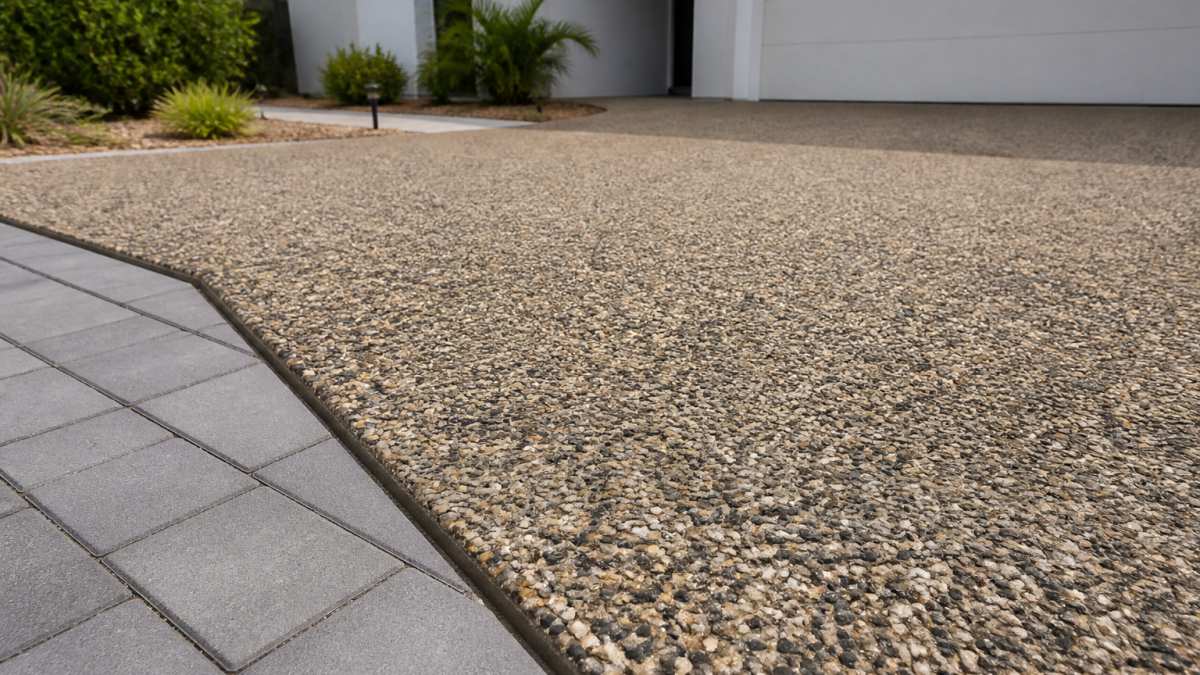
(/spray-on-concrete-vs-stencil-concrete-perth/) compares cost, durability and finish in more detail.
Best for: stencil for character homes, spray-on for worn but stable slabs.
Skip if: the underlying concrete is failing; both need a sound base.
Resurfacing and replacement solve different problems, and choosing wrongly is the most expensive mistake in this category. Use the decision points below before you request quotes.
| Condition | Resurface | Replace | Why It Matters |
|---|---|---|---|
| Hairline cracks, crazing or surface staining | Yes | No | The slab is still doing its structural job; a decorative overlay restores appearance and can improve grip. |
| Faded or worn colour, tyre marks that no longer clean out | Yes | No | Sealing or an overlay resets the surface without demolition. |
| Localised spalling or a failed patch under 1 m² | Yes, with repair | Sometimes | Small failures can be cut out and patched before resurfacing, provided the surrounding slab is sound. |
| Structural cracking with vertical movement or widening | No | Yes | Movement means the base or slab is failing; an overlay will crack along the same line. |
| Ponding water or poor fall toward the street | No | Usually | Resurfacing adds a thin layer and will not correct drainage; replacement allows the fall to be rebuilt. |
| Tree-root heave or reactive clay movement | No | Yes | Ongoing ground movement will telegraph through any thin overlay. |
| Driveway used by heavy vehicles or caravans | Assess | Often | Thin overlays are not designed for concentrated loads; a thicker slab or replacement may be needed. |
Resurfacing is a system, not a coat of paint. A typical sequence is:
Replacement means demolition, removal of the old slab, sub-base preparation and a new pour. It is the right call when the base is the problem, but it is more disruptive: access is blocked for longer, and the new slab needs its own curing period before vehicles are allowed on. If the existing slab is sound, resurfacing is usually the faster and lower-cost route; if it is moving or draining poorly, replacement is the only durable fix.
Indicative installed costs vary with area, access and finish, but the pattern is consistent: resurfacing typically costs a fraction of replacement because there is no demolition or new slab. Replacement carries the cost of removal, sub-base work and a new pour, plus the longer access disruption. Over a 15-20 year horizon, a well-sealed resurfaced driveway that is recoated when the sealer wears can defer replacement, but it will not outlast a failing base.
If resurfacing fits your situation, you can see the driveway resurfacing service we offer.
The process runs in stages: clean and repair the slab, apply the resurfacing system, then cure. Curing time matters because the driveway is out of action while it sets, so plan access around it. A common mistake is driving on the surface too early, which dulls the finish and shortens its life.
Maintenance is where decorative finishes diverge most, and it is the part most guides skip. The table below sets out what each finish actually demands, how visible repairs are, and how often sealing is typically needed.
| Finish | Routine Cleaning | Resealing Interval | Stain and Tyre-Mark Behaviour | Repair Visibility |
|---|---|---|---|---|
| Exposed aggregate | Sweep, occasional low-pressure wash | Every 3-5 years, depending on exposure | Hides dust and tyre marks well; oil can settle into the texture and needs a degreaser | Patches can blend if the same aggregate is used, but colour match is rarely perfect |
| Coloured concrete | Sweep, mop or wash | Every 2-4 years | Mid-tones hide marks; dark tones show oil and tyre rubber; light tones show dirt | Colour-matched patching is possible but can read as a patch under raking light |
| Honed/polished | Dust mop, pH-neutral cleaner | Every 1-3 years, or as gloss dulls | Smooth surface shows smudges and water spots; tyre marks wipe off easily | Repairs are visible because the surface sheen is interrupted |
| Stencil concrete | Sweep, wash | Every 2-4 years | Pattern breaks up the appearance of marks; grout lines can trap dirt | Pattern and colour matching make repairs moderately visible |
| Spray-on concrete | Sweep, low-pressure wash | Every 2-4 years | Texture hides marks well; thin coatings can wear at turning points | Recoating the whole area is often easier than spot repair |
| Resurfaced overlay | Sweep, wash | Every 2-4 years | Good camouflage; edges and transitions need checking | Overlay repairs are visible unless the whole section is recoated |
| Sealed finish | As above for the base finish | Regular resealing, often every 2-3 years | Sealer makes cleaning easier and reduces staining | Sealer wear shows as dull patches before the base is affected |
Sealing locks in colour, slows staining and makes cleaning easier, but it is a wear layer, not a permanent coating. The interval depends on sun exposure, traffic and the sealer type. Signs it is time to reseal include water no longer beading, colour looking chalky, and fine surface dust appearing after washing. Reseal before the wear reaches the decorative layer; resealing over a damp or poorly cleaned slab traps moisture and causes the coating to lift within a season.
Tyre marks are usually rubber transfer, not permanent staining. A degreaser and a stiff brush remove most of it, and a sealer reduces how readily it bonds. Oil stains need prompt treatment: blot, apply a degreaser, then wash. For product options, see our guide to the best concrete sealers for Perth conditions, or if you would rather have it done properly, book professional driveway sealing.
Light grey and natural tones reflect more heat and reduce glare on long, sun-exposed driveways. Dark colours absorb heat and show tyre marks and oil more readily. Texture improves wet grip: exposed aggregate and spray-on finishes generally offer better traction than honed or polished surfaces, which are slick when wet and belong on sheltered entries rather than steep, rain-exposed driveways.
For most Perth driveways with surface cracks, stains or faded colour, resurfacing is a sound option. A spray-on or overlay finish bonds to sound concrete and gives you a new decorative surface at a fraction of the cost and disruption of a full replacement. It works best when the slab is structurally sound with no major movement or drainage problems. If the base is failing, replacement is the safer call.
A properly applied decorative concrete finish with a quality sealer typically lasts many years, though lifespan depends on traffic, sun exposure and maintenance. Sealer is the wear layer, so resealing every few years keeps the finish looking fresh and protects against stains. Regular cleaning and prompt removal of oil drips extend the surface life considerably.
Exposed aggregate and textured spray-on finishes are the strongest choices for driveways because their surface texture provides grip in wet weather. Coloured concrete and stencil patterns add kerb appeal but need a textured or sealed topcoat to stay safe underfoot. The best pick depends on your home's architectural style, your colour preferences and how much maintenance you want to take on.
A textured finish is generally less slippery than smooth polished concrete, because the surface profile gives tyres and shoes something to grip. Slip resistance also depends on the sealer used and how it is applied. Ask your resurfacer about a slip-resistant topcoat for sloped driveways, pool surrounds and alfresco areas where water pools.
A decorative finish only performs as well as the preparation beneath it, and that is where most disappointing driveways go wrong. Spray Pave Pro brings 23 years of experience to concrete resurfacing, spray-on concrete and professional sealing, backed by a 100% satisfaction guarantee and a quick installation process that keeps disruption low. Get started with Spray Pave Pro and transform a tired driveway into a surface that lifts your kerb appeal and holds up to Perth weather.

