
Last Updated: September 28, 2026
Finding the 5 best epoxy coating for garage floor durability starts with one hard truth: the coating is only as good as the concrete beneath it. A garage floor takes a beating that no other surface in the home faces. Hot tyres, dropped tools, oil drips, chemical spills and constant traffic all work against whatever sits on top of the slab. This guide from Spray Pave Pro breaks down five coatings that hold up under that pressure, plus what separates a coating that lasts a decade from one that peels within two years.
| Product | Type | Best For | Key Strength |
|---|---|---|---|
| Spray Pave Pro | Professional applied system | Full-service durability | 23 years of experience |
| ArmorGarage 100% Solids | 100% solids epoxy | Heavy vehicle traffic | Impact resistance |
| MPC-100 Epoxy Kit | High-build epoxy | UV-exposed garages | Anti-yellowing |
| Rust-Oleum EpoxyShield | Water-based epoxy | DIY budgets | Easy application |
| Seal-Krete Epoxy-Seal | Water-based epoxy | Moisture-prone slabs | Low-odour formula |
Durability in a garage floor coating comes down to four measurable factors: adhesion to the concrete substrate, abrasion resistance, chemical resistance, and impact durability. A coating that scores well on all four handles hot tyre pickup, road salt, oil and dropped weight without failing.
We assessed each product on solids content, tensile strength, recommended mil thickness, and how well it tolerates moisture vapour transmission. Surface preparation demands and realistic curing time also shaped the ranking. A coating that needs diamond grinding to perform is not the same product as one that works over a properly etched slab, and buyers deserve to know the difference before they commit.
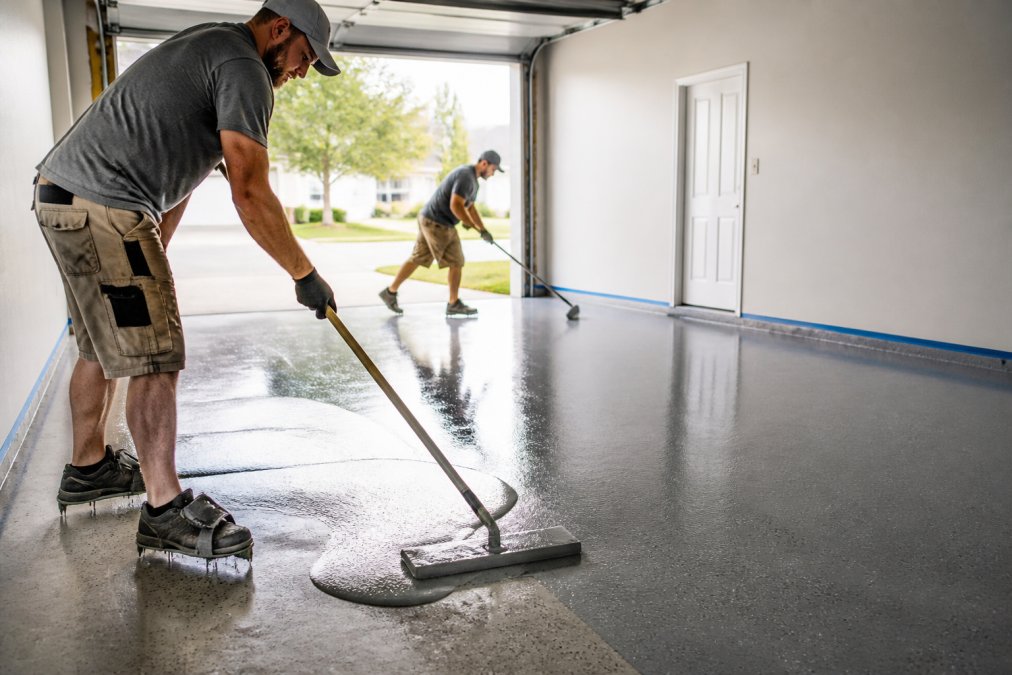
For homeowners who want the job done properly the first time, Spray Pave Pro is the strongest option on this list. This concrete resurfacing specialist brings over 23 years of experience to every project, handling surface preparation, application and sealing as one complete service rather than leaving the hard parts to the customer.
The difference shows in the details. Proper concrete preparation, correct primer coat selection and controlled curing time are what separate a coating that lasts from one that lifts within a season. Spray Pave Pro manages all of it, backed by a 100% satisfaction guarantee and a team that works quickly to minimise disruption.
Pros:
Cons:
ArmorGarage earns its place through solids content. A 100% solids epoxy contains no water or solvent to evaporate, so essentially everything you roll out stays on the slab and cures into film. Water-based kits, by contrast, are typically around 40-60% solids, which means a large share of what you apply disappears into the air and the cured film is correspondingly thinner. That single difference explains most of the durability gap between this product and the budget options further down the list.
Where it stands apart is chemical resistance. Once fully cured, a high-solids film forms a tight cross-linked surface that oil, petrol, brake fluid and road salts struggle to penetrate. Spills sit on top long enough to wipe up rather than soaking into the concrete. The trade-off is preparation and forgiveness. This system demands careful surface preparation, often diamond grinding to open the concrete's pores and create a mechanical key, and it has a finite pot life once the two parts are mixed. Mistakes during application, thin spots, missed sections, applying over a damp slab, are far less forgiving than with a water-based kit, because you cannot simply sand back and re-roll a fully cured 100% solids coat without scarifying it first.
Pros:
Cons:
Most epoxy coatings yellow when sunlight hits them, which matters for garage floors near open doors or carports. The reason is chemistry: standard epoxy is built on aromatic amines, and the aromatic rings absorb UV light and degrade into the amber tint homeowners notice after a season or two. MPC-100 addresses this directly by using an aliphatic (non-aromatic) curing system, which resists that UV-driven colour shift and keeps the finish clear rather than amber over time. It is the same chemistry used in UV-stable topcoats, applied here as a high-build resin.
The high-build resin system delivers strong adhesion to properly prepared concrete and a seamless surface that is easy to clean. Coverage is generous, so a single kit goes further than many competitors. The catch is availability: this is not a product you will find on a standard hardware shelf, which makes sourcing less convenient for a weekend project.
This is the part most guides skip, and it is where a good product still fails. Epoxy cures by an exothermic chemical reaction, and that reaction is temperature-sensitive. Below roughly 15°C the cure slows dramatically and the film can stay tacky for days; above about 30°C the pot life shortens and the coating can flash-cure before it levels, leaving roller marks.
Pros:
Cons:
Rust-Oleum EpoxyShield is the practical entry point for DIY enthusiasts. The water-based formula cleans up easily, applies in a single coat and comes with decorative colour chips to hide imperfections in the slab.
Pros:
Cons:
Seal-Krete targets a specific problem: slabs that push moisture upward. Its water-based formula resists oil, grease and petrol stains while standing up to moisture vapour transmission better than many budget coatings.
Pros:
Cons:
Polyaspartic coating generally outlasts standard epoxy in UV stability and curing speed, while 100% solids epoxy wins on thickness and cost per square metre. The right choice depends on sun exposure, traffic and budget.
100% solids epoxy systems generally outlast water-based kits because they cure thicker and resist abrasion, chemical spills and hot tyre pickup better. A high-build epoxy with a polyaspartic topcoat gives the longest service life, since the topcoat adds UV stability the epoxy alone cannot provide. Durability also depends on surface preparation: diamond grinding and a primer coat matter as much as the product you choose.
A well-installed garage floor epoxy usually keeps its colour and gloss after five years, especially with a UV-stable topcoat. Floors that fail early tend to show peeling near the garage door, hot tyre pickup marks, or yellowing from sunlight. Moisture vapor transmission through the concrete substrate is a common cause, which is why moisture testing before application matters.
DIY kits can perform reasonably in light-duty garages, but they usually contain less solids and cure thinner than professional systems. A DIY roller-applied coating may last a few years, while a professionally applied 100% solids epoxy with proper surface preparation can last considerably longer. The biggest difference is preparation: acid etching versus diamond grinding changes how well the coating bonds.
Lifespan depends on the system, traffic and maintenance. A water-based DIY coating might give three to five years, while a professionally installed 100% solids epoxy with a topcoat can last a decade or more. Regular sweeping, prompt spill cleanup and avoiding harsh solvents extend garage floor longevity. Recoating before the coating wears through is far cheaper than full removal.
Polyaspartic coatings cure faster, resist UV yellowing and tolerate lower temperatures during application, which suits outdoor or sun-exposed slabs. Epoxy bonds strongly and builds a thicker, harder film at a lower material cost. Many installers combine them, using epoxy as the base and polyaspartic as the topcoat, so you get abrasion resistance plus UV stability in one system.
A garage floor coating only performs as well as the preparation and application behind it. Spray Pave Pro handles the full process, from high-pressure cleaning and surface preparation through to epoxy flooring and professional sealing, backed by 23 years of experience and a 100% satisfaction guarantee. If your concrete is cracked, stained or simply worn out, get a free quote from Spray Pave Pro and find out what your garage floor can actually become.
