
Last Updated: September 14, 2026
Concrete resurfacing is the process of applying a new, bonded layer over an existing concrete slab to restore its appearance and function without demolition. For driveways with surface-level cracking, staining, or pitting, resurfacing typically costs far less than replacement and finishes in a fraction of the time.
At Spray Pave Pro, we've spent 23 years restoring concrete across residential and commercial properties, and the question we hear most is simple: which concrete resurfacing products actually hold up? Below, we break down the leading options by substrate, climate, and traffic load, so you can specify the right material the first time.
Replacement means breaking out the slab, carting away rubble, and recasting, which disrupts a property for days. Resurfacing bonds a new wearing layer to sound concrete, usually in a single visit.
The catch: resurfacing only works when the slab underneath is structurally sound. If cracks run deep, the slab has heaved, or moisture is rising through it, an overlay will fail regardless of product quality. That distinction drives every recommendation in this guide.
Most guides list products. Fewer explain how to choose between them. The table below adds the two columns that actually drive the decision, substrate compatibility and relative cost band, because the same product can be the right answer on a sound, dry slab and the wrong answer over a sealed, oil-stained, or moisture-affected one.
| Product | Type | Best For | Substrate Compatibility | Relative Cost Band | Key Limitation |
|---|---|---|---|---|---|
| Ardex CD | Cementitious overlay | High-traffic driveways | Bare, profiled concrete; not over sealed or painted slabs without mechanical removal | High | Needs precise mixing ratios |
| Quikrete Resurfacer | Polymer-modified cementitious | DIY, small-medium slabs | Bare concrete; bonds poorly over curing compounds and dense sealers | Low-medium | Not for structural cracks |
| Sakrete Flo-Coat | Self-levelling cementitious | Pitted driveways, walkways | Bare concrete; cosmetic fills only | Medium | Will not bridge movement |
| Ardex Feather Finish | Self-drying underlayment | Interior floors | Multiple interior substrates; not for exterior exposure | Medium | Interior use only |
| Rapid Set Resurfacer | Fast-setting cementitious | Time-critical repairs | Bare, prepared concrete | High | Very short working time |
| Like-Nu Kit | Spray-on system | Large weathered areas | Profiled concrete; fails over oil, paint, or epoxy without removal | Low-medium | Demands thorough prep |
Three variables decide the answer more than brand does.
1. Substrate condition. A cementitious overlay keys into open, profiled concrete pores. If the slab is sealed, painted, or coated in epoxy, the overlay bonds to the coating, not the concrete, and the coating is usually the weakest link. Mechanical removal (grinding or shot blasting) is normally required before any cementitious product will hold. This is the single biggest reason resurfacing fails, and it is why a compatibility check comes before a product shortlist.
2. Moisture and drainage. A slab releasing moisture vapour will push an overlay off from underneath regardless of product quality. Products differ in tolerance, but none tolerate a slab with no drainage path. Test before you specify.
3. Traffic and exposure. Foot traffic, vehicle traffic, and exposure to sun, rain, and temperature swings each narrow the field. Fast-setting products suit time-critical commercial work; self-levelling products suit cosmetic restoration of pitted surfaces; heavy-duty cementitious overlays suit driveways that take constant load.
Safe Work Australia guidance on silica dust control when grinding or cutting concrete
Ardex CD is a cement-based resurfacing compound built for surfaces that take a beating. Its high-strength formula suits driveways and patios where foot and vehicle traffic is constant, and it bonds well to prepared concrete.
Where it stands apart is weather resistance: the cured surface handles harsh conditions and provides a slip-resistant finish. The trade-off is technique. Ardex CD demands accurate mixing ratios and disciplined application, which is why it's usually specified for professional work rather than a weekend DIY job.
Quikrete's resurfacer is a polymer-modified cementitious blend that creates a new wearing surface over existing slabs. The polymer content improves bond strength, and it can be applied with a squeegee or broom, so standard tools are enough for small to medium projects.
It sets quickly, which shortens project time, and it's formulated for thin applications. For homeowners patching a tired patio or path, it's a sensible entry point. Just don't expect it to bridge structural cracks; that's a repair job, not a resurfacing one.
Sakrete Flo-Coat is a self-leveling resurfacer that fills minor imperfections and leaves a smooth, uniform finish. Its high-flow formula spreads with minimal labour, and it handles small surface defects well, making it a fit for old, pitted driveways and walkways.
Ardex Feather Finish takes a different role: a self-drying, cement-based underlayment for interior floors. It bonds strongly to multiple substrates, feathers to a thin edge, and needs no priming in most applications. Use it to prepare interior slabs before final flooring goes down.
When access can't stay blocked, Rapid Set is the answer. This fast-setting resurfacer can reach set in as little as 15 minutes, with a high-strength formula and feather-edge capability for seamless transitions.
The speed is both the feature and the risk. A set time that short leaves almost no margin for error, so you need your prep finished and your tools staged before you mix. It suits commercial entryways and time-critical exterior repairs where downtime carries a real cost.
Like-Nu's kit is a spray-on restoration system for rejuvenating old, stained, or weathered concrete. Spray application gives uniform coverage across large areas, and the kit format keeps it accessible for homeowners without professional equipment.
It's economical per square metre, which matters on big slabs. The non-negotiable part is preparation: a spray-on overlay bonds only as well as the surface allows, so cleaning and profiling decide whether it lasts.
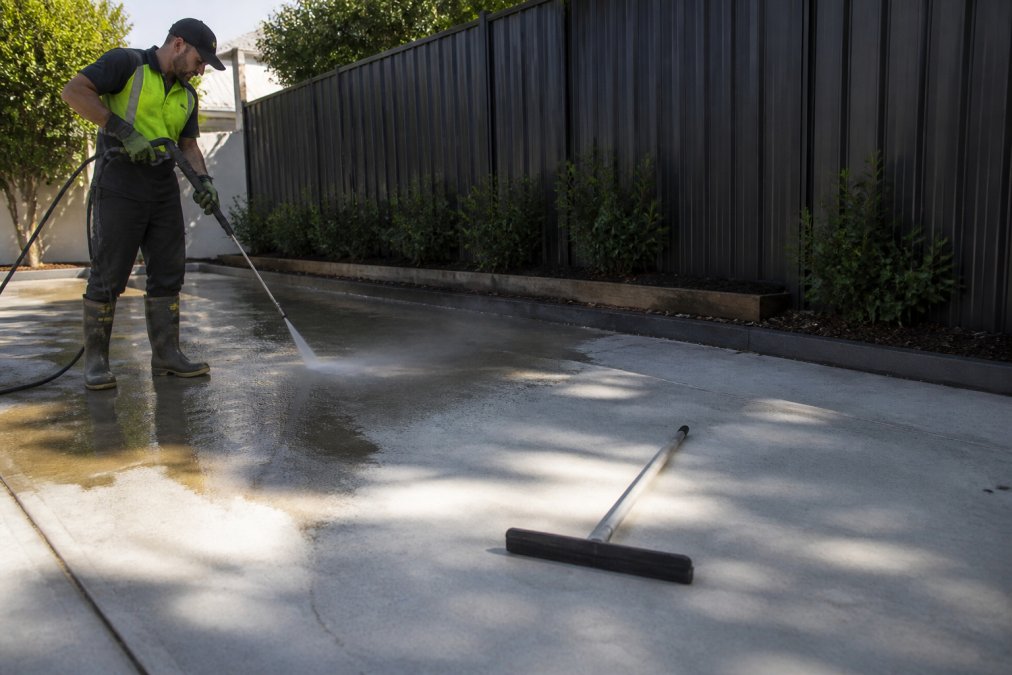
Delamination almost always traces back to preparation, not the product. But "prepare the surface" is not useful advice on its own. What matters is understanding why an overlay lets go, so you can test for the specific conditions that cause it before you mix anything.
Four mechanisms account for most overlay failures.
1. Bond failure at the interface. The overlay adheres to whatever is on top of the concrete, dust, curing compound, sealer, paint, oil, or a previous coating. When that intermediate layer fails, the overlay peels in sheets. This is the most common failure and the most preventable.
2. Moisture vapour transmission. Concrete is porous and releases moisture from below. If the slab has no drainage path or a vapour barrier, moisture accumulates at the bond line and pushes the overlay off. The failure appears as blistering or as debonding that spreads from the centre of the slab outward.
3. Movement and cracking. Concrete moves with temperature and moisture. A thin overlay cannot bridge active cracks or slab movement. If the crack is still opening and closing, the overlay will crack along the same line within a season.
4. Insufficient profile. A smooth or glossy surface gives the overlay nothing to key into. Mechanical profiling opens the pores so the material can mechanically interlock, not just sit on top.
Work through these checks in order. If any fails, resurfacing is the wrong answer until the underlying issue is fixed.
Check 1, Structural soundness. Tap the slab with a hammer. A hollow sound indicates a delaminated or drummy area. Resurfacing over it will fail. Deep cracks, heaving, or slab movement mean replacement, not resurfacing.
Check 2, Surface contamination. Look for oil stains, paint, sealer, curing compound, or previous coatings. Each one blocks the bond. Oil-stained concrete in particular needs mechanical removal, degreasers alone rarely open the pores enough for a reliable bond.
Check 3, Moisture. Test for moisture vapour transmission. A slab that is still releasing moisture will push an overlay off from underneath (Datasheets). If moisture is high, address drainage or specify a moisture-tolerant system before proceeding.
Check 4, Profile. The surface should feel like medium-grit sandpaper after preparation. If it feels smooth or glossy, it is not profiled enough.
Total Time: 1-2 days including curing
Difficulty: Intermediate
What You'll Need
Expected Result: A uniformly textured, sound surface ready to accept the overlay without peeling.
Bunnings stocks a limited range of concrete resurfacing products, typically including Quikrete and similar polymer-modified cementitious resurfacers. These are suitable for small DIY repairs. For larger driveways or commercial projects, professional-grade products like Ardex CD or Rapid Set are usually sourced through trade suppliers. If you need a durable, warranty-backed finish, a specialist like Spray Pave Pro can supply and apply the right product for your surface.
You can resurface small areas yourself with a DIY concrete resurfacing kit, but success depends on thorough surface preparation. You will need to clean, etch, and possibly grind the concrete to achieve the right surface profile. Mixing and applying the resurfacer within the pot life is tricky, and poor technique leads to delamination. For driveways, pool surrounds, or any area larger than a few square metres, professional application is more reliable and often more cost-effective long term.
Yes, when the substrate is sound and properly prepared. Resurfacing works by bonding a new cementitious or polymer-modified overlay to existing concrete. It restores appearance and improves slip resistance. However, it is not a structural fix for deep cracks or sinking slabs. Products like Ardex CD and Rapid Set have proven track records in high-traffic areas, but they rely on correct surface preparation and curing to last.
A professionally applied resurfacing system can last 10 to 15 years or more, depending on the product, traffic, and climate. Cementitious overlays with a quality acrylic sealer resist UV and moisture well. Epoxy coatings are durable but can degrade under constant UV exposure unless top-coated. Proper surface preparation, correct mixing, and timely resealing are the main factors that determine longevity.
Sealing applies a protective coating over existing concrete to repel water and stains, but it does not change the surface texture or repair damage. Resurfacing involves applying a new layer of cementitious or polymer-modified material that bonds to the concrete, covering cracks and worn areas. Resurfacing is a restorative process, while sealing is a maintenance step. Many resurfacing systems require a sealer as a final coat for best performance.
