
Last Updated: September 21, 2026
Epoxy has a reputation problem on driveways, and it is deserved. The same hard, glossy finish that works beautifully on a garage floor fails outdoors because epoxy is not UV-stable: sunlight breaks down its chemical bonds, causing yellowing, chalking and eventual delamination. Once water gets under a lifting edge, the coating peels in sheets.
The main alternatives to epoxy for residential driveways are polyaspartic and polyurea coatings, spray-on concrete resurfacing, decorative concrete stains, acrylic and penetrating sealers, and full replacement with pavers or tiles. Each solves a different problem.
| Option | Best For | Upfront Cost | Lifespan | Maintenance |
|---|---|---|---|---|
| Polyaspartic coating | Sun-exposed driveways, hot tyre areas | Higher than epoxy | Long, with UV stability | Low |
| Spray-on concrete | Cracked, stained or patchy concrete | Mid-range, quoted per job | Long | Low |
| Concrete stain | Decorative colour on sound concrete | Lower | Permanent colour | Re-seal periodically |
| Acrylic sealer | Budget protection on good concrete | Low | Short, needs redoing | Frequent |
| Pavers or tiles | Full replacement, high-end finish | Highest | Very long | Occasional re-sanding |
Polyaspartic is a fast-curing aliphatic polyurea coating. The word that matters is aliphatic: its molecular backbone lacks the aromatic rings that epoxy contains, and those rings are exactly what absorb UV energy and break down. That is why epoxy chalks, yellows and eventually delaminates on a sun-facing driveway while polyaspartic holds its colour.
| Property | Epoxy | Polyaspartic |
|---|---|---|
| UV stability | Poor, yellows and chalks | Good, colour-stable |
| Cure time | Slow (often 12-24 hours before traffic) | Fast (often return to service same day) |
| Hot tyre pickup | Common | Rare |
| Flexibility | Rigid, brittle in cold | More flexible |
| Moisture tolerance during cure | Low | Higher |
| Relative material cost | Lower | Higher |
Polyaspartic also tolerates application in a wider band of temperatures and humidity, which matters if you are trying to book a job in a shoulder season. Epoxy is fussier: too cold, too damp, or too humid and the cure goes wrong, which is one of the most common reasons a DIY epoxy driveway fails in its first year.
This is where most guides stop, and where the real decision sits. The same driveway can punish a coating in two completely different ways depending on where you are.
Polyaspartic costs more in materials and installation than epoxy, and it still needs sound, dry concrete underneath. Neither coating fixes a failing slab, and neither will hide structural movement, if the concrete is cracking because the base is moving, the coating will crack with it.
If your slab is sound and sun-exposed, polyaspartic is the strongest coating alternative to epoxy, and it is the option most likely to still look right after several summers. If your slab is sound but shaded, or if you are in a cool, wet climate, a penetrating sealer or a sealed resurfacing system may give you better long-term value for less money.
Spray-on concrete is a resurfacing system that lays a new, bonded concrete layer over your existing slab, rather than a thin film coating. It hides cracks, stains and patchy repairs while restoring a uniform, textured finish.
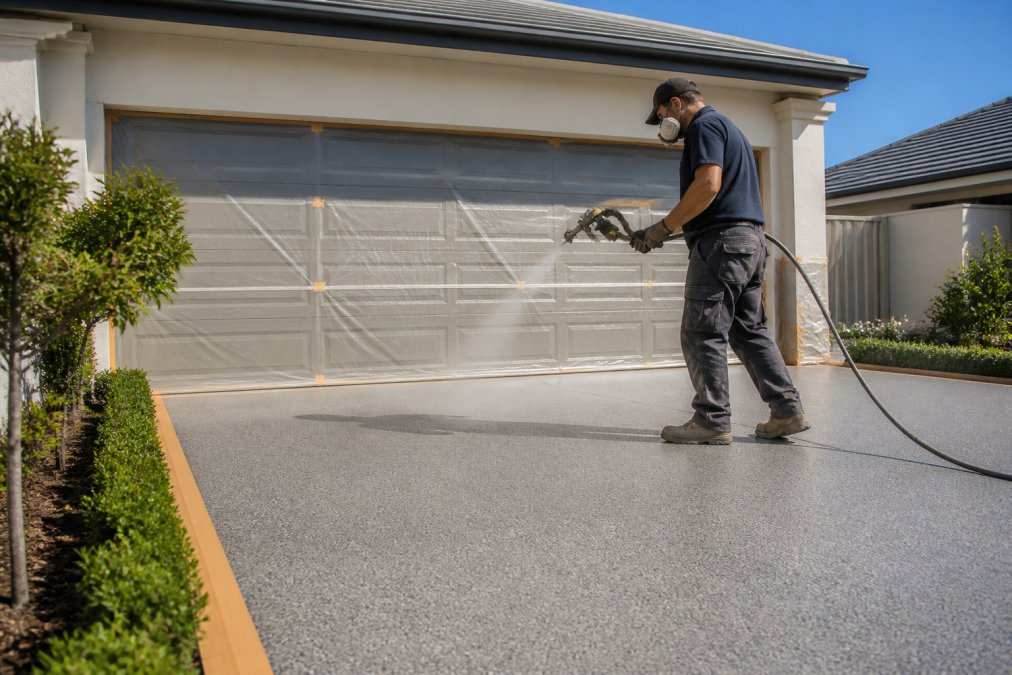
Key advantages include:
Spray-on concrete fixes cosmetic and surface-level damage: cracks, stains, spalling and worn patches. It cannot fix structural failure. If the slab is sinking, heaving or badly broken, resurfacing will crack again. A common mistake is coating over a slab that needed underpinning or replacement first, which wastes the whole job. Get the substrate assessed before committing.
Beyond coatings and spray-on concrete, several options suit specific budgets and goals. The right pick depends on how much you want to spend and how long you plan to stay.
Concrete stain is a penetrating colour treatment that reacts with the slab rather than sitting on top of it, so it cannot peel or flake. It suits sound concrete and pairs well with a sealer for protection.
When a driveway is beyond resurfacing, pavers or tiles are the durable replacement. They handle heavy loads, individual units can be lifted for utility repairs, and permeable options help with stormwater. The catch is cost: this is the most expensive route upfront, and it means the most disruption while the old surface is removed and a new base is laid.
Concrete resurfacing cost is driven by surface area, substrate condition, the system chosen and how much preparation is needed. There is no single national figure, and any guide that quotes one is guessing. What you can do is understand the cost structure, so you can sanity-check a quote instead of trusting it.
1. Size. Material and labour scale roughly with square metres. A double driveway is not double the cost of a single, because setup, masking and travel are largely fixed, but it is close.
This is the strongest argument for choosing the right system the first time. A UV-stable coating on a sun-exposed slab, or a breathable system in a wet climate, avoids the strip-and-replace cycle entirely.
When you have two or three quotes in front of you, compare them on these lines rather than on the headline number:
Because every driveway differs in size, condition and access, a site assessment and written quote is the only reliable way to know your figure. Spray Pave Pro provides free quotes so you can compare options on real numbers rather than guesswork.
The right choice comes down to three factors: your climate, the condition of the substrate, and how long you intend to keep the property. A sun-exposed driveway in a hot climate needs a UV-stable system, which rules epoxy out immediately.
Match the coating to the conditions. In a hot, sunny climate, choose a UV-stable option such as polyaspartic or a properly sealed spray-on concrete surface. If the slab is sound, resurfacing wins on value. If it is failing structurally, replacement is the honest answer.
Polyaspartic coatings are the closest like-for-like substitute, offering faster curing, better UV stability and greater flexibility than standard epoxy. Spray-on concrete resurfacing is another strong option because it rebuilds the worn surface rather than just coating it, and it can hide cracks and stains. Penetrating stains and acrylic sealers suit homeowners who want a lower-cost, no-peel finish, while pavers or interlocking tiles work when the existing slab is too far gone to coat.
Polyaspartic coatings cure much faster than epoxy, often allowing a driveway to be back in use the same day, and they resist UV yellowing that dulls epoxy over time. They also stay flexible through thermal expansion and contraction, which reduces cracking. The trade-off is a higher upfront cost than epoxy. For driveways exposed to strong sun and heat, the longer service life and colour retention usually justify the difference.
For driveways with existing cracks, pitting or staining, spray-on concrete often performs better long term because it adds a new wearing surface rather than sitting on top of a failing one. Epoxy bonds well to sound, dry concrete but can delaminate if moisture vapor transmission is high. Spray-on concrete also gives you control over texture and slip resistance, which matters for pool surrounds and steep driveways.
Acrylic sealers cost the least upfront and are simple to reapply, but they typically need refreshing more often than polyurethane or polyaspartic systems. If you want fewer maintenance cycles, a penetrating sealer paired with a quality topcoat gives better protection against stains and UV. The most cost-effective choice depends on how much traffic the driveway sees and how long you plan to stay in the property.
Polyaspartic and polyurea coatings handle heat well because they stay flexible and resist UV degradation. Light-coloured finishes also help by reflecting rather than absorbing heat, which reduces surface temperature and hot tire pickup. Concrete stains are a good option too, since they penetrate the slab instead of forming a film that can soften or peel in high temperatures.
A cracked, faded driveway drags down the whole look of a property, and patching it yourself rarely lasts. Spray Pave Pro has spent 23 years resurfacing driveways and patios, with spray-on concrete, professional sealing, high-pressure cleaning and epoxy flooring backed by a 100% satisfaction guarantee and a highly professional team. Get a free quote from Spray Pave Pro and transform your driveway with a finish built to handle the sun.
