
Last Updated: September 22, 2026
Choosing the right concrete sealers in Western Australia means matching the product to your surface, climate exposure, and desired finish. Long dry summers, intense UV, and coastal salt spray all attack an unsealed slab. This guide from Spray Pave Pro compares five proven options, from full-service professional application to DIY penetrating formulas.
| Sealer | Type | Finish | Best For | Starting Price |
|---|---|---|---|---|
| Spray Pave Pro | Full-service sealing | Custom | Driveways, patios, commercial | Free quote |
| Avista Concrete Sealer | Solvent-based acrylic | High gloss | Decorative concrete | Contact for pricing |
| Crommelin DiamondCoat | Tinted acrylic | Charcoal matte | Faded or tired slabs | $75.90 |
| Foundation Armor SX5000WB | Silane-siloxane penetrating | Natural | Driveways, walkways | Contact for pricing |
| Deco Crete D-ONE | High-solids topical | Satin | High-traffic surfaces | Contact for pricing |
Penetrating sealers soak into the concrete and react below the surface; topical sealers form a film on top. The choice shapes appearance, slip resistance, maintenance, and longevity.
Penetrating sealers, typically silane-siloxane or siliconate formulas, bond chemically with the substrate inside the pores, leaving the surface almost unchanged while making it hydrophobic so water beads and runs off.
Film-forming sealers, acrylic, polyurethane, and epoxy coatings, sit on top of the concrete as a continuous membrane. They deliver gloss or matte finishes, deepen decorative concrete colour, and resist oil and chemical stains more aggressively.
Work through these questions in order; the first that applies usually settles the choice.
Not every product fits one camp. Some penetrating sealers have a slight sheen, and some topical acrylics are more breathable than a traditional membrane. Lithium silicate densifiers harden rather than waterproof the surface and are usually a preparatory step before a sealer. If a technical data sheet does not state whether a product is breathable or film-forming, ask the supplier before you buy.
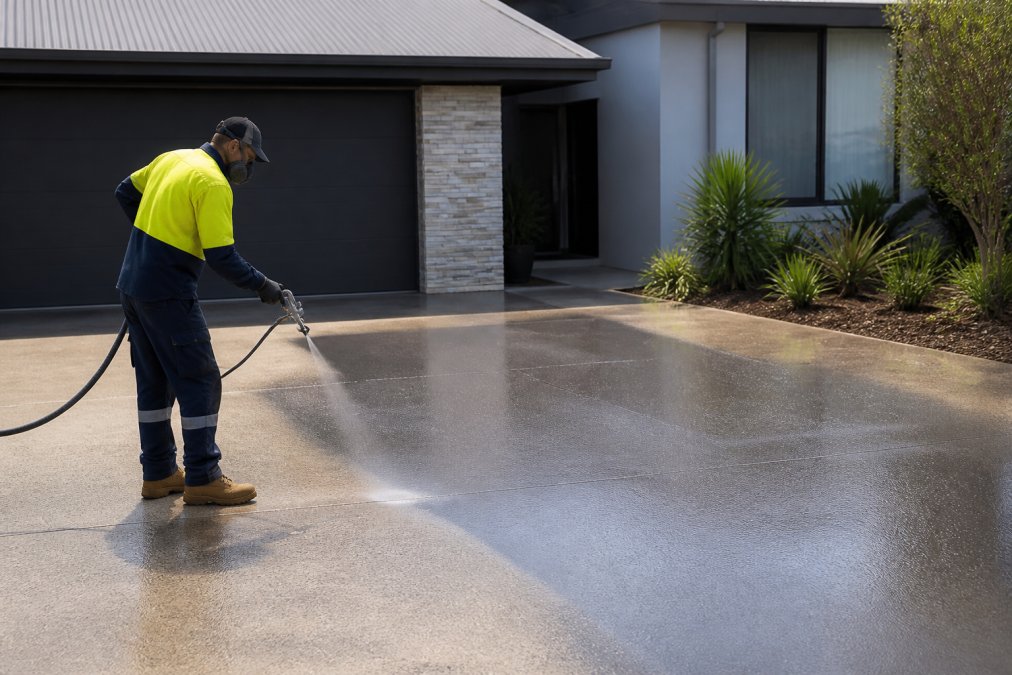
Our top pick for most homeowners is Spray Pave Pro, because the job is only as good as the preparation and application behind it. With 23 years of experience, the team handles high-pressure cleaning, crack repair, and professional sealing as a complete package, backed by a 100% satisfaction guarantee.
Pros:
Cons:
Avista Concrete Sealer is a solvent-based acrylic for decorative concrete that needs to look as good as it performs. The high-gloss finish deepens colour and adds a wet-look sheen suited to exposed aggregate and stamped surfaces.
Pros:
Cons:
Crommelin DiamondCoat Charcoal Tint protects the slab and refreshes its colour at once. If your concrete has faded to patchy grey, this tinted acrylic sealer gives a uniform charcoal finish while blocking water and oil penetration.
Pros:
Cons:
Foundation Armor SX5000WB is a water-based, high-solids silane-siloxane penetrating sealer for protection without changing how the concrete looks. It soaks deep into the substrate, reducing water absorption and salt damage while staying non-yellowing and UV stable.
Pros:
Cons:
Deco Crete D-ONE is built for surfaces that take a pounding: commercial entries, industrial floors, and busy residential driveways. Its high-solids content delivers better coverage per litre, and enhanced chemical resistance holds up against fuel, oil, and cleaning agents.
Pros:
Cons:
Proper preparation is the difference between a sealer that lasts years and one that fails within months. These steps apply to penetrating and film-forming products alike.
Concrete sealing cost per square metre varies with surface area, sealer type, and preparation required. A simple penetrating sealer on a clean slab sits at the lower end; decorative coatings, crack repair, and high-traffic commercial products push it higher.
Use the table below as a starting point, not a rule, the complexity of your slab should override the square metreage.
| Situation | Recommended approach | Why |
|---|---|---|
| Small patio or path, under roughly 30 m², sound and clean | DIY with a quality penetrating sealer | Low risk, low material cost, easy to recoat |
| Standard driveway, 30-80 m², no major defects | Either, depending on confidence and tools | Prep is the deciding factor; a pressure cleaner and roller are the main requirements |
| Driveway with oil stains, cracks, or an existing failed coating | Professional | Stripping, degreasing, crack repair, and profiling are skilled work |
| Decorative concrete (exposed aggregate, stamped, coloured) | Professional | Lap marks and uneven gloss are almost impossible to fix after the fact |
| Commercial or high-traffic surface | Professional | Downtime, abrasion resistance, and documented slip resistance all matter |
| Slab within a few kilometres of the coast | Professional assessment first | Salt exposure and moisture testing change the product choice |
| Any slab showing moisture, efflorescence, or spalling | Professional assessment first | Sealing over an active moisture problem guarantees failure |
A failed sealer is not just a wasted tin. Stripping a peeling coating, re-etching, and starting again can cost several times the original job. The common causes are predictable: sealing a damp slab, skipping prep, applying in direct heat, and choosing a film-forming product where a breathable one was needed.
Solvent-based acrylic sealers and UV-stable penetrating sealers hold up best under strong sun. Look for products labelled non-yellowing and UV resistant, such as Avista Concrete Sealer or Foundation Armor SX5000WB. These resist the chalking and colour fade that cheaper sealers develop after a summer or two, keeping your concrete looking consistent for longer.
It depends on the finish you want. Penetrating sealers soak into the concrete, keep a natural matte look, and resist moisture without trapping vapour, which suits driveways and paths. Topical sealers sit on the surface and add gloss or colour, but they can peel if moisture gets underneath. For most outdoor slabs, a penetrating sealer is the lower-maintenance choice.
Most driveways need resealing every two to five years, depending on the product and traffic. Penetrating sealers often last longer than film-forming ones because they do not wear away as a visible layer. Test by dripping water on the surface: if it soaks in instead of beading, it is time to reseal.
Hot summers, intense UV, and coastal salt spray all shorten sealer life. Sealers that resist UV degradation and moisture vapour transmission cope better with these conditions. Applying at the right temperature and preparing the surface properly also matters more than the brand name, since poor adhesion causes most early failures.
Professional sealing protects against stains, oil, and water damage while making the surface easier to clean. It also extends the life of the slab and improves appearance. A specialist can match the sealer to the concrete's porosity and the conditions it faces, which reduces the risk of peeling, efflorescence, or patchy finishes.
