
Last Updated: September 6, 2026
Choosing between epoxy flooring and spray pave comes down to one question: where is the surface located? Epoxy is a seamless, high-gloss resin system that bonds to concrete for a hard, smooth, durable surface. Spray pave is a decorative, textured resurfacing method that layers a coloured, slip-resistant coating over your existing slab. Both restore tired concrete, but they serve very different purposes.
At Spray Pave Pro, we have spent over 23 years resurfacing driveways, patios, and pool surrounds across the country. A glossy epoxy floor outdoors in harsh sun will chalk and fade, while a textured spray pave finish inside a garage traps tyre marks and is harder to sweep clean. The real distinction is not quality but application: epoxy excels in controlled indoor environments, while spray pave suits exterior concrete facing weather, moisture, and bare feet.
| Factor | Epoxy Flooring | Spray Pave |
|---|---|---|
| Best location | Indoor garages, workshops | Outdoor driveways, patios, pools |
| Slip resistance | Smooth, slippery when wet | Textured, non-slip finish |
| UV stability | Poor, yellows and chalks in sun | Excellent, holds colour outdoors |
| Flexibility | Rigid, can crack with movement | Flexible, bridges minor cracks |
| Maintenance | Easy wipe-down, low effort | Requires broom or pressure wash |
| Lifespan | 10 to 20+ years indoors | Long-lasting when sealed properly |
| Installation | Multi-layer, precise curing | Quick, single-day application |
Epoxy delivers a harder, more chemical-resistant finish, but its rigidity and poor UV stability make it a poor fit for exterior concrete. Spray pave delivers the safety and weather resistance that outdoor conditions demand.
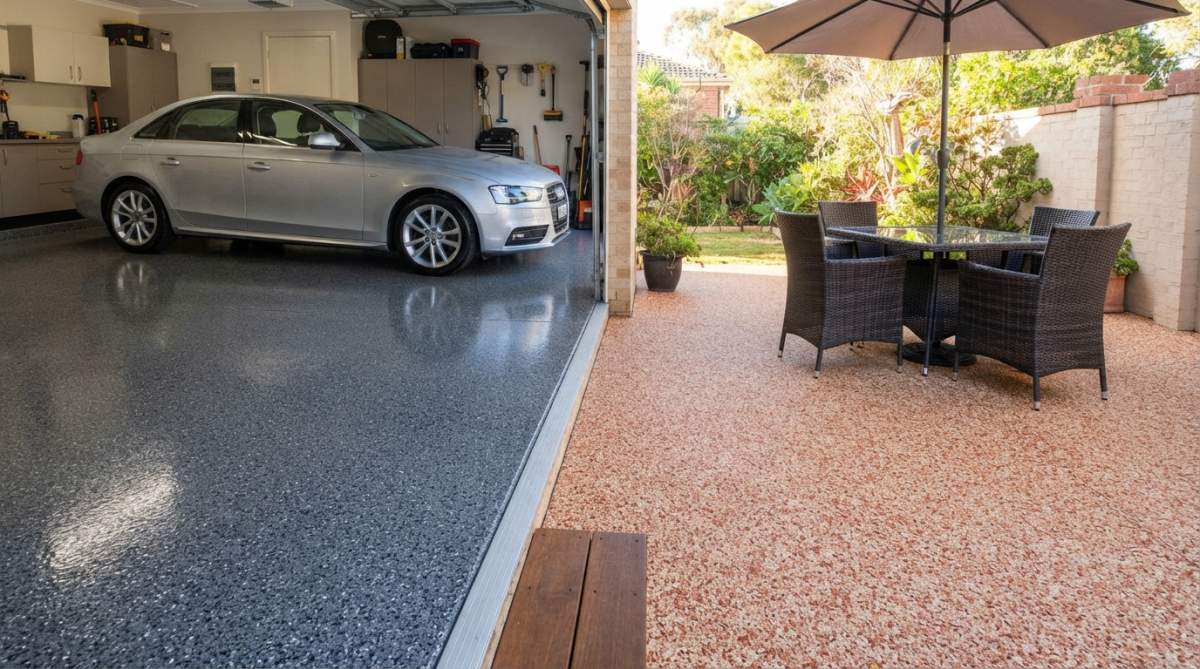
The durability of spray-on concrete vs epoxy depends entirely on the environment. Epoxy is exceptionally hard and abrasion-resistant, with 100% solids formulations rated for 10 to 20+ years in garages when applied correctly (peer-reviewed research). That longevity assumes stable indoor conditions; epoxy is brittle, so concrete movement, thermal shock, or impact can crack or delaminate it.
Spray pave is built for the outdoors. Its flexible, textured formulation absorbs minor substrate movement and handles thermal shock. The trade-off is that a textured surface is more porous than smooth epoxy, so it requires a quality sealer to lock out stains. For a driveway or pool surround, a properly sealed spray pave surface delivers durability a rigid epoxy film cannot match outdoors.
Concrete resurfacing cost per square metre is rarely a single figure; the final price is driven by the condition of the existing slab, the system you choose, and whether you DIY or hire a professional.
Surface preparation is the largest variable. Both epoxy and spray pave require a clean, sound, and profiled substrate. If your concrete is relatively new and free of sealers, a simple grind and clean may suffice. If it has old paint, glue residue, or significant spalling, you will pay for additional grinding time, patching compounds, and potentially a shot-blast to achieve the correct profile. This preparation work often represents 30-50% of the total project cost, regardless of which coating you select (the CDC).
Area size matters, but not as you might think. While larger areas cost more in materials, the price per square metre often decreases for bigger jobs because setup and clean-up costs are spread over a larger surface.
For epoxy, the system choice significantly impacts price. A basic water-based epoxy is the cheapest per litre but offers the least durability and often requires a separate topcoat. A high-build, 100% solids epoxy, the type that delivers the 10-20 year lifespan, is more expensive but is the only formulation that performs as advertised in a garage.
DIY epoxy kits are the budget entry point, but the hidden cost is labour and risk. You must grind the floor, patch cracks, apply primer, two colour coats, and a topcoat within strict recoat windows. A missed step or damp slab means the system fails. Professional installation removes that risk but adds labour cost, narrowing the gap between DIY and professional.
Spray pave is typically applied in a single, thicker pass, reducing labour hours compared to multi-layer epoxy. The material is a cementitious or polymer-modified blend that is trowelled and sprayed for texture. Because application is faster and preparation less finicky, the installed cost per square metre is frequently competitive with, or lower than, professional-grade epoxy.
Instead of chasing a single number, budget for the worst-case preparation scenario. If your slab is in good condition, expect the lower end of the range; if it is old, stained, or previously coated, add 30-50% for preparation. Always request a site inspection before comparing quotes.
For an accurate, site-specific concrete resurfacing cost per square metre for your driveway, patio, or pool surround, request a free quote from Spray Pave Pro. We will assess the slab condition, measure moisture, and provide a fixed price that reflects the real work required, not a generic estimate.
For the best low maintenance for non-slip pool surfacing, spray pave is the clear winner. Pool surrounds are constantly wet, exposed to chlorine and sun, and trafficked by bare feet, a combination that defeats smooth epoxy, which becomes dangerously slippery when wet and degrades in full sun. Spray pave is designed for exactly this environment.
The textured finish provides excellent slip resistance even when saturated, making it the preferred choice for pool decks and wet-area paving. It handles constant moisture without peeling if the substrate is correctly prepared and sealed. Maintenance is genuinely low: a quick rinse or light pressure wash removes debris, and the sealed surface resists staining from chlorine and sunscreen.
The one honest limitation is that the textured surface is more effort to keep spotless than smooth epoxy; dirt can settle into the texture, so it needs hosing down more often. For most homeowners, that trade-off is worth the safety and longevity in a constantly wet area.
The decision to DIY or hire a professional is rarely about skill, it is about risk tolerance and the true cost of failure. The product is only 20% of the equation; the other 80% is surface preparation, environmental conditions, and application technique.
Industry practitioners report that most DIY epoxy failures trace back to three preventable errors: inadequate surface profiling, applying over a damp slab, and ignoring recoat windows. A clean-looking garage floor often still has a film of oil or a smooth, power-floated surface that epoxy cannot grip; without mechanical grinding, the epoxy delaminates under the first heavy tyre turn.
Moisture is the second silent killer. Concrete slabs release moisture vapour continuously, especially in garages without a vapour barrier. A plastic-sheet test (taping a 500mm square of plastic to the floor for 24 hours) can reveal trapped moisture, but most DIYers skip it, resulting in a floor that blisters and peels within months.
A failed DIY coating is not just the cost of wasted materials. The full cost includes:
When added together, a "cheap" DIY job that fails can cost more than hiring a professional from the start. DIY only makes financial sense when you have the time, patience, and willingness to follow a strict preparation protocol without shortcuts.
Spray pave is more forgiving of minor surface imperfections because its texture hides defects that would be glaring in glossy epoxy. However, it still requires specialised spray equipment for an even texture. A common DIY mistake is applying material too thick, causing runs, uneven colour, and slow curing. Equipment cost alone often makes DIY spray pave uneconomical for a single project.
Before you choose DIY, ask yourself these four questions:
For any outdoor area, any surface over 40 m², or any slab with unknown history, professional application is the safer investment. The job is completed in a day, the surface is guaranteed, and you avoid hidden costs of failure. If still considering DIY, at minimum invest in a moisture test kit and a concrete grinder, not just a chemical etch.
Every premature coating failure traces back to one of three root causes: poor substrate preparation, moisture trapped in the slab, or choosing the wrong product for the location.
Substrate preparation is non-negotiable for both systems. The concrete must be clean, free of old sealers or paint, and mechanically profiled so the new coating has something to grip. Moisture is the second killer: if you apply a non-breathing epoxy film over a damp slab, vapour pressure pushes the coating off, causing blisters and delamination. A moisture test before installation prevents this. Finally, product selection: using an indoor epoxy outdoors, or decorative spray pave in a high-abrasion industrial setting, guarantees failure.
| Failure Mode | Root Cause | Prevention |
|---|---|---|
| Peeling or blistering | Moisture vapour trapped under coating | Test slab moisture before application |
| Cracking or delamination | Rigid coating on moving substrate | Use flexible spray pave outdoors |
| Yellowing or chalking | UV exposure on epoxy | Choose UV-stable spray pave for sun |
| Bubbling during cure | Solvent or air trapped in coating | Follow curing times between coats |
The best way to avoid these failure points is to have the surface assessed by an experienced applicator, who will test the concrete, recommend the right system, and guarantee the work. As one customer put it, the team was "reliable but also trustworthy and professional in their approach to customer service."
The decision should be driven by location, not by which looks shinier in a brochure. Choose epoxy for enclosed, climate-controlled spaces needing a smooth, seamless, chemical-resistant surface that is easy to wipe clean, such as a garage, workshop, or commercial kitchen. It delivers the hardest finish and longest lifespan indoors, but it will fail outdoors.
Choose spray pave for any exterior concrete, including driveways, patios, pathways, and pool surrounds. Its non-slip texture, flexibility, and UV stability make it the only sensible choice for surfaces facing weather, wet feet, and direct sun. It also transforms old, cracked, or stained concrete without the cost of full replacement, improving curb appeal.
If still unsure, consider how the surface will be used and what happens when wet. A driveway that takes cars and sits in full sun needs spray pave. A garage floor that must resist oil stains and be hosed clean needs epoxy. For most homeowners, the answer is often both, each in its proper place.
Epoxy can be slippery when wet unless slip-resistant additives are mixed in, so it is less ideal for pool surrounds. It also needs thorough substrate preparation to bond properly, and direct sunlight can cause it to yellow or chalk over time. Once cured, it is difficult to remove or repair in sections. For outdoor conditions, a textured spray pave finish is often the safer choice.
Epoxy is smooth and non-porous, so a mop or broom keeps it clean, but it shows dust and tyre marks more readily. Spray pave has a textured surface that hides dirt well, yet the texture can hold onto grime if left untouched. Both require periodic resealing to maintain their finish. Epoxy typically needs less frequent cleaning, while spray pave is more forgiving in high-traffic outdoor areas.
Yes, but only after the epoxy is properly prepared. The existing coating must be clean, sound, and free of any peeling or delamination. A professional will typically grind or etch the surface to create a mechanical profile for the new coating to grip. If the old epoxy is failing in large areas, it is best to remove it completely before applying a spray pave system.
For outdoor conditions, spray pave generally holds up better. Epoxy is susceptible to UV degradation, which causes it to yellow and lose its gloss. Spray pave uses UV-stable resins and a flexible, textured finish that resists thermal shock from the sun. This flexibility also helps it bridge minor surface cracks that would cause a rigid epoxy system to fail.
For large driveways, spray pave is usually the more cost-effective option. The application is faster because it is sprayed on, reducing labour time. Epoxy often requires a primer and a topcoat, adding material and labour costs. However, the final price depends on surface condition and preparation needs. Request a site inspection for an accurate quote based on your driveway size.
Choosing the right system is about matching the coating to the environment, not picking a favourite. At Spray Pave Pro, we have spent over 23 years resurfacing driveways, patios, and pool surrounds, and our team can assess your concrete, recommend the correct system, and install it quickly with a satisfaction guarantee. Get in touch for a free quote and see how a professionally applied surface can enhance your home's value and safety.
