
Last Updated: August 17, 2026
Perth's climate is one of the most demanding environments for outdoor concrete in the country. Intense UV radiation, summer temperatures regularly exceeding 40°C, and coastal salt air create a perfect storm for concrete degradation. At Spray Pave Pro, with over 23 years of experience sealing and resurfacing driveways, patios, and pool surrounds across Perth, we've seen firsthand what happens when homeowners choose the wrong sealer or skip sealing altogether. This guide breaks down the best concrete sealers for Perth conditions, explains critical differences between product types, and provides a clear framework for choosing the right one.
Quick Picks:
Perth's outdoor concrete faces stresses that most other Australian cities don't. UV intensity here is among the highest on the continent, breaking down unsealed concrete through photo-oxidation and causing surface chalking, colour fade, and micro-cracking. Heat cycling between cool mornings and scorching afternoons causes significant expansion and contraction, while coastal salt air accelerates carbonation and corrosion of steel reinforcement.
A quality sealer creates a hydrophobic barrier that repels water, oil, and salt contaminants before they penetrate the substrate. It also protects against mould and algae growth, which thrive in shaded areas during Perth's winter wet season. According to the Australasian Concrete Repair Association's guidance on concrete protection, surface protection is the single most cost-effective intervention for extending concrete lifespan in harsh climates.
Solvent-based acrylic sealers are film-forming products that create a hard, durable protective layer on top of the concrete. They penetrate slightly into surface pores before curing to form a continuous film, delivering excellent chemical resistance and a high-gloss or wet-look finish. The trade-off is VOC content, they release volatile organic compounds during application and curing, requiring adequate ventilation. For outdoor driveways and patios with good airflow, this is rarely a practical issue. They bond aggressively to porous or weathered surfaces and enhance colour dramatically.
Water-based acrylic sealers work similarly to solvent-based versions but use water as the carrier. They produce lower sheen, dry faster, and are easier to clean up with much lower VOC content.
Penetrating sealers based on silane, siloxane, or fluoro-bond technology don't form a surface film. Instead, they migrate into the concrete's pore structure and chemically bond with the substrate, creating an internal hydrophobic barrier. The surface looks completely natural with no sheen or colour enhancement. Because they don't form a surface film, they can't peel, flake, or trap moisture, and they're breathable, critical for slabs experiencing moisture vapour transmission from the ground.
| Sealer Type | Finish | VOC Level | Lifespan | Best For |
|---|---|---|---|---|
| Solvent-Based Acrylic | High gloss / wet-look | Higher | 3-5 years | Exposed aggregate, decorative concrete |
| Water-Based Acrylic | Low gloss / matte | Low | 2-4 years | Patios, pool surrounds, foot traffic areas |
| Penetrating Silane-Siloxane | Natural / invisible | Very low | 5-15+ years | Driveways, pavers, dense or polished concrete |
| Polyurethane (PU) | Gloss or low sheen | Low (waterborne) | 5-10 years | Commercial floors, epoxy topcoats |
The products below represent the strongest options available for Perth conditions, selected for their performance in the local climate and availability through specialist suppliers.
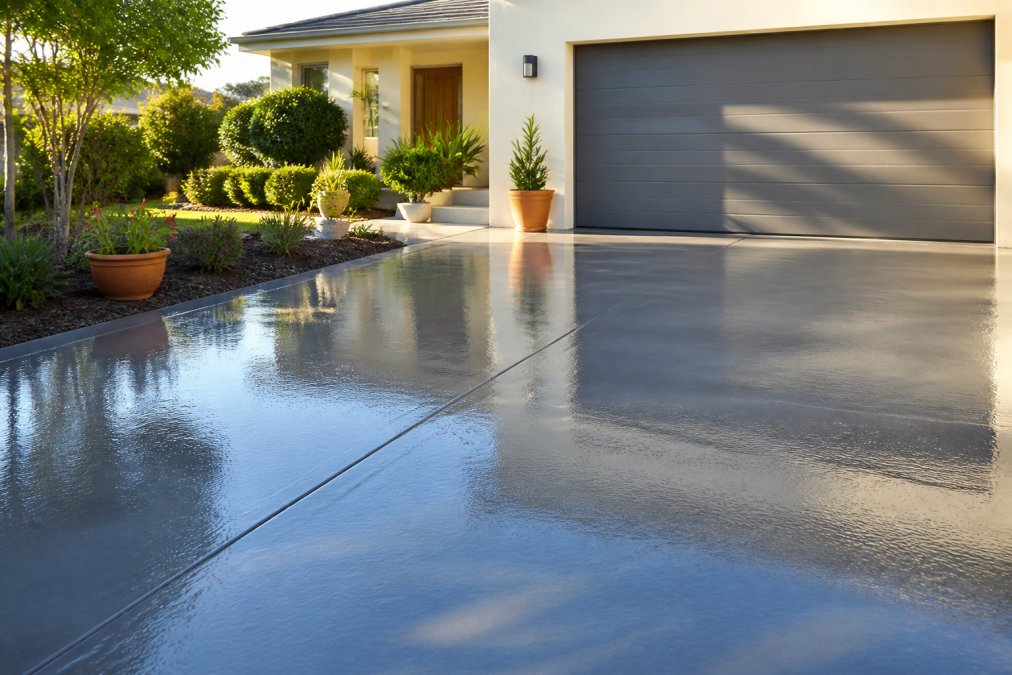
For most residential driveways and outdoor concrete, the Deepshield Transparent Penetrating Sealer is the strongest all-round choice. It penetrates deep into porous concrete, pavers, and grout to repel water, oil, and staining contaminants at the substrate level. Key advantages for Perth conditions are its longevity (up to 10 years or longer), completely natural finish, and non-slip surface retention. Because it's water-based, it's odourless and non-flammable during application.
Best for: Driveways, paths, and patios where a natural appearance and minimal maintenance are the priority.
Pros: Up to 10 years protection; environmentally friendly; maintains natural non-slip texture
Cons: No colour enhancement or gloss effect; professional application recommended for large areas
The GOLD variant is engineered for denser or more highly finished concrete surfaces. It uses advanced fluoro-bond technology to penetrate very fine surface pores, making it the correct choice for polished concrete or honed limestone. Protection extends up to 15 years or longer, with superior stain resistance against both water-based and oil-based contaminants.
Best for: Polished concrete, honed limestone, and dense or highly finished surfaces requiring maximum stain protection.
Pros: Up to 15 years protection; superior stain resistance; ideal for high-end finishes
Cons: Higher cost than standard penetrating sealers; pricing requires direct quote
This product creates a film-forming coating over the concrete surface, available in medium or high gloss. It resists oil, efflorescence, and chemical penetration effectively, making it well-suited for driveways that see vehicle traffic and potential fuel or oil spills. The gloss finish enhances the colour of exposed aggregate significantly. On its own, the high-gloss finish can become slippery when wet, so anti-slip additives should be used on any area that gets wet regularly.
Best for: Exposed aggregate driveways and patios where a gloss finish and chemical resistance are priorities.
Pros: Hard-wearing with strong chemical resistance; medium or high gloss options; compatible with anti-slip additives
Cons: Solvent-based with stronger fumes during application; requires anti-slip additives for wet areas
This water-based acrylic delivers a low-gloss matte finish with lower VOC content and easier cleanup than solvent-based versions. It's hard-wearing and stain-resistant, making it practical for pool surrounds and high-foot-traffic patios where a wet-look surface would be impractical and potentially slippery.
Best for: Patios, pool surrounds, and driveways where a natural matte look and lower VOC content are preferred.
Pros: Low gloss matte finish; water-based and environmentally friendlier; suitable for high foot traffic areas
Cons: Anti-slip additives needed for consistently wet areas; less colour enhancement than solvent-based alternatives
The CCS Streetscape sealer stands out for Green Star IEQ-13 compliance, making it the correct choice for any project with sustainability or low-VOC certification requirements. It's a waterborne, single-component penetrating silane-siloxane sealer that improves stain resistance against water, salts, oil-based contaminants, and even chewing gum. The natural finish and minimal impact on slip resistance make it suitable for public-facing commercial surfaces. Concrete must be fully cured for a minimum of 28 days before application.
Best for: Commercial concrete, masonry, and pavers where low VOC and sustainability credentials are required.
Pros: Green Star IEQ-13 compliant, very low VOC; excellent stain resistance; maintains natural appearance and slip resistance
Cons: Not a waterproofing compound; requires 28-day concrete cure before application
The CCS Colour Master Sealer is an opaque tinted sealer with UV-resistant compounds designed to recolour old, stained, or faded concrete while providing durable protection. For homeowners with concrete that's beyond cleaning but not yet at replacement stage, this is the most cost-effective option. It's available in gloss or matte finish.
Best for: Old, stained, or faded concrete that needs recolouring and protection in a single application.
Pros: Transforms appearance of worn concrete without resurfacing; UV-resistant compounds prevent colour fade; gloss or matte finish options
Cons: Requires careful, even application to avoid colour variation; opaque finish hides natural concrete texture
The Hychem PU100 is a two-component, water-based polyurethane sealer that's UV-stable, scratch-resistant, and non-yellowing. These properties make it the strongest choice for high-traffic commercial floors, retail spaces, and as a topcoat over epoxy systems. The two-component system requires precise mixing, putting it firmly in the professional application category.
Best for: Commercial floors, retail spaces, factory floors, and as a topcoat for epoxy finishes.
Pros: Exceptional scratch resistance and durability; non-yellowing, UV-stable clear finish; suitable for residential and commercial applications
Cons: Two-component mixing requires precision, not ideal for DIY; best suited to interior or covered applications
A non-slip concrete sealer for pool areas must create a protective barrier against constant moisture and chemical exposure while maintaining enough surface texture to prevent slips on a wet surface.
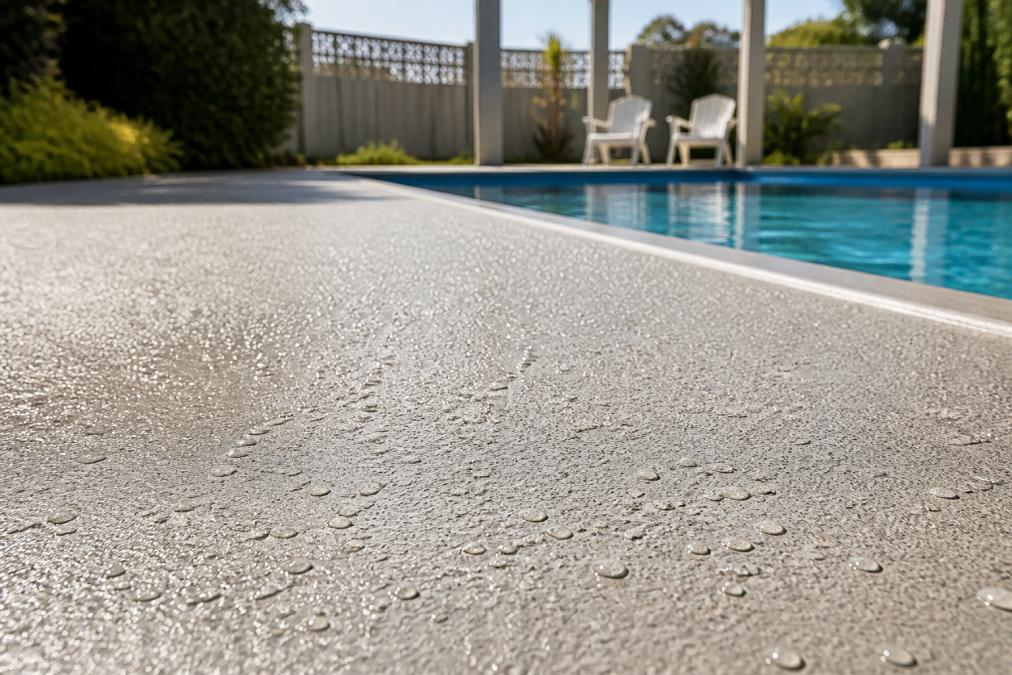
Film-forming sealers, particularly high-gloss solvent-based acrylics, become dangerously slippery when wet unless anti-slip additives are incorporated before application. Penetrating sealers are naturally non-slip because they don't alter the surface profile. The Deepshield Transparent Penetrating Sealer and the CCS Streetscape silane-siloxane sealer both maintain the existing texture of the concrete substrate, requiring no additional anti-slip additive.
For pool surrounds specifically, the water-based Best Bar Acrylic Sealer with anti-slip additive is a practical and cost-effective choice. For a longer-lasting solution with zero film-forming risk, the Deepshield penetrating range is the stronger recommendation.
According to Standards Australia's guidance on slip resistance for pedestrian surfaces, pool surrounds fall into a high-risk wet area classification requiring specific minimum slip resistance ratings under AS 4586.
Concrete sealer lifespan depends primarily on sealer type, surface porosity, traffic volume, and UV exposure. Penetrating sealers last longest because they're not subject to the surface wear and UV degradation that breaks down film-forming coatings.
For Perth outdoor conditions:
The single biggest factor reducing sealer lifespan in Perth is UV degradation. Products with UV-stabilising compounds, like the CCS Colour Master and Hychem PU100, resist this process significantly better. Re-sealing intervals should be based on visual inspection rather than a fixed calendar.
Surface preparation is where most DIY sealing failures originate. A sealer applied to a dirty, contaminated, or insufficiently prepared substrate will fail prematurely, regardless of product quality. The substrate must be clean, dry, and free of any previous coating, oil stains, mould, or efflorescence. High-pressure cleaning is the standard starting point. For oil-contaminated driveways, a degreaser application before pressure washing is essential.
DIY application is viable for penetrating sealers on straightforward residential surfaces. These products are generally applied with a roller, brush, or pump sprayer, and the margin for error is relatively forgiving.
Film-forming sealers are less forgiving. Uneven application produces lap marks, bubbling, or areas of different sheen. Solvent-based products require careful attention to ventilation and temperature conditions. Application in direct sunlight or temperatures above 35°C causes the solvent to flash off too quickly, resulting in poor film and reduced adhesion.
For two-component systems like the Hychem PU100, professional application is strongly recommended. For a straightforward driveway with a penetrating sealer, a competent DIYer can achieve excellent results. For decorative or polished concrete, commercial surfaces, or any two-component system, professional application protects the investment.
White haze or milky appearance in a film-forming sealer is caused by moisture trapped beneath the coating during application. Allow the concrete to dry completely, typically 48 hours after rain or pressure washing, before applying any film-forming product.
Peeling or delamination occurs when a new sealer is applied over an existing coating without adequate surface preparation. Full removal of the existing coating by grinding or chemical stripping is required before re-sealing.
Uneven sheen or patchy finish in acrylic sealers results from variable porosity across the slab. A second coat applied after the first has cured typically evens this out.
The right concrete sealer for Perth depends on four variables: the surface type, the desired finish, the traffic load, and the application method.
| Situation | Recommended Sealer | Key Reason |
|---|---|---|
| Natural-look driveway, long lifespan | Deepshield Transparent Penetrating | Up to 10 years, no film to peel |
| Polished or dense concrete | Deepshield GOLD | Fluoro-bond penetrates fine pores |
| Exposed aggregate, want gloss finish | Best Bar Solvent-Based Acrylic | Strong chemical resistance, wet-look |
| Pool surround, matte finish needed | Best Bar Water-Based Acrylic + additive | Low sheen, non-slip compatible |
| Commercial or low-VOC requirement | CCS Streetscape Silane-Siloxane | Green Star IEQ-13 compliant |
| Old stained concrete, needs colour | CCS Colour Master | Recolours and protects in one coat |
| Epoxy topcoat or commercial floor | Hychem PU100 | UV-stable, scratch-resistant PU |
The most common mistake is choosing a sealer based on appearance alone. A wet-look solvent-based acrylic looks impressive on an exposed aggregate driveway, but if Perth's UV intensity breaks down the film in three years, the re-sealing cost compounds quickly. A penetrating sealer with a 10-year lifespan may be less glamorous, but the total cost of ownership is lower.
Perth's outdoor concrete faces a genuinely demanding environment, and the sealer you choose needs to match those conditions. The Spray Pave Pro team brings 23 years of on-the-ground experience sealing and resurfacing driveways, patios, and pool surrounds, and we back every job with a 100% satisfaction guarantee. Whether you need a penetrating sealer for a new driveway, a colour restoration for faded concrete, or a non-slip solution for a pool surround, get a free quote from Spray Pave Pro and get the right product applied correctly the first time.
For most outdoor concrete driveways, a penetrating silane-siloxane or acrylic sealer suits the conditions well. Penetrating sealers soak into the substrate, creating a hydrophobic barrier without changing the surface appearance. Solvent-based acrylic sealers offer a high-gloss or wet-look finish with strong chemical resistance, making them popular on exposed aggregate. The right choice depends on your surface porosity, desired finish, and whether you need UV resistance for sun-exposed areas.
Lifespan varies significantly by sealer type. Standard water-based acrylic sealers typically last 2-5 years on driveways in high-UV conditions. Solvent-based acrylics can last 3-5 years with proper maintenance. Premium penetrating sealers, such as fluoro-bond formulations, can protect concrete for 10-15 years or longer because they chemically bond within the substrate rather than forming a surface film. High-traffic areas and harsh sun exposure will shorten any sealer's effective life, so inspect your surface annually.
Solvent-based sealers penetrate denser surfaces more effectively and deliver a richer wet-look or high-gloss finish, but they carry higher VOC content and stronger fumes during application. Water-based sealers are lower in VOC, odourless, and easier to apply safely in enclosed or residential settings. For pool surrounds and patios where safety and low odour matter, water-based options are generally preferred. For driveways requiring maximum gloss and chemical resistance, solvent-based acrylic sealers are often the stronger performer.
Pool surrounds need a non-slip concrete sealer that maintains grip when wet. Water-based acrylic sealers with an anti-slip additive mixed in are widely used for this application. Penetrating silane-siloxane sealers are another strong option because they do not form a film on the surface, preserving the concrete's natural texture and slip resistance. Avoid high-gloss film-forming sealers on pool decks without anti-slip additives, as they become dangerously slippery when wet.
Both methods work, and the best choice depends on the sealer type and surface area. Spraying produces a more even, thin coat and is faster over large driveways or patios. Rolling is easier for DIY application and works well on textured surfaces like exposed aggregate where a roller can push the sealer into crevices. For solvent-based sealers, spraying in low-wind conditions gives the most consistent result. Penetrating sealers are often applied by roller or brush to ensure full absorption into the concrete substrate.
This article was written using GrandRanker
