
Last Updated: October 3, 2026
DIY concrete sealing looks like the cheap fix until the first wet season proves otherwise. On new, sound concrete, a hardware-store sealer can work fine.
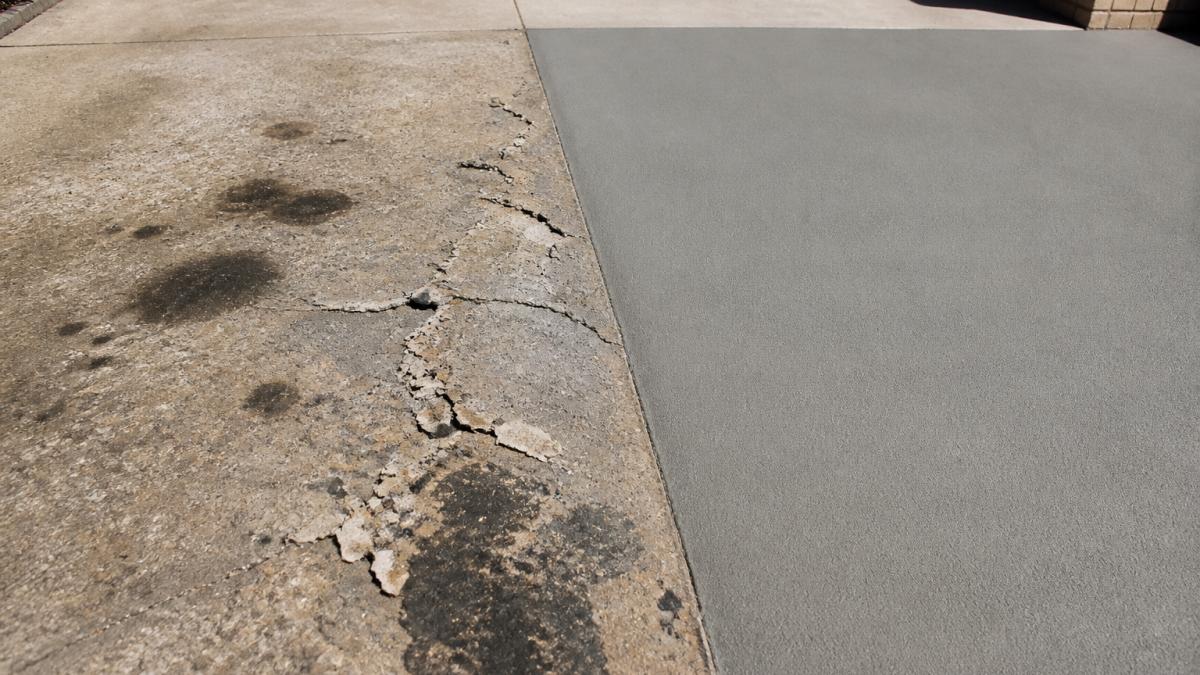
The core issue: most DIY sealers are film-forming coatings that sit on top of the slab rather than soaking in.
The problem is the substrate, no topical sealer fixes spalling, deep cracks or years of ground-in oil.
Three professional routes dominate: spray-on resurfacing, epoxy and polyaspartic coatings, and polished concrete. Each suits a different slab condition and budget, and choosing wrong is the most common and costly mistake we see.
A spray-on overlay is a cement-based coating applied over the existing slab to rebuild a worn surface. It covers cracks, stains and minor spalling, then gets a coloured or stencilled finish that can mimic tile, slate or exposed aggregate. Application is quick, often a day or two for a driveway, making it the strongest fit for weathered residential concrete that needs both repair and a new look.
Epoxy resin bonds hard and gives a seamless, glossy finish with strong chemical resistance. Polyaspartic cures faster and handles UV better, resisting yellowing and chalkiness in direct sun. Both need a dry, sound substrate and proper preparation, including etching or grinding. Epoxy struggles outdoors with moisture: a slab with no damp-proof membrane can push vapor up and delaminate the coating.
Polished concrete mechanically grinds and densifies the slab to a high-sheen finish with no topical sealer to peel, making it the most durable option for high-traffic areas with very little maintenance. Grind-and-seal is the lighter version: grind the surface, remove imperfections, then apply a protective sealer. It costs less than full polishing and still delivers a clean, modern look.
| Option | Best For | Key Strength | Main Trade-off |
|---|---|---|---|
| Spray-on overlay | Weathered, cracked driveways and patios | Covers damage and restyles the surface | Needs professional application |
| Epoxy / polyaspartic | Garages, commercial floors, wet areas | Chemical and abrasion resistance | Can delaminate on damp slabs |
| Polished concrete | High-traffic floors, long-term low maintenance | No topical sealer to wear out | Highest upfront investment |
| Grind-and-seal | Cost-conscious durable flooring | Balance of cost and wear resistance | Grinding needs pro equipment |
Professional concrete resurfacing outlasts DIY sealing because it fixes the substrate first: high-pressure cleaning, crack repair and surface preparation before any coating goes down, where a DIY reseal skips straight to the coating.
The other gap is product grade.
What most guides miss is that a failed DIY sealer does not just look bad. It actively damages the slab by trapping moisture, turning a cosmetic problem into a structural one.
Pool surrounds need a different answer to driveways: slip resistance, not just looks. A glossy epoxy finish around a pool is a liability, because a wet, smooth surface is exactly where people slip.
The better options for wet areas share three traits: a textured profile, water resistance, and UV stability so the finish does not chalk or fade under constant sun.
The failure mode to avoid is a coating that peels in wet conditions.
The cost of professional concrete sealing is higher upfront than a bucket of DIY sealer, and that comparison is misleading on its own. DIY looks cheaper until you count the resealing every year or two, the surface prep you do yourself, and the eventual repair when trapped moisture damages the slab.
The honest way to compare is cost per year of service life, not cost per tin. Work through the four cost lines below and the picture changes fast.
A cheap coating that fails in two years costs more than a durable system that lasts a decade, because you pay for the product, the prep and the downtime twice, and still end up repairing the slab.
Professional pricing depends on the size of the area, the slab condition, the system chosen and the prep required, so we quote each job on its own merits rather than publish a flat rate.
If a quote cannot answer those four, the low number is not a saving. It is a deferred cost.
Match the method to the slab, not to the budget alone. That single rule decides whether your surface lasts five years or fifteen. The decision has three layers most guides skip: what is already on the slab, what the climate will do to it, and how hard it will be to remove later.
You cannot apply most alternatives straight over an unknown old sealer. Compatibility is the first filter, and getting it wrong is the most common cause of a new coating failing within a season.
| Existing surface | Spray-on overlay | Epoxy / polyaspartic | Grind-and-seal | Polished concrete |
|---|---|---|---|---|
| Bare, sound concrete | Yes | Yes | Yes | Yes |
| Old acrylic / water-based sealer | Usually needs removal or a bonding primer | Needs full removal and grinding | Grinding removes it | Grinding removes it |
| Old solvent-based sealer | Needs mechanical removal | Needs mechanical removal | Grinding removes it | Grinding removes it |
| Peeling epoxy or film coating | Needs full removal first | Needs full removal first | Grinding removes it | Grinding removes it |
| Damp slab, no membrane | Only with a moisture-tolerant system | High delamination risk | Lower risk | Lowest risk |
| Heavily spalled or cracked | Best fit, rebuilds the surface | Does not fix the substrate | Cosmetic only | Not suitable |
The pattern is simple: overlays and grind-and-seal tolerate a tired surface better than epoxy, and epoxy is the least forgiving of a damp or contaminated slab. If you do not know what is on the concrete, a test patch in an inconspicuous corner is the cheapest diagnostic you can run.
Performance is not universal. The same product can excel in one climate and fail in another.
This is the exit strategy, and almost no guide covers it. Every alternative has a removal cost worth knowing before you commit.
If there is any chance you will want to change the finish later, favour a system with a low removal cost. If you want to set and forget, favour one with no film at all.
For most weathered residential slabs, a spray-on overlay is the best alternative to DIY sealing because it repairs and restyles in one process. For commercial and high-traffic floors, polished concrete or epoxy wins on durability.
Choosing between spray-on resurfacing, epoxy and polished concrete comes down to your slab's condition and climate, and getting that wrong wastes money. At Spray Pave Pro, we have spent 23 years resurfacing concrete, and we offer professional sealing, epoxy flooring and spray-on concrete backed by a 100% satisfaction guarantee.
Get a free quote from Spray Pave Pro and transform your old concrete into a surface that stands up to the weather.
The cheapest upfront option is a DIY acrylic or water-based sealer, but these often need reapplication every 1-2 years. Over a decade, the cost of professional concrete sealing can be comparable or lower because the finish lasts much longer. For a cost-effective long-term solution, spray-on resurfacing or a penetrating sealer applied by a professional usually offers better value per year of protection.
You can seal concrete yourself if the surface is clean, un cracked, and you use the right product for your climate. However, DIY sealing often fails when the concrete is weathered, has moisture issues, or requires surface preparation like grinding or etching. Professional concrete resurfacing includes proper prep and commercial-grade materials, which is why it outlasts most DIY applications. If your concrete is stained, cracked, or you want a non-slip finish, a professional service is the more reliable choice.
Epoxy flooring forms a thick, durable coating that resists chemicals, abrasion, and moisture far better than most DIY sealants. It also provides a seamless, glossy finish and can include non-slip additives. The trade-off is that epoxy requires professional installation for best results, has a longer cure time, and can be slippery when wet unless textured. For high-traffic areas or pool surrounds, epoxy is often a superior alternative to DIY sealers.
Professional resurfacing adds a new, durable layer that can fix cracks, stains, and uneven surfaces, whereas DIY sealing only protects what is already there. A resurfaced driveway or patio typically lasts 10-15 years with minimal maintenance, compared to 1-3 years for many DIY sealers. It also improves slip resistance and curb appeal, which can add real value if you plan to sell.
Yes, spray-on concrete overlays are generally more durable than topical sealers because they bond to the existing slab and create a new wear surface. They resist UV fading, abrasion, and moisture better than most DIY products. However, durability depends on proper surface preparation and the quality of the overlay mix. A professional installer will ensure the substrate is ready, which is critical for longevity.
