
Last Updated: October 1, 2026
Choosing between epoxy flooring vs concrete sealing for garages comes down to one question: do you want a coating that sits on top of your slab, or a treatment that soaks into it? Epoxy forms a thick, resin-based layer bonded to the surface. A sealer penetrates the concrete and repels liquid from within.
Epoxy is a two-part resin and hardener system that cures into a rigid, film-forming layer on top of the concrete. It creates a mechanical bond with the slab, which is why surface preparation matters so much.
A penetrating sealer soaks into the concrete's pores and reacts internally rather than building a film. Because nothing sits on top, there is nothing to peel, flake or delaminate.
Epoxy outperforms sealers on abrasion, impact and chemical resistance, but only when the slab underneath is sound and dry. Get the prep wrong and the most expensive coating will fail within months.
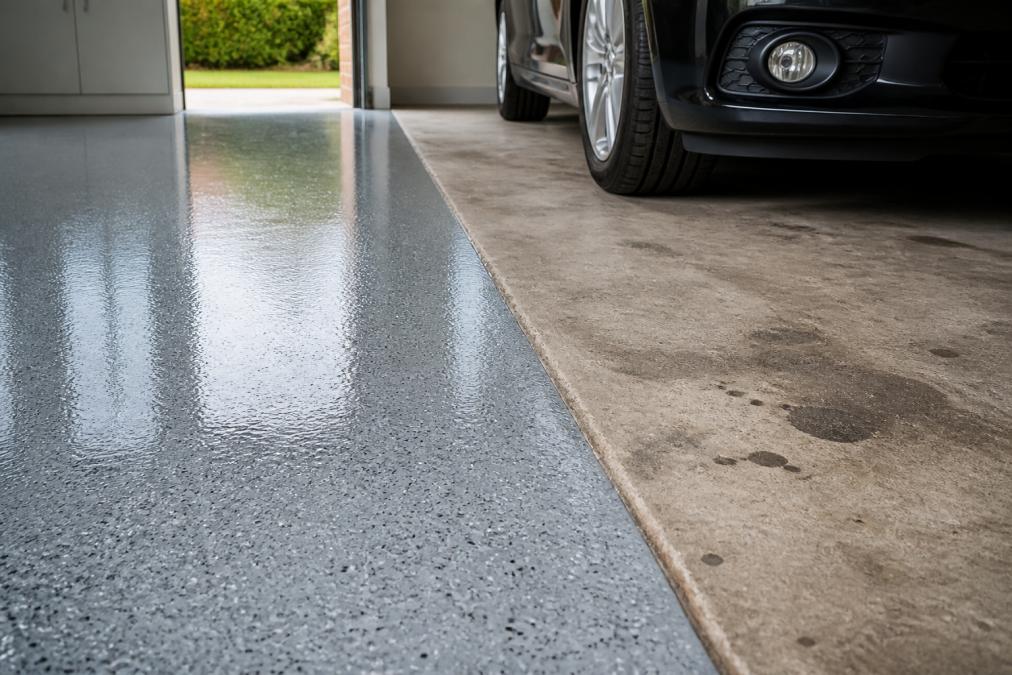
Hot tire pickup happens when warm tyres bond to a coating and lift it as the car reverses out, the most common failure on cheap DIY epoxy jobs. Proper surface preparation and a high-solids system prevent it. Penetrating sealers never suffer hot tire pickup because there is no film to lift, but they also repel oil stains less over the long term.
The cost of epoxy flooring vs concrete sealing depends heavily on slab condition, size and preparation, so pricing is best quoted after an on-site assessment. You can still budget sensibly if you understand what drives the number.
Four variables move the quote more than anything else:
Rather than quote a fixed figure that will be wrong for your slab, think in bands:
| Factor | Epoxy Coating | Penetrating Sealer |
|---|---|---|
| Upfront cost | Higher | Lower |
| Preparation needed | Diamond grinding, crack repair | Cleaning, sometimes light etch |
| Reapplication | Full recoat when worn | Periodic refresh |
| Lifespan under heavy use | Long with correct prep | Shorter, needs topping up |
| Appearance | Glossy, coloured finishes | Natural concrete look |
Over a longer horizon, the cheaper option is not always the sealer. If a sealer needs refreshing every couple of years with a call-out fee each time, the cumulative spend can approach a single well-prepped epoxy system that lasts many times longer. The break-even point depends on how long you stay and how hard the floor is used.
The most expensive outcome is not choosing the pricier system, it is paying for epoxy on a slab that was never properly prepared, or sealing a slab that then needs stripping and coating anyway. Both mean paying twice. A moisture test and hammer-tap survey before quoting cost little and prevent the most common expensive mistake.
Concrete floor preparation for coatings separates a floor that lasts a decade from one that peels in a season. No coating or sealer can outperform the bond it forms with the slab.
Diamond grinding opens the concrete's pores and creates a profile epoxy resin can grip. Acid etching can work on sound slabs but is harder to control and less reliable on older, denser concrete. Moisture testing, usually with a plastic sheet or calcium chloride test, tells you whether the slab is dry enough to coat; if hydrostatic pressure is present, standard epoxy is the wrong choice.
Most comparison guides stop at 'epoxy is durable, sealers are cheap' and never cover damage. Repairability is where the two systems diverge most sharply, and it decides the true long-term cost of ownership.
Sealers are easier to maintain because there is no film to match:
Epoxy repairs are more involved because the coating is a film with a colour and texture:
A solid-colour epoxy is relatively forgiving to patch because the repair can be blended. A decorative flake, quartz or metallic finish is not: flake blends are hard to reproduce exactly, and metallic finishes can show a visible patch even under careful work. On a decorative floor, a localised repair often looks worse than the original damage, pushing owners toward a full recoat sooner than expected.
Neither epoxy nor a sealer prevents cracking from structural or ground movement. Repair the crack before coating, open it out, fill with a suitable repair mortar or flexible filler, and let it cure, then accept that movement may reappear. Coating over a live crack transfers the failure into the coating.
A useful rule of thumb: if the damaged area is small and caused by impact or abrasion, repair it. If damage is widespread, recurring, or accompanied by blistering and lifting, the problem is underneath the coating and no patching will fix it. Strip, assess the slab and start again, which is why getting the substrate right the first time matters.
Temperature swings and vehicle type change the recommendation more than most guides admit. Epoxy becomes brittle in sustained cold and can soften in extreme heat, though a polyaspartic topcoat improves both. A penetrating sealer moves with the slab because it is part of it.
If you want the decision taken off your hands, Spray Pave Pro assesses your slab, tests for moisture and recommends the system that fits your usage and budget, backed by a 100% satisfaction guarantee.
The wrong choice is not picking the "lesser" system; it is picking one that does not match how you use the garage. A sealer on a welding bay will disappoint; a full epoxy system on a storage shed is money you did not need to spend.
It depends on how you use the garage. A penetrating sealer suits storage and light parking because it repels oil and water without changing the concrete's look, and it never peels. Epoxy flooring vs concrete sealing comes down to wear: epoxy forms a resin-based film that resists hot tire pickup, brake fluid and abrasion, making it the better choice for workshops, heavy tools and high-traffic areas. Sealing costs less initially, but epoxy typically delivers stronger long-term value where the floor takes real punishment.
Epoxy demands meticulous surface preparation. Without diamond grinding or acid etching, the coating can delaminate within months. Moisture vapor transmission through the slab is another risk: if hydrostatic pressure builds under a film-forming coating, blistering follows. Epoxy also needs a full cure before vehicles return, and gloss levels can fade under intense UV if the formula lacks UV stability. None of these are dealbreakers, but they explain why professional installation matters more with epoxy than with a simple topical sealant.
A penetrating sealer typically needs reapplication every few years depending on traffic and exposure, while a well-installed epoxy system can hold up for many years before showing wear. The trade-off is maintenance style: sealers are reapplied, epoxy is repaired. If stains return after a year, the sealer has usually worn thin rather than failed outright. Regular cleaning and prompt spill removal extend the life of both systems considerably.
Polyaspartic and polyurea coatings cure faster and handle temperature swings better than standard epoxy, and they resist yellowing from UV exposure. They cost more upfront. For garages with significant moisture issues, a concrete densifier plus a penetrating sealer can outperform a film-forming coating because it lets the slab breathe. The right answer depends on your slab's condition, your climate and how hard the floor works.
Match the coating to the job. For a workshop with chemical spills and heavy tools, a high-solids epoxy or polyurea system with proper substrate preparation is hard to beat. For a garage used mainly for parking and storage, a penetrating sealer offers low maintenance and a natural finish at lower cost. Whichever you choose, surface preparation, moisture testing and correct curing time decide how long the result lasts.
