
Last Updated: October 3, 2026
DIY concrete sealing looks like the cheap fix until the first wet season proves otherwise. On new, sound concrete, a hardware-store sealer can work fine.
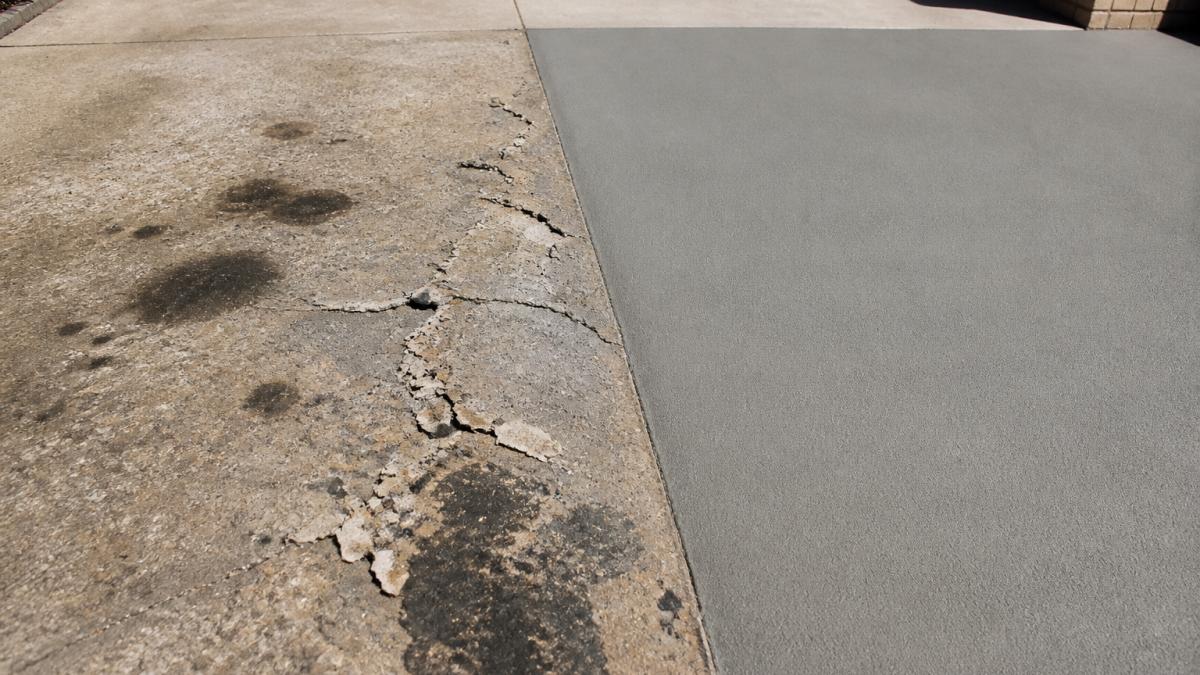
The core issue: most DIY sealers are film-forming coatings that sit on top of the slab rather than soaking in.
The problem is the substrate, no topical sealer fixes spalling, deep cracks or years of ground-in oil.
Three professional routes dominate: spray-on resurfacing, epoxy and polyaspartic coatings, and polished concrete. Each suits a different slab condition and budget, and choosing wrong is the most common and costly mistake we see.
A spray-on overlay is a cement-based coating applied over the existing slab to rebuild a worn surface. It covers cracks, stains and minor spalling, then gets a coloured or stencilled finish that can mimic tile, slate or exposed aggregate. Application is quick, often a day or two for a driveway, making it the strongest fit for weathered residential concrete that needs both repair and a new look.
Epoxy resin bonds hard and gives a seamless, glossy finish with strong chemical resistance. Polyaspartic cures faster and handles UV better, resisting yellowing and chalkiness in direct sun. Both need a dry, sound substrate and proper preparation, including etching or grinding. Epoxy struggles outdoors with moisture: a slab with no damp-proof membrane can push vapor up and delaminate the coating.
Polished concrete mechanically grinds and densifies the slab to a high-sheen finish with no topical sealer to peel, making it the most durable option for high-traffic areas with very little maintenance. Grind-and-seal is the lighter version: grind the surface, remove imperfections, then apply a protective sealer. It costs less than full polishing and still delivers a clean, modern look.
| Option | Best For | Key Strength | Main Trade-off |
|---|---|---|---|
| Spray-on overlay | Weathered, cracked driveways and patios | Covers damage and restyles the surface | Needs professional application |
| Epoxy / polyaspartic | Garages, commercial floors, wet areas | Chemical and abrasion resistance | Can delaminate on damp slabs |
| Polished concrete | High-traffic floors, long-term low maintenance | No topical sealer to wear out | Highest upfront investment |
| Grind-and-seal | Cost-conscious durable flooring | Balance of cost and wear resistance | Grinding needs pro equipment |
Professional concrete resurfacing outlasts DIY sealing because it fixes the substrate first: high-pressure cleaning, crack repair and surface preparation before any coating goes down, where a DIY reseal skips straight to the coating.
The other gap is product grade.
What most guides miss is that a failed DIY sealer does not just look bad. It actively damages the slab by trapping moisture, turning a cosmetic problem into a structural one.
Pool surrounds need a different answer to driveways: slip resistance, not just looks. A glossy epoxy finish around a pool is a liability, because a wet, smooth surface is exactly where people slip.
The better options for wet areas share three traits: a textured profile, water resistance, and UV stability so the finish does not chalk or fade under constant sun.
The failure mode to avoid is a coating that peels in wet conditions.
The cost of professional concrete sealing is higher upfront than a bucket of DIY sealer, and that comparison is misleading on its own. DIY looks cheaper until you count the resealing every year or two, the surface prep you do yourself, and the eventual repair when trapped moisture damages the slab.
The honest way to compare is cost per year of service life, not cost per tin. Work through the four cost lines below and the picture changes fast.
A cheap coating that fails in two years costs more than a durable system that lasts a decade, because you pay for the product, the prep and the downtime twice, and still end up repairing the slab.
Professional pricing depends on the size of the area, the slab condition, the system chosen and the prep required, so we quote each job on its own merits rather than publish a flat rate.
If a quote cannot answer those four, the low number is not a saving. It is a deferred cost.
Match the method to the slab, not to the budget alone. That single rule decides whether your surface lasts five years or fifteen. The decision has three layers most guides skip: what is already on the slab, what the climate will do to it, and how hard it will be to remove later.
You cannot apply most alternatives straight over an unknown old sealer. Compatibility is the first filter, and getting it wrong is the most common cause of a new coating failing within a season.
| Existing surface | Spray-on overlay | Epoxy / polyaspartic | Grind-and-seal | Polished concrete |
|---|---|---|---|---|
| Bare, sound concrete | Yes | Yes | Yes | Yes |
| Old acrylic / water-based sealer | Usually needs removal or a bonding primer | Needs full removal and grinding | Grinding removes it | Grinding removes it |
| Old solvent-based sealer | Needs mechanical removal | Needs mechanical removal | Grinding removes it | Grinding removes it |
| Peeling epoxy or film coating | Needs full removal first | Needs full removal first | Grinding removes it | Grinding removes it |
| Damp slab, no membrane | Only with a moisture-tolerant system | High delamination risk | Lower risk | Lowest risk |
| Heavily spalled or cracked | Best fit, rebuilds the surface | Does not fix the substrate | Cosmetic only | Not suitable |
The pattern is simple: overlays and grind-and-seal tolerate a tired surface better than epoxy, and epoxy is the least forgiving of a damp or contaminated slab. If you do not know what is on the concrete, a test patch in an inconspicuous corner is the cheapest diagnostic you can run.
Performance is not universal. The same product can excel in one climate and fail in another.
This is the exit strategy, and almost no guide covers it. Every alternative has a removal cost worth knowing before you commit.
If there is any chance you will want to change the finish later, favour a system with a low removal cost. If you want to set and forget, favour one with no film at all.
For most weathered residential slabs, a spray-on overlay is the best alternative to DIY sealing because it repairs and restyles in one process. For commercial and high-traffic floors, polished concrete or epoxy wins on durability.
Choosing between spray-on resurfacing, epoxy and polished concrete comes down to your slab's condition and climate, and getting that wrong wastes money. At Spray Pave Pro, we have spent 23 years resurfacing concrete, and we offer professional sealing, epoxy flooring and spray-on concrete backed by a 100% satisfaction guarantee.
Get a free quote from Spray Pave Pro and transform your old concrete into a surface that stands up to the weather.
The cheapest upfront option is a DIY acrylic or water-based sealer, but these often need reapplication every 1-2 years. Over a decade, the cost of professional concrete sealing can be comparable or lower because the finish lasts much longer. For a cost-effective long-term solution, spray-on resurfacing or a penetrating sealer applied by a professional usually offers better value per year of protection.
You can seal concrete yourself if the surface is clean, un cracked, and you use the right product for your climate. However, DIY sealing often fails when the concrete is weathered, has moisture issues, or requires surface preparation like grinding or etching. Professional concrete resurfacing includes proper prep and commercial-grade materials, which is why it outlasts most DIY applications. If your concrete is stained, cracked, or you want a non-slip finish, a professional service is the more reliable choice.
Epoxy flooring forms a thick, durable coating that resists chemicals, abrasion, and moisture far better than most DIY sealants. It also provides a seamless, glossy finish and can include non-slip additives. The trade-off is that epoxy requires professional installation for best results, has a longer cure time, and can be slippery when wet unless textured. For high-traffic areas or pool surrounds, epoxy is often a superior alternative to DIY sealers.
Professional resurfacing adds a new, durable layer that can fix cracks, stains, and uneven surfaces, whereas DIY sealing only protects what is already there. A resurfaced driveway or patio typically lasts 10-15 years with minimal maintenance, compared to 1-3 years for many DIY sealers. It also improves slip resistance and curb appeal, which can add real value if you plan to sell.
Yes, spray-on concrete overlays are generally more durable than topical sealers because they bond to the existing slab and create a new wear surface. They resist UV fading, abrasion, and moisture better than most DIY products. However, durability depends on proper surface preparation and the quality of the overlay mix. A professional installer will ensure the substrate is ready, which is critical for longevity.
Last Updated: September 25, 2026
Concrete sealing is the process of applying a protective coating to concrete surfaces to prevent moisture, stains, and chemical damage. For homeowners across Perth, choosing the right concrete sealing service protects one of your most valuable assets: your driveway, patio, or pool surround.
This guide compares concrete sealing services in Perth, covering what each does best, where they fall short, and how to compare them on substance rather than sales pitch. Below, we break down each provider and explain exactly what separates a sealing job that lasts a decade from one that fails in a year.
Spray Pave Pro is a concrete resurfacing and sealing specialist with over 23 years of experience transforming residential and commercial properties across Perth. The team handles spray-on concrete, high-pressure cleaning, epoxy flooring, and professional sealing in one coordinated service.
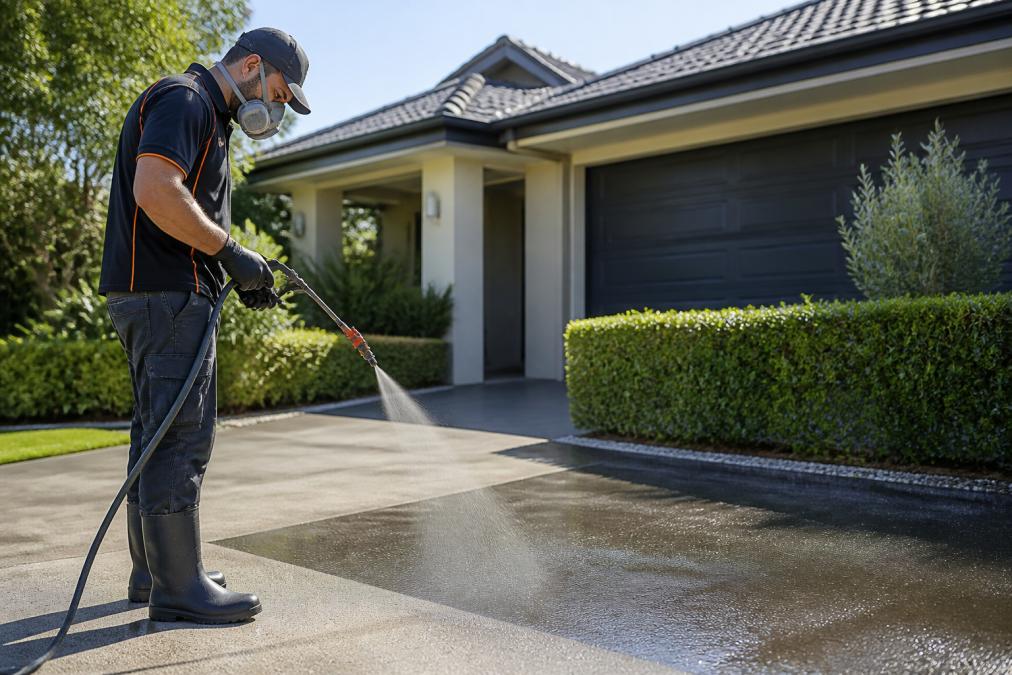
What sets this service apart is the pairing of resurfacing with sealing. If your driveway has cracks, stains, or worn patches, a sealer alone will not fix the surface underneath. Spray Pave Pro addresses the damage first, then applies a protective finish designed for long-term performance.
Pros:
Cons:
Cons:
A sealing-only quote is not the same as a resurfacing quote, and the line items should reflect that. A properly scoped driveway or slab sealing job normally covers:
If a quote lists only "clean and seal" with a single figure, treat it as a starting point rather than a finished scope. The preparation and joint work are where most sealing failures originate, and they are the first items a low quote will quietly drop.
Cons:
Cons:
Cons:
Compare concrete sealing services on four criteria: surface preparation, sealer type, warranty terms, and total resurfacing cost. A cheap quote that skips crack repair or uses a thin acrylic sealer may cost more over five years than a properly prepared job.
Use this checklist when reviewing quotes:
| Provider | Specialisation | Best For | Quote Basis |
|---|---|---|---|
| Spray Pave Pro | Resurfacing and sealing | Cracked, stained driveways and pool surrounds | Free quote |
| PM Industries | Dedicated sealing | Driveways and slabs needing protection only | Free quote after inspection |
| NextGen Concrete Services | Remedial and sealing | Structurally damaged concrete | Custom quote |
| Tuff Cut n Seal | Cutting and sealing | Small residential maintenance | Service-based quote |
| Concrete and Spray Solutions WA | Decorative spraying | Exposed aggregate and coloured concrete | Per square metre |
The best non-slip pool deck coating for wet areas is a textured epoxy or rubberised surface with a verified coefficient of friction rating. Standard smooth sealers become dangerous when wet, which is why pool surrounds need a different specification from driveways.
Rubberised and textured epoxy finishes add grip through surface texture rather than a separate anti-slip treatment that wears off. For pool surrounds, prioritise:
Most pool-deck guides stop at slip ratings and never mention that the surface is sitting in a mild chemical bath for years. Chlorinated water, salt water and pool-balancing chemicals each attack a coating differently, and the wrong sealer will chalk, blister or lift long before its warranty period ends.
A practical test before you commit: ask the provider which sealer chemistry they recommend for your specific pool type, and whether they will warrant the coating against chemical exposure as well as UV. A provider who offers only one product for every pool has not thought about the chemistry.
In full sun, a dark sealed concrete deck can become uncomfortable or unsafe to walk on barefoot, and the difference between coatings is larger than most buyers expect. Colour and finish matter more than the sealer brand.
If cool-underfoot performance matters, the two levers are colour and texture, in that order. A light, textured finish will outperform a dark, smooth one regardless of the sealer chemistry, and no amount of UV additive will fix a black deck in full sun.
Sealed concrete also needs a maintenance schedule to keep performing. Reseal high-traffic areas every two to three years, clean with pH-neutral products rather than harsh acids, and address hairline cracks before they widen. For guidance on surface safety standards, refer to Safe Work Australia's slip and trip prevention guidance.
Rubberised coatings and textured epoxy with non-slip additives offer the best grip when wet. They create a coefficient of friction that meets Australian slip resistance standards, reducing the risk of falls on wet pool surrounds. Spray Pave Pro applies these coatings over existing concrete, so you get a safer surface without full replacement. Regular cleaning and resealing every few years keep the texture effective.
Concrete resurfacing cost depends on the area size, surface condition, and coating type. Most providers quote per square metre after an on-site inspection. Spray Pave Pro offers free quotes and can tailor a solution to your budget. Request a quote to get an accurate figure for your project.
To maintain sealed concrete, sweep or hose it regularly to remove grit, and clean spills promptly with mild detergent. Avoid harsh chemicals that can break down the sealer. Reapply a fresh coat every two to three years, or sooner in high-traffic or coastal areas. Spray Pave Pro can advise on a maintenance schedule suited to your surface and climate.
Professional sealing typically lasts longer and provides better protection than DIY kits. Professionals prepare the surface correctly, use commercial-grade sealers, and apply even coats. While DIY may save money upfront, poor preparation often leads to peeling and early failure. Spray Pave Pro's 23 years of experience and 100% satisfaction guarantee mean you get a durable result.
Choosing the wrong sealing provider costs more than the original quote, because failed coatings mean paying twice. Spray Pave Pro has spent 23 years sealing and resurfacing concrete across Perth, pairing crack repair with durable protective coatings and backing every job with a 100% satisfaction guarantee. Get a free quote from Spray Pave Pro and protect your driveway, patio, or pool surround with a finish built to last.
Last Updated: September 19, 2026
Concrete sealing applies a protective coating that blocks water, UV rays, stains and chemicals from reaching the slab beneath. Perth's long dry summers, intense sunlight and heavy downpours age bare concrete fast.
Sealing slows concrete's two biggest killers: water ingress and surface erosion. Water soaks into porous concrete, expands as it heats, and breaks the surface apart. Sealing blocks that path.
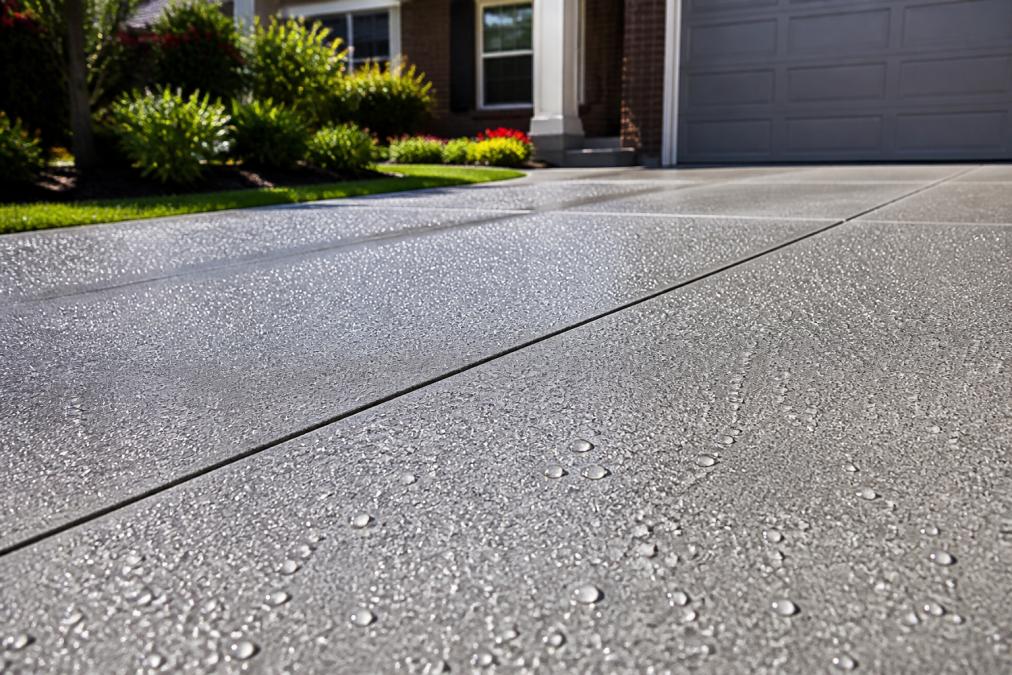
Perth gets more sunny days than almost any capital city in the country, and that sunlight breaks down bare concrete. UV degradation fades colour, chalks the surface and turns the top layer powdery. A sealer with UV blockers acts like sunscreen for your slab.
Bare concrete is porous, so oil, grease, wine and rust soak straight in. Once a stain reaches the substrate, scrubbing will not remove it. A penetrating sealer lines the pores and makes the surface hydrophobic, so spills sit on top.
Sealed concrete needs less work to keep clean: dirt, leaves and grime sit on the surface rather than bonding to it, so a hose-down or quick pressure clean does most of the job.
Wet concrete around pools, paths and patios is a genuine hazard. The right sealer adds a slip-resistant finish with better grip when wet, without making the surface rough.
| Surface area | Slip risk when wet | Best sealer approach |
|---|---|---|
| Pool surrounds | High | Slip-resistant topical sealer |
| Driveways | Medium | Penetrating sealer |
| Patios and paths | Medium | Matte sealer with grip additive |
| Garage floors | Low to medium | Epoxy with anti-slip aggregate |
A sealed, well-kept driveway changes how a home looks from the street: richer colour, an even surface, and a property that reads as well maintained. That first impression counts when selling.
Water is concrete's quietest enemy: it seeps into pores, carries dissolved salts, and causes efflorescence, the white powdery bloom on the surface, plus moisture ingress that weakens the slab over time.
There are two families of concrete sealer, and they work in completely different ways. Picking the wrong one is the most common reason a sealing job fails within a year.
| Feature | Penetrating sealer | Topical sealer |
|---|---|---|
| Chemistry | Silane, siloxane, silicate | Acrylic, polyurethane, epoxy |
| Where it sits | Inside the pores | Film on the surface |
| Look | Natural, matte, slight darkening | Glossy, satin or coloured |
| Breathability | High, moisture escapes | Low, can trap moisture |
| UV behaviour | Stable, does not chalk | Acrylics can yellow and chalk |
| Wear pattern | Wears evenly, no peeling | Scuffs, scratches, peels at edges |
| Salt-air performance | Excellent | Varies; cheap acrylics fail fast |
| Best for | Driveways, paths, exposed aggregate | Decorative patios, garage floors, showpiece areas |
| Maintenance | Reapply when water stops beading | Clean regularly; strip and recoat when worn |
You can seal concrete yourself, but the result depends almost entirely on surface preparation. Most failed DIY jobs skip cleaning and repair, and the sealer peels or fails within a year.
Safe Work Australia guidance on outdoor surface safety
Cost per square metre is the first thing most homeowners want to know, and the number most articles dodge. The honest answer is a range, driven by four things: surface area, condition, sealer type and access.
As a general guide, most residential sealing work falls into these bands per square metre:
| Job type | Typical band (per m²) | Notes |
|---|---|---|
| Reseal over sound, previously sealed concrete | Lowest band | Minimal prep, single coat |
| First seal on clean, sound bare concrete | Mid band | Pressure clean, dry, one or two coats |
| First seal with crack repair and stain treatment | Upper-mid band | Prep dominates the cost |
| Decorative or coloured finish with topical sealer | Upper band | Film-forming product, more care required |
| Epoxy garage coating system | Separate bracket | Not a sealer; includes grinding and multi-coat build |
When you get quotes, ask each provider to break the price into four parts: preparation, repairs, product (brand and type), and number of coats. A dramatically cheaper quote almost always means less prep, a thinner product or a single coat, the job that fails first.
Also ask:
A failed seal is more expensive than a correct one. If a cheap job peels within a year, you pay for stripping, surface repair and a second application, often more than the original professional quote. That is the real cost comparison.
Master Builders Australia guide to home improvement work
How long a concrete sealer lasts depends on the type, surface and local climate. Penetrating sealers generally last longer between coats than topical film-forming sealers, which wear and peel.
Several factors shorten the lifespan of any sealer:
CSIRO research on building materials and durability
The seven benefits stack up: longer life, UV protection, stain resistance, easier cleaning, better safety, stronger curb appeal and a moisture barrier. Together they turn a tired slab into a surface that looks good and lasts.
Resealing frequency depends on the sealer type and how much traffic the surface gets. Penetrating sealers typically need reapplying every 3 to 5 years, while topical sealers may need refreshing every 1 to 2 years. High-traffic driveways and pool surrounds wear faster, so check the surface annually for dullness, water absorption or colour fade. A simple water test, where you splash water on the concrete and see if it soaks in rather than beading, tells you when it is time to reseal.
Sealing does not stop structural cracking caused by ground movement or tree roots, but it does protect against surface-level cracking and spalling. By forming a moisture barrier, a sealer stops water from soaking into the concrete and expanding during temperature changes, which is a common cause of surface deterioration. For existing cracks, a professional resurfacing service can fill and repair them before sealing so the finished surface is smooth and protected.
Yes, sealing old concrete is often worth it, especially if the surface is structurally sound but looks tired or stained. Sealing locks in the existing surface, prevents further UV degradation and makes cleaning easier. It also improves slip resistance when the right product is used. If the concrete has deep cracks or major spalling, resurfacing before sealing delivers a better long-term result. Speak to a specialist to assess whether sealing alone will meet your needs.
You can seal concrete yourself if the surface is clean, dry and in good condition, and you use a quality product suited to the job. However, professional concrete sealing delivers more consistent coverage, better surface preparation and access to commercial-grade sealers that last longer. Professionals also know how to handle moisture issues, apply the right number of coats and avoid common mistakes like trapping moisture under the sealer. For driveways with stains, cracks or high-traffic use, hiring a professional is usually the more cost-effective choice.
Last Updated: September 15, 2026
The difference between concrete sealing and coating comes down to where the product sits: a sealer works inside the concrete, while a coating sits on top of it. Spray Pave Pro has spent 23 years resurfacing driveways, patios and pool surrounds, and this is the question we hear most often. Getting it wrong costs money twice: once for the product that fails, and again to strip it off.
Concrete sealing applies a protective material that penetrates the concrete's pores or forms a thin surface film to repel water, stains and chloride ingress. A concrete coating is a thicker, film-forming layer, typically epoxy, polyurethane or polyaspartic, that bonds to the surface and becomes the new wearing surface. One protects the slab you have; the other replaces its appearance entirely.
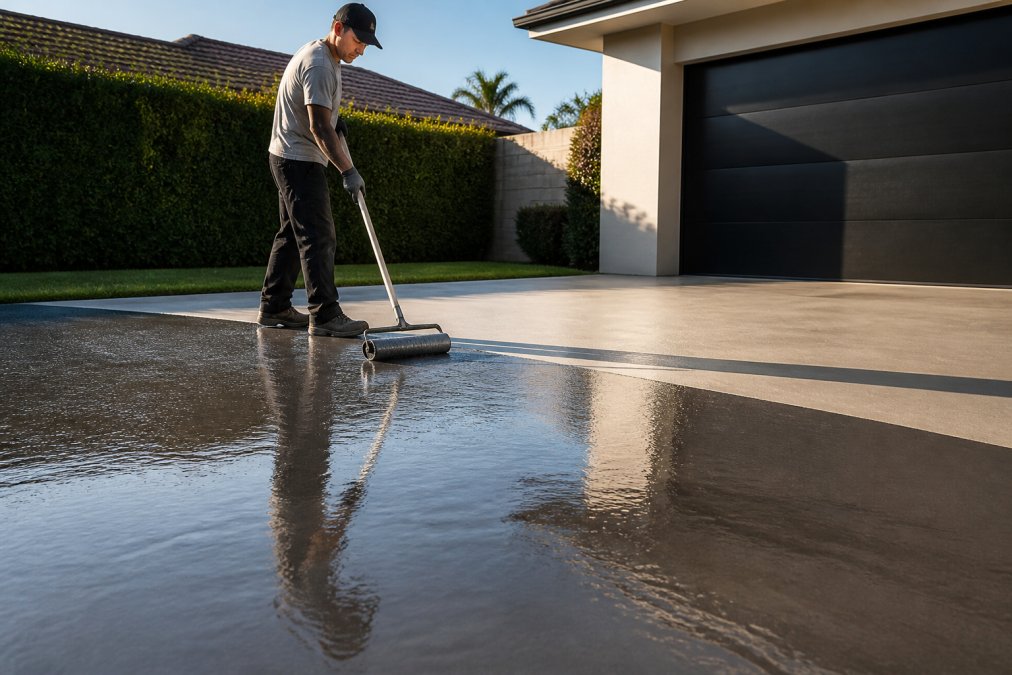
A concrete sealer slows moisture, salt and stain penetration without changing the slab's texture. Penetrating sealers soak into the pores and react chemically within them; topical sealers leave a thin film on top. A penetrating sealer leaves no gloss and cannot peel. A topical acrylic or solvent-based sealer gives a low sheen and is easier to recoat, but wears in high-traffic areas and needs reapplying every few years.
A concrete coating is a resin-based layer that bonds to the substrate and becomes the visible, load-bearing surface. Epoxy, polyurethane and polyaspartic systems are common, applied at several times the thickness of a sealer. Coatings hide imperfections, deliver a decorative finish and resist chemicals and abrasion far better than any sealer. The trade-off: a coating depends entirely on bond strength, so a damp or poorly prepared slab makes it delaminate and lift in sheets.
Penetrating products absorb into the concrete pores and react with free lime, blocking moisture vapour transmission from within. Film-forming products, whether a topical sealer or a full coating, create a membrane across the surface. That distinction drives everything else: a penetrating sealer cannot peel, but will not hide a crack or give a gloss finish. A film-forming coating delivers aesthetic appeal and chemical resistance, but only as long as the bond holds.
| Feature | Penetrating Sealer | Topical Sealer | Epoxy / Polyaspartic Coating |
|---|---|---|---|
| Where it sits | Inside the pores | Thin film on top | Thick bonded layer |
| Typical lifespan | 5-10 years | 1-3 years | 5-15 years |
| Appearance | Natural, no gloss | Low sheen | Gloss, colour, flake |
| Slip resistance | Unchanged | Can become slick | Additive required |
| Best for | Driveways, pavers | Light foot traffic | Garages, commercial floors |
Lifespan figures are quoted as if they were properties of the product. They are not. They are outcomes of four variables: product chemistry, slab preparation, surface exposure and maintenance.
Chemistry. A penetrating silane or siloxane sealer reacts within the pores and is consumed slowly by UV and water cycling; it has nothing on the surface to abrade away. A topical acrylic sealer is a thin film that wears under traffic and chalks under UV. Epoxy is hard and chemically resistant but degrades under UV, making it an indoor product in most specifications. Polyaspartic and polyurethane coatings resist UV yellowing and tolerate cold application, which is why they dominate outdoor coating work.
Preparation. This is the single largest variable. A coating applied to a diamond-ground slab with an open profile will outlast an identical coating over a damp, contaminated or previously sealed surface by years, not months. A sealer applied to a dirty slab will bead water for one season and then stop.
Exposure. Hot tyre pick-up is the classic coating killer on driveways: warm rubber grabs a softening epoxy or polyaspartic topcoat and lifts it. De-icing salt, pool chlorine and constant moisture accelerate the breakdown of any film-forming product. Full sun breaks down epoxy and cheap acrylics.
Maintenance. A coating cleaned with a pH-neutral product will outlast one cleaned with aggressive degreasers. A sealer reapplied on schedule never reaches failure; one left until water stops beading is already failing.
| Product | Typical lifespan | Main failure mode |
|---|---|---|
| Penetrating silane/siloxane sealer | 5-10 years | Gradual loss of water repellency |
| Topical acrylic sealer | 1-3 years | Wear, scuffing, UV chalking |
| Epoxy coating (indoor) | 5-15 years | Abrasion, UV yellowing if exposed |
| Polyaspartic / polyurethane coating | 5-15 years | Hot tyre pick-up, impact damage |
Treat these as planning ranges, not guarantees. A north-facing driveway with hot tyres sits at the bottom of the coating range; a shaded, well-drained patio sits at the top of the sealer range.
Most comparison articles treat climate as an afterthought. It is often the deciding factor.
Freeze-thaw cycles. Where a slab repeatedly freezes and thaws, water soaked into the concrete expands as it turns to ice and spalls the surface. A penetrating sealer that blocks liquid water ingress while letting the slab breathe is safer, because it reduces the water available to freeze without trapping vapour. A fully sealed film-forming coating can trap moisture beneath it and blister or delaminate through the freeze-thaw season unless a moisture-tolerant system is specified.
High-UV exposure. In hot, sun-exposed regions, epoxy is the wrong outdoor choice, it chalks and yellows.
| Task | Penetrating sealer | Topical sealer | Epoxy / polyaspartic coating |
|---|---|---|---|
| Routine cleaning | Sweep, occasional hose | Sweep, gentle hose | Sweep, pH-neutral cleaner |
| Reapplication interval | 5-10 years | 1-3 years | Not reapplied; repaired |
| Repair method | Re-spray affected area | Recoat whole slab | Patch and blend, or full regrind |
| Stripping required? | No | Sometimes | Yes, before any recoat |
| Typical failure mode | Gradual water absorption | Wear and scuffing | Delamination, hot tyre pick-up |
Work through these in order:
Sealers penetrate into the concrete pores to block moisture and dust without changing the surface look, while coatings sit on top as a film that adds colour, texture and a protective layer. Sealers are usually cheaper and faster to apply, but coatings offer more design options and better resistance to chemicals and abrasion. The right choice depends on whether you want invisible protection or a decorative, thicker finish.
A penetrating sealer and a film-forming sealer require reapplication at intervals that depend on traffic and exposure. Epoxy or polyaspartic coatings generally last five to ten years or more if the concrete surface preparation is done correctly. Longevity depends on UV exposure, traffic, cleaning products and how well the concrete was prepared before application.
Coatings usually win for pool surrounds because they can be finished with a textured aggregate or grip additive that stays effective when wet. A penetrating sealer does not change the surface profile, so it relies on the concrete's existing texture for slip resistance. For the best low maintenance for non-slip pool surfacing, look for a coating system that includes a UV-stable topcoat and a graded non-slip additive.
No, a coating will not bond properly to a surface that still has sealer on it, and it may peel or delaminate within months. The old sealer must be removed first, often by grinding or chemical stripping, before any coating goes down. This is why concrete surface preparation for coatings is so important, and why it is worth confirming what was previously applied before planning a recoat.
For driveways, workshop floors and commercial entries, a coating generally handles high-traffic areas better because its thicker film resists abrasion, oil and hot tyre pick-up. A sealer is still a good option for low-traffic paths or as a temporary protectant. If the concrete has cracks or surface imperfections, a coating can also hide them, while a sealer will not.
Choosing between sealing and coating is really a question about how you use the surface and how long you want to wait before touching it again. Spray Pave Pro brings 23 years of resurfacing experience, a 100% satisfaction guarantee and a team that prepares properly the first time, which is what separates a finish that lasts from one that lifts. Get a free quote from Spray Pave Pro and find out which system your concrete actually needs.
