
Last Updated: September 24, 2026
Choosing the best low maintenance for non-slip pool surfacing comes down to one trade-off: how much ongoing work you accept for grip, comfort and looks. Spray Pave Pro has spent 23 years resurfacing concrete around pools. Below is a comparison of six options, followed by detail on each.
| Option | Maintenance Level | Slip Resistance | Best For |
|---|---|---|---|
| Spray Pave Pro resurfacing | Low | High, textured | Cracked or stained existing concrete |
| Tanzite Stone Decks | Low | High | Stone-look upgrades |
| Polysplash Rubber | Low | Very high | Families with young children |
| Porcelain Pavers | Very low | High (R-rated) | Long-term value |
| Acrylic Elastomeric Coating | Medium | Medium-high | Budget concrete resurfacing |
| Broom-Finished Concrete | Very low | Medium | New pool builds |
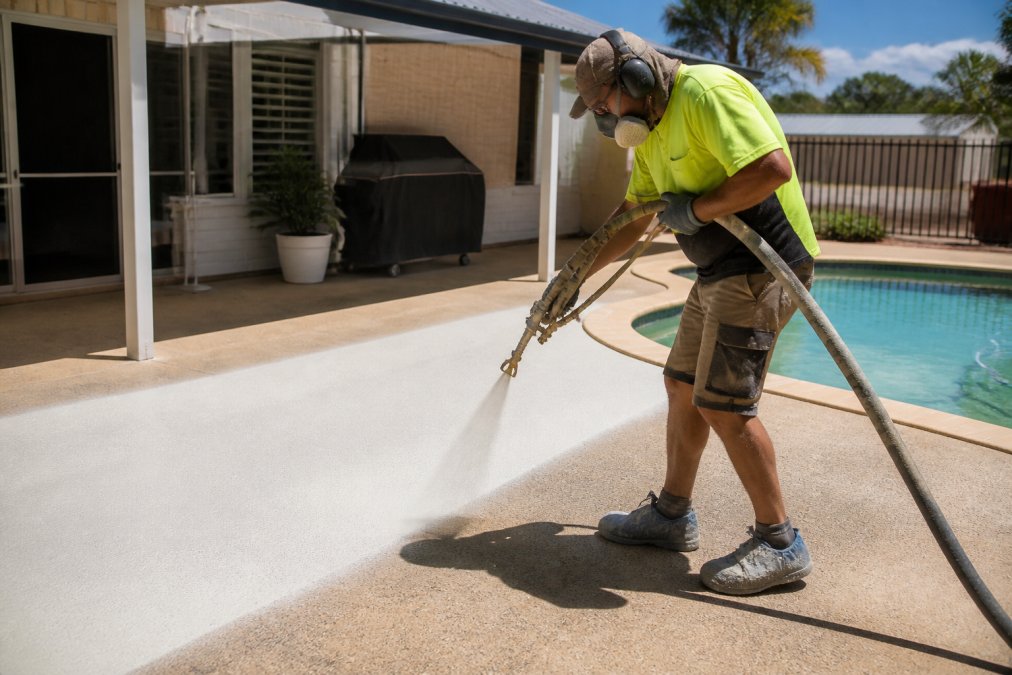
Spray Pave Pro is a concrete resurfacing specialist that transforms worn pool surrounds with spray-on concrete, high-pressure cleaning and professional sealing, backed by 23 years of experience and a 100% satisfaction guarantee.
Tanzite Stone Decks is a composite stone decking system built for pool surrounds. Its engineered stone resists water absorption, and the textured profile provides grip without exposed aggregate's roughness.
Polysplash is a rubberised safety surface for wet areas and the softest option here. Its porous design drains water quickly, and the cushioning reduces impact if someone falls near the pool edge.
Porcelain pavers are high-density, vitrified tiles made for outdoor use and the lowest-maintenance surface here. The non-porous face resists staining and mould and never needs sealing.
Acrylic elastomeric coating is a textured, liquid-applied finish applied straight over existing concrete. It is the most affordable way to resurface a sound slab, and its flexible formula bridges minor cracks.
Broom-finished concrete is created by dragging a stiff broom across the surface while it cures, leaving fine grooves that improve grip. It is the cheapest option upfront and needs almost no maintenance.
Slip resistance for pool surrounds in Australia is governed by two standards. AS 1926.1 sets barrier and safety requirements for swimming pool surrounds, and AS 4586 sets out how slip resistance is classified and tested. If an installer cannot tell you which classification their finished surface achieves under AS 4586, that is a red flag.
AS 4586 recognises two main wet tests for pedestrian surfaces:
| Classification | Test | Typical use around a pool |
|---|---|---|
| R10-R11 | Wet pendulum | Minimum for general wet areas |
| R12-R13 | Wet pendulum | Pool decks, ramps, steps |
| A | Wet barefoot ramp | Pool surrounds, shallow water zones |
| B | Wet barefoot ramp | Pool surrounds, sloping entries |
| C | Wet barefoot ramp | Steep ramps and pool steps |
A product can carry an R-rating and an A/B/C classification at once, they measure different things. For a residential pool deck, look for at least R11 under the wet pendulum test and A or B under the wet barefoot ramp test. Higher ratings mean more grip but also more texture, affecting comfort and cleaning.
Slip ratings apply to the installed surface, not the tin. A coating that tests R12 in a laboratory can drop to R9 once thinned, over-broomed or worn. Two mechanisms cause this:
Slip resistance is not static, it degrades with chemical exposure. Pool surrounds are constantly splashed with chlorinated water, salt water and pH-balancing chemicals, and surfaces respond differently:
AS 4586 slip resistance classification
How to clean non-slip pool surfaces comes down to one rule: never scrub textured finishes with anything abrasive. A stiff brush and mild detergent lift most dirt, and a low-pressure rinse clears the grooves.
Non-slip pool deck coating cost depends on three things: surface area, the existing slab's condition, and the finish you choose. Resurfacing an existing deck costs less than laying new pavers, no demolition, disposal or sub-base work.
Rather than quote a single rate that will not apply to your deck, it helps to understand the order of magnitude. From lowest to highest upfront cost:
Spray Pave Pro provides free quotes, so you can get a figure for your actual deck rather than a generic rate. Ask for the quote to list the finish, the slip classification of the cured surface, and the resealing interval so you can compare the lifetime cost, not just the day-one price.
The best non-slip pool surfacing depends on your priorities. Porcelain pavers offer the lowest maintenance because they are non-porous and resist algae growth. Rubberised surfaces provide the best grip and cushioning for families with children. Acrylic elastomeric coatings are the most affordable way to resurface existing concrete. Each option meets slip resistance standards for pool surrounds when installed correctly by a professional.
Regular cleaning is the main task. Sweep debris weekly and wash the surface with a mild detergent and a stiff brush to prevent algae growth. For textured coatings, a low-pressure hose works better than a high-pressure cleaner, which can damage the surface profile. Resealing frequency depends on the material: acrylic coatings may need recoating every two to three years, while porcelain pavers and rubberised surfaces need no sealing at all.
Acrylic elastomeric coating is typically the most affordable resurfacing option for existing concrete pool decks. It is a liquid-applied product that bridges minor cracks and provides a textured, heat-reflective finish. Broom-finished concrete is cost-effective for new builds but cannot be applied over an existing slab. For a precise non-slip pool deck coating cost for your specific pool surround, request a quote from a resurfacing specialist.
Acrylic elastomeric coatings have heat-reflective properties that keep the surface cooler in direct sun compared with plain concrete or dark stone. Porcelain pavers also stay relatively cool because they do not absorb as much heat. Rubberised surfaces can warm up in full sun but remain comfortable due to their cushioning. Light-coloured finishes consistently perform better than dark tones for heat retention.
Resealing depends on the material. Acrylic elastomeric coatings generally need recoating every two to three years to maintain optimal slip resistance and colour. Concrete sealers may need reapplication annually in high-traffic or chemically exposed areas. Porcelain pavers and rubberised surfacing do not require sealing. Check with your installer for a maintenance schedule specific to your pool surround and local climate.
Last Updated: September 20, 2026
Searching for a concrete painter near me usually means your driveway, patio, or pool surround has faded, cracked, or stained, and you want it fixed without a full replacement. Spray Pave Pro has spent 23 years restoring these surfaces across residential and commercial properties.
Residential and commercial jobs differ more in specification than technique. A home driveway needs a hard-wearing surface that resists tyre scuffing and looks sharp from the street. A retail or industrial floor needs a coating that handles foot traffic, trolleys, and cleaning chemicals without losing its slip rating.
For homes, the usual scope covers:
The real differences sit in four areas most service pages never spell out:
| Specification | Residential | Commercial |
|---|---|---|
| Slip rating | Often P3 for wet outdoor areas | Frequently P4 or P5 for kitchens, ramps, and trolley traffic |
| Cure window | Flexible, can stage across days | Tight, often overnight or weekend shutdowns |
| Chemical exposure | Pool chlorine, sunscreen, general cleaning | Degreasers, sanitising agents, hot water wash-downs |
| Coating system | Acrylic sealer, decorative resurfacing, epoxy | High-build epoxy, polyaspartic, urethane cement in wet processing areas |
Spray Pave Pro handles both residential and commercial work, with quick installation that keeps disruption short. The specification is matched to the surface and the traffic it faces, not a one-size-fits-all product.
Proper cleaning is not a formality. Every coating system, from acrylic sealer to full epoxy, needs a clean, sound substrate to bond to. This stage decides whether the finish lasts three years or fifteen, and it is the stage most DIY attempts and cheap quotes skip.
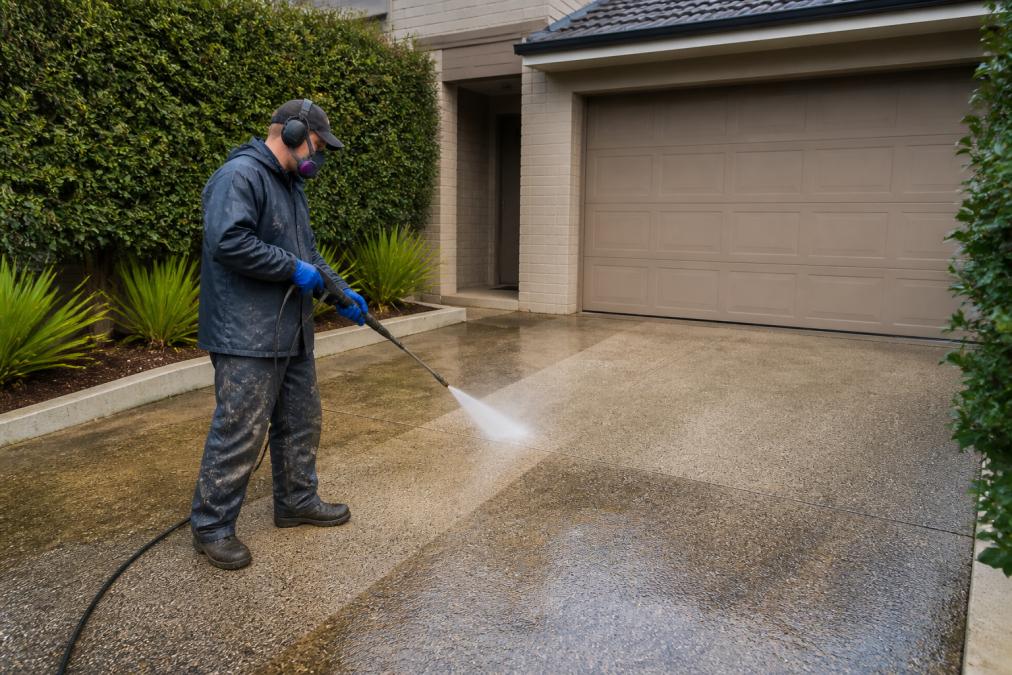
The process starts with pressure cleaning to strip dirt, mould, oil, and old failing coatings. Each contaminant behaves differently:
After cleaning comes concrete repair: filling cracks, patching spalled sections, and grinding back high spots. Concrete etching may open the surface profile so the coating can grip, but grinding or shot blasting is often preferred over acid etching because it produces a more consistent profile and leaves no residue to neutralise.
A common method is the plastic sheet test: plastic taped to the slab for 24 hours, with any condensation underneath indicating moisture vapour rising through the concrete. More accurate readings come from a calibrated moisture meter or calcium chloride test. The result determines whether the slab needs a moisture-tolerant primer, a vapour barrier, or more drying time.
The cleaning routine does not end when the job is done, how you maintain the surface directly affects how long the coating lasts:
Concrete resurfacing cost depends on surface area, slab condition, coating system, and preparation required. There is no flat rate, and any quote given without seeing the site is a guess.
The factors that move a quote most:
| Factor | Why It Matters | Effect on Cost |
|---|---|---|
| Surface area | More square metres, more material and labour | Scales directly |
| Crack and damage repair | Deep cracks need structural patching, not filler | Increases with severity |
| Coating system | Acrylic sealer vs epoxy vs decorative finish | Varies widely |
| Access and drainage | Tight access slows equipment movement | Increases labour time |
| Existing coatings | Old coatings must be stripped first | Adds a preparation stage |
Epoxy flooring installation follows a set sequence, and rushing any stage shortens the coating's life. The process runs across several days, with curing time built in.
The best low maintenance option for non-slip pool surfacing is a textured epoxy or resurfacing system with an integrated slip-resistant aggregate, sealed against moisture. It holds its grip when wet and needs only routine cleaning.
What to look for:
DIY concrete painting looks cheaper on the material receipt. It rarely is once you account for preparation equipment, coating failures, and rework.
Here is the honest comparison:
| Factor | DIY | Professional |
|---|---|---|
| Upfront cost | Lower material cost | Higher, includes labour |
| Equipment | Pressure washer, grinder, applicators | Included |
| Surface preparation | Often underdone | Full prep and repair |
| Coating life | Frequently short | Longer with correct system |
| Rework risk | High if prep is skipped | Low, backed by guarantee |
| Time | Weekends over several weeks | Days |
A correctly applied coating on a well-prepared slab outlasts a cheap coating on a poorly prepared one by a wide margin. Longevity comes from correct specification, proper application, and basic ongoing care.
Keep it simple:
Resurfacing is usually the better choice for driveways and patios with cracks, stains or uneven texture. A concrete painter near me will often recommend a spray-on paving system because it bonds to the existing slab and hides flaws, whereas paint sits on the surface and can peel within a year. Resurfacing also lets you add a slip-resistant coating, which matters around pool areas. If your concrete is structurally sound and only needs a colour refresh, a stain or sealer may be enough, but for long-term durability, resurfacing wins.
A professionally applied coating can last 5 to 10 years or more, depending on the system used and how well it is maintained. Epoxy coatings on garage floors typically last longer than basic acrylic sealers, especially when a protective topcoat is added. The key is surface preparation: if the concrete is properly cleaned, etched and primed, the coating adheres better and resists UV damage. Regular sweeping and occasional re-sealing will extend the life of any coating, particularly in outdoor areas exposed to sun and rain.
No, you should not paint directly over most existing sealers. Paint and epoxy need to bond with the concrete itself, and a sealer creates a barrier that prevents adhesion. If you try to coat over a sealed surface, the new layer will likely peel or flake within months. A professional concrete painter will first test the surface to see if a sealer is present, then remove it using a chemical stripper or mechanical grinding before applying any new coating. Skipping this step is one of the most common reasons DIY coatings fail.
They are strongly recommended for any outdoor concrete that gets wet, especially pool surrounds, driveways and patios. Standard smooth coatings become dangerously slippery when wet, increasing the risk of falls. A slip-resistant coating adds texture that grips even in heavy rain or splashes. Many non-slip systems also include UV resistance to stop fading and a moisture barrier to protect the concrete underneath. If you have children, elderly visitors or a pool, a slip-resistant finish is not optional; it is a safety essential.
Last Updated: September 15, 2026
The difference between concrete sealing and coating comes down to where the product sits: a sealer works inside the concrete, while a coating sits on top of it. Spray Pave Pro has spent 23 years resurfacing driveways, patios and pool surrounds, and this is the question we hear most often. Getting it wrong costs money twice: once for the product that fails, and again to strip it off.
Concrete sealing applies a protective material that penetrates the concrete's pores or forms a thin surface film to repel water, stains and chloride ingress. A concrete coating is a thicker, film-forming layer, typically epoxy, polyurethane or polyaspartic, that bonds to the surface and becomes the new wearing surface. One protects the slab you have; the other replaces its appearance entirely.
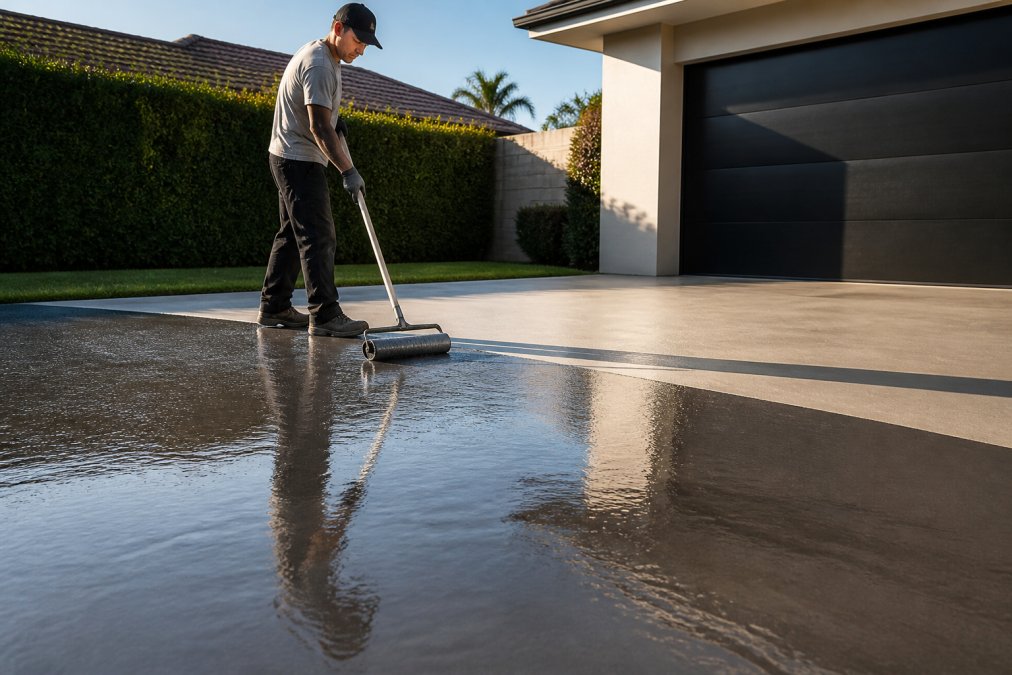
A concrete sealer slows moisture, salt and stain penetration without changing the slab's texture. Penetrating sealers soak into the pores and react chemically within them; topical sealers leave a thin film on top. A penetrating sealer leaves no gloss and cannot peel. A topical acrylic or solvent-based sealer gives a low sheen and is easier to recoat, but wears in high-traffic areas and needs reapplying every few years.
A concrete coating is a resin-based layer that bonds to the substrate and becomes the visible, load-bearing surface. Epoxy, polyurethane and polyaspartic systems are common, applied at several times the thickness of a sealer. Coatings hide imperfections, deliver a decorative finish and resist chemicals and abrasion far better than any sealer. The trade-off: a coating depends entirely on bond strength, so a damp or poorly prepared slab makes it delaminate and lift in sheets.
Penetrating products absorb into the concrete pores and react with free lime, blocking moisture vapour transmission from within. Film-forming products, whether a topical sealer or a full coating, create a membrane across the surface. That distinction drives everything else: a penetrating sealer cannot peel, but will not hide a crack or give a gloss finish. A film-forming coating delivers aesthetic appeal and chemical resistance, but only as long as the bond holds.
| Feature | Penetrating Sealer | Topical Sealer | Epoxy / Polyaspartic Coating |
|---|---|---|---|
| Where it sits | Inside the pores | Thin film on top | Thick bonded layer |
| Typical lifespan | 5-10 years | 1-3 years | 5-15 years |
| Appearance | Natural, no gloss | Low sheen | Gloss, colour, flake |
| Slip resistance | Unchanged | Can become slick | Additive required |
| Best for | Driveways, pavers | Light foot traffic | Garages, commercial floors |
Lifespan figures are quoted as if they were properties of the product. They are not. They are outcomes of four variables: product chemistry, slab preparation, surface exposure and maintenance.
Chemistry. A penetrating silane or siloxane sealer reacts within the pores and is consumed slowly by UV and water cycling; it has nothing on the surface to abrade away. A topical acrylic sealer is a thin film that wears under traffic and chalks under UV. Epoxy is hard and chemically resistant but degrades under UV, making it an indoor product in most specifications. Polyaspartic and polyurethane coatings resist UV yellowing and tolerate cold application, which is why they dominate outdoor coating work.
Preparation. This is the single largest variable. A coating applied to a diamond-ground slab with an open profile will outlast an identical coating over a damp, contaminated or previously sealed surface by years, not months. A sealer applied to a dirty slab will bead water for one season and then stop.
Exposure. Hot tyre pick-up is the classic coating killer on driveways: warm rubber grabs a softening epoxy or polyaspartic topcoat and lifts it. De-icing salt, pool chlorine and constant moisture accelerate the breakdown of any film-forming product. Full sun breaks down epoxy and cheap acrylics.
Maintenance. A coating cleaned with a pH-neutral product will outlast one cleaned with aggressive degreasers. A sealer reapplied on schedule never reaches failure; one left until water stops beading is already failing.
| Product | Typical lifespan | Main failure mode |
|---|---|---|
| Penetrating silane/siloxane sealer | 5-10 years | Gradual loss of water repellency |
| Topical acrylic sealer | 1-3 years | Wear, scuffing, UV chalking |
| Epoxy coating (indoor) | 5-15 years | Abrasion, UV yellowing if exposed |
| Polyaspartic / polyurethane coating | 5-15 years | Hot tyre pick-up, impact damage |
Treat these as planning ranges, not guarantees. A north-facing driveway with hot tyres sits at the bottom of the coating range; a shaded, well-drained patio sits at the top of the sealer range.
Most comparison articles treat climate as an afterthought. It is often the deciding factor.
Freeze-thaw cycles. Where a slab repeatedly freezes and thaws, water soaked into the concrete expands as it turns to ice and spalls the surface. A penetrating sealer that blocks liquid water ingress while letting the slab breathe is safer, because it reduces the water available to freeze without trapping vapour. A fully sealed film-forming coating can trap moisture beneath it and blister or delaminate through the freeze-thaw season unless a moisture-tolerant system is specified.
High-UV exposure. In hot, sun-exposed regions, epoxy is the wrong outdoor choice, it chalks and yellows.
| Task | Penetrating sealer | Topical sealer | Epoxy / polyaspartic coating |
|---|---|---|---|
| Routine cleaning | Sweep, occasional hose | Sweep, gentle hose | Sweep, pH-neutral cleaner |
| Reapplication interval | 5-10 years | 1-3 years | Not reapplied; repaired |
| Repair method | Re-spray affected area | Recoat whole slab | Patch and blend, or full regrind |
| Stripping required? | No | Sometimes | Yes, before any recoat |
| Typical failure mode | Gradual water absorption | Wear and scuffing | Delamination, hot tyre pick-up |
Work through these in order:
Sealers penetrate into the concrete pores to block moisture and dust without changing the surface look, while coatings sit on top as a film that adds colour, texture and a protective layer. Sealers are usually cheaper and faster to apply, but coatings offer more design options and better resistance to chemicals and abrasion. The right choice depends on whether you want invisible protection or a decorative, thicker finish.
A penetrating sealer and a film-forming sealer require reapplication at intervals that depend on traffic and exposure. Epoxy or polyaspartic coatings generally last five to ten years or more if the concrete surface preparation is done correctly. Longevity depends on UV exposure, traffic, cleaning products and how well the concrete was prepared before application.
Coatings usually win for pool surrounds because they can be finished with a textured aggregate or grip additive that stays effective when wet. A penetrating sealer does not change the surface profile, so it relies on the concrete's existing texture for slip resistance. For the best low maintenance for non-slip pool surfacing, look for a coating system that includes a UV-stable topcoat and a graded non-slip additive.
No, a coating will not bond properly to a surface that still has sealer on it, and it may peel or delaminate within months. The old sealer must be removed first, often by grinding or chemical stripping, before any coating goes down. This is why concrete surface preparation for coatings is so important, and why it is worth confirming what was previously applied before planning a recoat.
For driveways, workshop floors and commercial entries, a coating generally handles high-traffic areas better because its thicker film resists abrasion, oil and hot tyre pick-up. A sealer is still a good option for low-traffic paths or as a temporary protectant. If the concrete has cracks or surface imperfections, a coating can also hide them, while a sealer will not.
Choosing between sealing and coating is really a question about how you use the surface and how long you want to wait before touching it again. Spray Pave Pro brings 23 years of resurfacing experience, a 100% satisfaction guarantee and a team that prepares properly the first time, which is what separates a finish that lasts from one that lifts. Get a free quote from Spray Pave Pro and find out which system your concrete actually needs.
