
Last Updated: September 23, 2026
Car park paving is the process of designing, preparing and surfacing a parking area so it carries vehicle loads, drains properly and stays serviceable for years. A commercial project combines subgrade preparation, base course installation, compaction, surfacing, kerbing, drainage and line marking into one scope.
The choice comes down to traffic load, climate exposure and how much maintenance you will tolerate. Bitumen and asphalt are flexible and quick to lay; concrete is rigid, handles heavy duty loads well, and costs more upfront.
| Surface | Best For | Key Weakness |
|---|---|---|
| Asphalt | Fast turnaround, tight budgets | Softens in heat, needs sealing |
| Bituminous | Resurfacing over sound base | Inherits base defects |
| Concrete | Heavy duty, industrial paving | Higher upfront cost, joint maintenance |
A commercial paving installation process follows a fixed sequence, and skipping any stage shows up within a season or two.
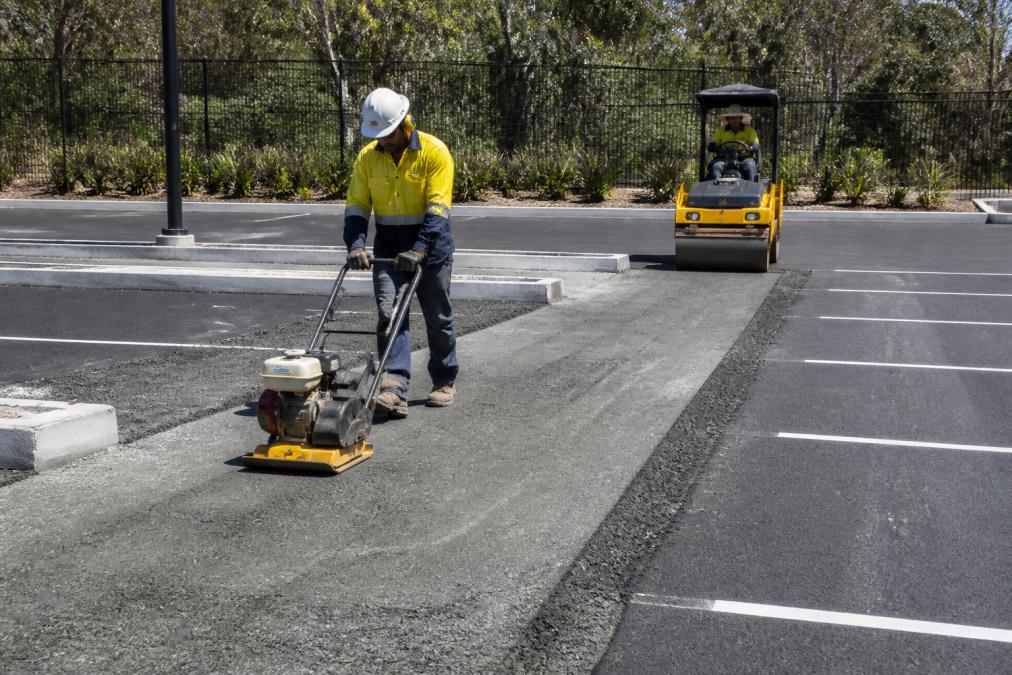
Subgrade is the natural soil beneath the pavement; base course is the engineered aggregate layer on top of it. Compaction turns loose aggregate into a load-bearing structure.
Water is the single biggest cause of premature car park failure. Drainage and kerbing requirements exist to move surface water away from the pavement structure before it saturates the base course.
Key elements include:
Resurfacing is the right call when the base structure is still sound and damage is confined to the surface layer. Rebuilding is the right call when the base has failed. Look at the pattern of the damage.
Durable outdoor floor coatings are surface systems applied over prepared concrete or asphalt to improve wear resistance, slip resistance and appearance. They are not a substitute for structural repair, but they extend service life on sound pavements.
Line marking and signage make a finished car park legal and usable. Getting them wrong creates liability long after the paving crew has left, and it is one of the few parts of a car park project where a defect can be enforced against the owner rather than the contractor.
Off-street car parking in Australia is governed primarily by AS/NZS 2890.1 (off-street car parking) and AS/NZS 2890.6 (off-street parking for people with disabilities). These are the reference documents councils, certifiers and building surveyors use when assessing a car park against its development approval.
Line marking degrades faster than the surface beneath it. In a busy retail or office car park, expect legibility to drop noticeably within two to three years, sooner on entries, exits and loading zones where tyre scuffing is heaviest. Faded accessible bay markings and directional arrows are compliance and liability issues, and cheap to fix compared with the cost of an incident.
Maintenance is where car park owners consistently under-budget. The pattern is predictable: nothing for three years, then a large unplanned repair bill that lands in the same financial year as a roof replacement or an HVAC failure.
These are typical ranges for a well-constructed car park on a sound base, in a temperate climate, with basic maintenance. Poor drainage, heavy vehicle loads or a clay subgrade will pull these numbers down.
| Surface | Typical Service Life | Major Intervention |
|---|---|---|
| Asphalt (sealed) | 15-20 years | Reseal every 3-5 years; resurface at end of life |
| Asphalt (unsealed) | 8-12 years | Oxidation and raveling accelerate without sealing |
| Concrete | 25-30 years | Joint sealing and slab repair; full replacement rarely needed |
| Exposed aggregate / decorative | 15-20 years | Resealing to maintain appearance and slip resistance |
| Permeable pavers | 20-25 years | Periodic cleaning to maintain infiltration |
| Task | Frequency | Purpose |
|---|---|---|
| Inspection and debris clearing | Every 6 months | Catch drainage blockages and early cracking |
| Crack sealing | Annually | Stop water entering the base course |
| Pothole repair | As needed | Prevent edge deterioration spreading |
| Resealing (asphalt) | Every 3-5 years | Restore surface protection and appearance |
| Line marking refresh | Every 2-4 years | Maintain compliance and legibility |
| Joint sealing (concrete) | Every 5-7 years | Prevent water ingress at joints |
| Full-depth repair | As needed | Address localised base failures before they spread |
A practical approach for a commercial car park is to budget for routine maintenance, plus a separate reserve for the major intervention at end of life. For asphalt, that is a mill-and-resurface; for concrete, typically joint rehabilitation and localised slab repair.
For a commercial car park, the cost of the work is only part of the budget. Lost parking, staged closures, relocating tenants or customers, longer travel times, often exceeds the construction cost on a busy site. Scheduling major works during low-demand periods and staging so a portion stays open is usually worth the small premium.
Permeable paving allows water to pass through the surface into the sub-base rather than running off. For car parks, it reduces stormwater load, lowers ponding risk and can help projects meet sustainability requirements in planning approvals.
Options worth considering:
Pricing for car park paving depends on the surface type, site access, subgrade condition and total area, so it varies from project to project. Asphalt, bitumen and concrete each carry different material and labour costs, and resurfacing an existing slab is usually cheaper than a full rebuild. Request a site assessment and itemised quote rather than relying on a generic per-square-metre figure.
Asphalt car parks typically need resurfacing within 15 to 20 years, while well-constructed concrete pavements can last 30 years or more with proper maintenance. Lifespan depends heavily on base course preparation, drainage, traffic loads and how quickly cracks and potholes are repaired. Regular crack sealing and seal coating extend the interval between major works considerably.
In many cases, yes. If the subgrade and base course are structurally sound and damage is limited to surface cracking, staining or minor potholes, commercial concrete resurfacing restores the pavement at a fraction of rebuild cost. A site assessment confirms whether the slab can carry the intended traffic load or whether sections need full-depth repair first.
Car park projects must satisfy AS 2890 for parking facilities and AS 3600 for concrete structures, along with local council and state drainage requirements covering stormwater discharge and runoff. Line marking, bay dimensions and accessible parking spaces must comply before the car park is signed off for use.
