
Last Updated: September 20, 2026
Searching for a concrete painter near me usually means your driveway, patio, or pool surround has faded, cracked, or stained, and you want it fixed without a full replacement. Spray Pave Pro has spent 23 years restoring these surfaces across residential and commercial properties.
Residential and commercial jobs differ more in specification than technique. A home driveway needs a hard-wearing surface that resists tyre scuffing and looks sharp from the street. A retail or industrial floor needs a coating that handles foot traffic, trolleys, and cleaning chemicals without losing its slip rating.
For homes, the usual scope covers:
The real differences sit in four areas most service pages never spell out:
| Specification | Residential | Commercial |
|---|---|---|
| Slip rating | Often P3 for wet outdoor areas | Frequently P4 or P5 for kitchens, ramps, and trolley traffic |
| Cure window | Flexible, can stage across days | Tight, often overnight or weekend shutdowns |
| Chemical exposure | Pool chlorine, sunscreen, general cleaning | Degreasers, sanitising agents, hot water wash-downs |
| Coating system | Acrylic sealer, decorative resurfacing, epoxy | High-build epoxy, polyaspartic, urethane cement in wet processing areas |
Spray Pave Pro handles both residential and commercial work, with quick installation that keeps disruption short. The specification is matched to the surface and the traffic it faces, not a one-size-fits-all product.
Proper cleaning is not a formality. Every coating system, from acrylic sealer to full epoxy, needs a clean, sound substrate to bond to. This stage decides whether the finish lasts three years or fifteen, and it is the stage most DIY attempts and cheap quotes skip.
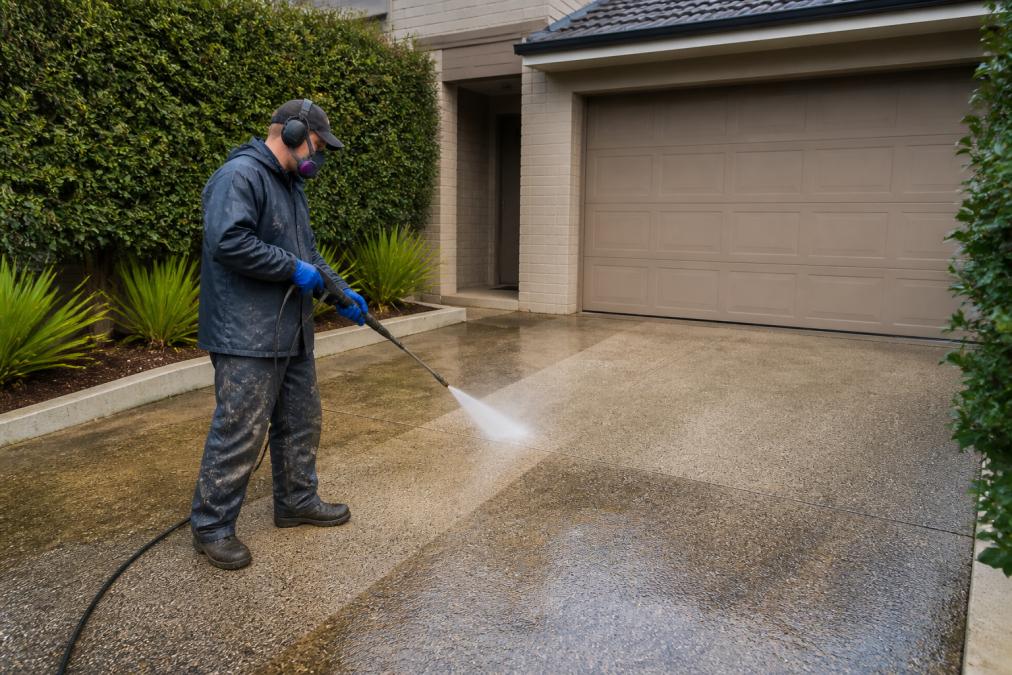
The process starts with pressure cleaning to strip dirt, mould, oil, and old failing coatings. Each contaminant behaves differently:
After cleaning comes concrete repair: filling cracks, patching spalled sections, and grinding back high spots. Concrete etching may open the surface profile so the coating can grip, but grinding or shot blasting is often preferred over acid etching because it produces a more consistent profile and leaves no residue to neutralise.
A common method is the plastic sheet test: plastic taped to the slab for 24 hours, with any condensation underneath indicating moisture vapour rising through the concrete. More accurate readings come from a calibrated moisture meter or calcium chloride test. The result determines whether the slab needs a moisture-tolerant primer, a vapour barrier, or more drying time.
The cleaning routine does not end when the job is done, how you maintain the surface directly affects how long the coating lasts:
Concrete resurfacing cost depends on surface area, slab condition, coating system, and preparation required. There is no flat rate, and any quote given without seeing the site is a guess.
The factors that move a quote most:
| Factor | Why It Matters | Effect on Cost |
|---|---|---|
| Surface area | More square metres, more material and labour | Scales directly |
| Crack and damage repair | Deep cracks need structural patching, not filler | Increases with severity |
| Coating system | Acrylic sealer vs epoxy vs decorative finish | Varies widely |
| Access and drainage | Tight access slows equipment movement | Increases labour time |
| Existing coatings | Old coatings must be stripped first | Adds a preparation stage |
Epoxy flooring installation follows a set sequence, and rushing any stage shortens the coating's life. The process runs across several days, with curing time built in.
The best low maintenance option for non-slip pool surfacing is a textured epoxy or resurfacing system with an integrated slip-resistant aggregate, sealed against moisture. It holds its grip when wet and needs only routine cleaning.
What to look for:
DIY concrete painting looks cheaper on the material receipt. It rarely is once you account for preparation equipment, coating failures, and rework.
Here is the honest comparison:
| Factor | DIY | Professional |
|---|---|---|
| Upfront cost | Lower material cost | Higher, includes labour |
| Equipment | Pressure washer, grinder, applicators | Included |
| Surface preparation | Often underdone | Full prep and repair |
| Coating life | Frequently short | Longer with correct system |
| Rework risk | High if prep is skipped | Low, backed by guarantee |
| Time | Weekends over several weeks | Days |
A correctly applied coating on a well-prepared slab outlasts a cheap coating on a poorly prepared one by a wide margin. Longevity comes from correct specification, proper application, and basic ongoing care.
Keep it simple:
Resurfacing is usually the better choice for driveways and patios with cracks, stains or uneven texture. A concrete painter near me will often recommend a spray-on paving system because it bonds to the existing slab and hides flaws, whereas paint sits on the surface and can peel within a year. Resurfacing also lets you add a slip-resistant coating, which matters around pool areas. If your concrete is structurally sound and only needs a colour refresh, a stain or sealer may be enough, but for long-term durability, resurfacing wins.
A professionally applied coating can last 5 to 10 years or more, depending on the system used and how well it is maintained. Epoxy coatings on garage floors typically last longer than basic acrylic sealers, especially when a protective topcoat is added. The key is surface preparation: if the concrete is properly cleaned, etched and primed, the coating adheres better and resists UV damage. Regular sweeping and occasional re-sealing will extend the life of any coating, particularly in outdoor areas exposed to sun and rain.
No, you should not paint directly over most existing sealers. Paint and epoxy need to bond with the concrete itself, and a sealer creates a barrier that prevents adhesion. If you try to coat over a sealed surface, the new layer will likely peel or flake within months. A professional concrete painter will first test the surface to see if a sealer is present, then remove it using a chemical stripper or mechanical grinding before applying any new coating. Skipping this step is one of the most common reasons DIY coatings fail.
They are strongly recommended for any outdoor concrete that gets wet, especially pool surrounds, driveways and patios. Standard smooth coatings become dangerously slippery when wet, increasing the risk of falls. A slip-resistant coating adds texture that grips even in heavy rain or splashes. Many non-slip systems also include UV resistance to stop fading and a moisture barrier to protect the concrete underneath. If you have children, elderly visitors or a pool, a slip-resistant finish is not optional; it is a safety essential.
