
Last Updated: October 8, 2026
The cost of concrete resurfacing per square metre depends on the finish, surface condition, and site access.
Concrete resurfacing is the process of applying a thin decorative or protective overlay to existing concrete rather than removing and replacing it.
That definition matters because it explains the pricing. You're paying for preparation, product, and labour, not for a new slab. Here's how each component moves the number.
Material costs cover the resurfacing compound, colour pigments, and sealer. Basic spray-on finishes sit at the lower end; decorative stencil or patterned finishes push material costs higher because they need more product and more careful application.
Labour is usually the bigger line item. A straightforward spray-on overlay over a clean, sound slab takes less time than a stencilled finish with borders and colour work.
Preparation is where quotes diverge most. A surface that's dirty, flaking, or contaminated needs high-pressure cleaning and possibly grinding before resurfacing. Skip that step and the overlay fails early, which is why we never quote a job without seeing the slab first.
Access matters too. A driveway with clear vehicle access lets equipment and materials move in quickly. A enclosed courtyard or a pool surround hemmed in by landscaping slows the crew down and adds labour hours.
Finish selection is the most controllable cost variable. A basic finish keeps the per-square-metre rate low. Upgrades like stencil patterns, multiple colours, or a high-build sealer add cost but extend the surface's working life.
Small jobs also attract a minimum job charge. A 15 m² patio still needs the same setup, cleaning, and pack-down as a 100 m² driveway, so the per-square-metre rate on small areas often looks higher.
Driveway resurfacing is the most common residential project we quote, and driveway pricing swings widely because driveways vary so much in size, slope, and condition. A large, flat, sound driveway with good access sits at the lower end of the range.
To make a driveway quote directly comparable, it helps to see what a per-square-metre rate actually contains. A typical resurfacing quote bundles six cost lines:
When you ask for a quote, ask the contractor to separate these lines. A rate that looks cheap usually means one or more of them has been left out.
Indicative totals below assume a sound slab, straightforward access, and a single-colour spray-on finish. They are starting points for a conversation, not fixed prices, condition and access can move them either way.
| Driveway size | Typical area | Indicative total (single-colour spray finish) | What to watch |
|---|---|---|---|
| Small | 30-40 m² | Lower end of the per-square-metre range, but the minimum call-out lifts the effective rate | Fixed setup cost dominates |
| Medium | 60-80 m² | Mid-range, with economies of scale starting to show | Preparation and crack repair are the swing factors |
| Large | 100-150 m² | Best per-square-metre value, because fixed costs are spread further | Access and drainage become the main variables |
Two patterns are worth noting. First, the effective per-square-metre rate falls as area rises, because mobilisation and setup are spread across more square metres. Second, a small driveway can carry a higher effective rate than a large one even when the finish is identical, that is the minimum call-out at work, not a markup.
Driveway resurfacing versus replacement is the real decision here. Replacement means breaking out the old slab, disposing of it, and pouring new concrete, which costs substantially more and disrupts the property for far longer. Resurfacing only makes sense when the slab underneath is sound, which is why a site inspection matters more than any online rate.
Patio resurfacing runs on different economics than driveways. Patios are usually smaller, so the minimum job charge and fixed setup costs weigh more heavily on the per-square-metre rate. The trade-off is that patios often need more finish work per square metre, borders, edges around pool fencing, and colour transitions all add labour.
Indicative totals below assume a sound slab, reasonable access, and a single-colour spray finish. Decorative finishes, pool surrounds, and confined courtyards sit higher.
| Patio size | Typical area | Indicative total (single-colour spray finish) | What to watch |
|---|---|---|---|
| Small courtyard | 10-20 m² | Minimum call-out dominates; effective rate is at its highest | Fixed setup cost is the main driver |
| Standard patio | 25-40 m² | Mid-range, with finish detail the swing factor | Edges, borders, and colour transitions |
| Large entertaining area | 50-80 m² | Better per-square-metre value, but more edge work | Drainage and slip resistance |
A 15 m² patio and a 100 m² driveway can carry similar totals even though the driveway is several times larger. That is not a pricing anomaly, it is the fixed cost of getting a crew on site, cleaning the slab, and packing down, spread across far fewer square metres.
Resurfacing is a surface treatment, not a structural fix. It is unsuitable when:
In those cases, replacement is the honest recommendation even though it costs more and takes longer. Covering a failing slab just delays the inevitable, and the overlay typically cracks within a season or two.
A properly applied patio resurfacing system on a sound slab lasts many years, and the sealer coat is what determines whether you get the short end or the long end of that range. Maintenance is minimal: clean the surface regularly, avoid harsh chemical cleaners that degrade the sealer, and reseal on the schedule your contractor recommends. For pool surrounds and other wet areas, expect to reseal more often than a sheltered patio.
| Project Type | Typical Size Range | Main Cost Driver | Key Consideration |
|---|---|---|---|
| Driveway | Large surface area | Condition and access | Resurface vs replace decision |
| Patio | Smaller surface area | Finish detail and edges | Slip resistance for wet areas |
| Pool surround | Small, wet area | Sealer specification | Ongoing moisture exposure |
Resurfacing usually makes financial sense when the existing slab is structurally sound.
Replacement becomes the better call when the slab itself has failed. Significant subsidence, widespread structural cracking, or drainage problems that start below the surface won't be fixed by an overlay.
The practical test is simple: if a contractor can walk the surface, tap for hollow spots, and confirm the slab is sound, resurfacing is viable.
A properly applied resurfacing system on a sound slab typically lasts many years, and the sealer coat is what determines whether you get the short end or the long end of that range.
Lifecycle value is where resurfacing wins clearly. Replacement resets the clock but at a much higher upfront cost and with major disruption.
Maintenance is minimal: clean the surface regularly, avoid harsh chemical cleaners that degrade the sealer, and reseal on the schedule your contractor recommends.
Comparing quotes properly means comparing scope, not just the bottom-line figure. Two quotes with the same total can cover very different work, and the cheaper one often excludes preparation that the job genuinely needs.
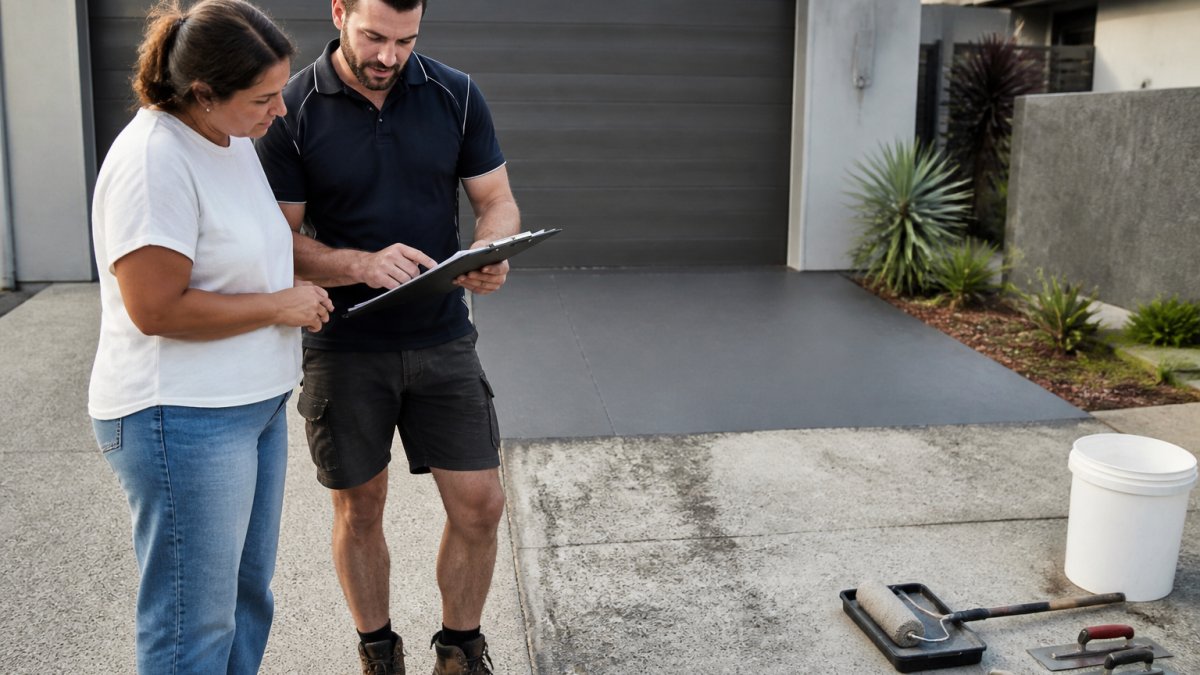
Ask every contractor the same questions and check the answers line by line:
A quote that's silent on preparation is not a cheaper quote; it's an incomplete one.
The cost of concrete resurfacing per square metre depends on surface area, existing concrete condition, preparation requirements, and finish selection. A basic spray-on finish costs less than decorative options such as stencil or patterned finishes. Larger areas often attract a lower per m² rate because setup and minimum job charges are spread across more square metres. For a price estimate tailored to your driveway or patio, request a free quote from Spray Pave Pro.
Key cost factors include the total surface area in square metres, the condition of the existing concrete, crack repair and surface preparation requirements, access and site conditions, and your choice of decorative finish, colour, and sealer. A surface with deep cracks or previous failed coatings needs more preparation, which adds labour and material costs. Minimum job charges also apply to smaller residential projects.
Concrete resurfacing typically costs less than full replacement because the existing slab stays in place. Replacement involves demolition, removal, disposal, and pouring a new slab, all of which add to the total cost. Resurfacing suits structurally sound concrete with surface-level damage such as cracks, stains, or worn finishes. If the slab has major structural faults, replacement may be the more sensible option. A site assessment confirms which path suits your concrete.
Concrete resurfacing lifespan depends on the resurfacing compound used, surface preparation quality, and ongoing maintenance. A properly prepared and sealed overlay on sound concrete can last many years. Regular cleaning and periodic resealing extend the life of the finish. Poor preparation or resurfacing over a failing slab shortens the lifespan considerably, which is why condition-dependent pricing and correct preparation matter.
Concrete resurfacing restores the look of a worn driveway or patio at a lower cost than replacement, and it improves slip resistance when the right finish and sealer are used. For homeowners preparing to sell, a resurfaced driveway can improve curb appeal. For commercial premises, a durable overlay reduces long-term maintenance. Whether it is worth it depends on the condition of your existing concrete and how long you plan to stay.
Yes, cracked concrete can often be resurfaced, provided the cracks are repaired and the slab is structurally sound. The process involves cleaning the surface, filling and treating cracks, then applying the resurfacing compound. Deep or moving cracks need proper repair before the overlay goes down, otherwise the crack can reflect through the new finish. A contractor assesses crack type and slab condition before quoting.
Concrete resurfacing turns a tired driveway or patio into a surface that lifts curb appeal and holds up to daily use, without the cost and disruption of replacement. If you're weighing up a project, Spray Pave Pro brings 23 years of experience, high-pressure cleaning, spray-on concrete, epoxy flooring, and professional sealing to every job. Get a free quote from Spray Pave Pro and see exactly what your surface needs.
