
Last Updated: October 2, 2026
If you're searching for an epoxy flooring cost per square meter review, no single figure applies to every job. Epoxy flooring cost depends on substrate condition, coating thickness, surface preparation, and whether you choose a DIY kit or professional application. This review breaks down each cost driver so you can judge quotes on substance, not just the bottom line.
Epoxy flooring is a resin-based coating applied over prepared concrete to create a hard, seamless, chemical-resistant surface. It bonds mechanically to the substrate, which is why surface preparation matters more than the coating itself.
A contractor's rate per square metre bundles several separate jobs. Strip it apart to compare quotes properly:
Two quotes for the same garage can differ by thousands and both be internally consistent. The usual reasons:
Consider two identical garages. The first is a sound, dry, indoor slab with light oil staining. The second has hairline cracks, a history of damp and old flaking paint.
Comparing quotes on the headline rate alone is misleading. Compare scope: what preparation is included, what thickness is specified, what warranty is offered, and what happens if moisture is found mid-job.
A coating that peels within two years because preparation was skipped doesn't save money, it costs the original job plus removal plus a second application. Compare cost per year of service, not cost per square metre on the invoice.
Concrete sealing and epoxy coating solve different problems. A penetrating sealer soaks into the concrete's pores to block moisture and stains, leaving the surface largely unchanged. Epoxy forms a film on top, adding colour, gloss and impact resistance.
| Factor | Penetrating Sealer | Epoxy Coating |
|---|---|---|
| Bond type | Chemical (inside pores) | Mechanical (surface bond) |
| Appearance | Natural concrete look | Coloured, gloss or matte finish |
| Best for | Driveways, patios, exposed aggregate | Garages, workshops, commercial floors |
| Recoating | Reapply every few years | Full recoat when worn |
| Stain protection | Good against water and salts | Excellent against oil and chemicals |
A topical sealant wears away under abrasion and UV, so recoating becomes routine. Epoxy resists abrasion and impact far better because the resin cures hard. The trade-off: epoxy needs a sound, dry substrate and can delaminate if moisture vapour transmission isn't addressed first.
Epoxy pulls ahead decisively here. Oil stains, petrol drips and most household chemicals wipe off a cured epoxy surface. A penetrating sealer slows staining but doesn't stop oil soaking into concrete porosity over time. For garages and workshops, that difference alone often justifies the higher upfront cost.
Concrete surface preparation requirements are where most coating failures begin. Epoxy needs a clean, profiled, dry substrate to form a mechanical bond.
The main preparation methods are:
A concrete densifier can harden soft, dusty surfaces before coating. Skipping moisture testing is the most common mistake on failed jobs: a floor that looks dry can still push vapour through and blister a coating from underneath.
The epoxy flooring installation process typically runs two to four days for a residential garage, including preparation and curing. The coating goes down fast; preparation and curing take longest.
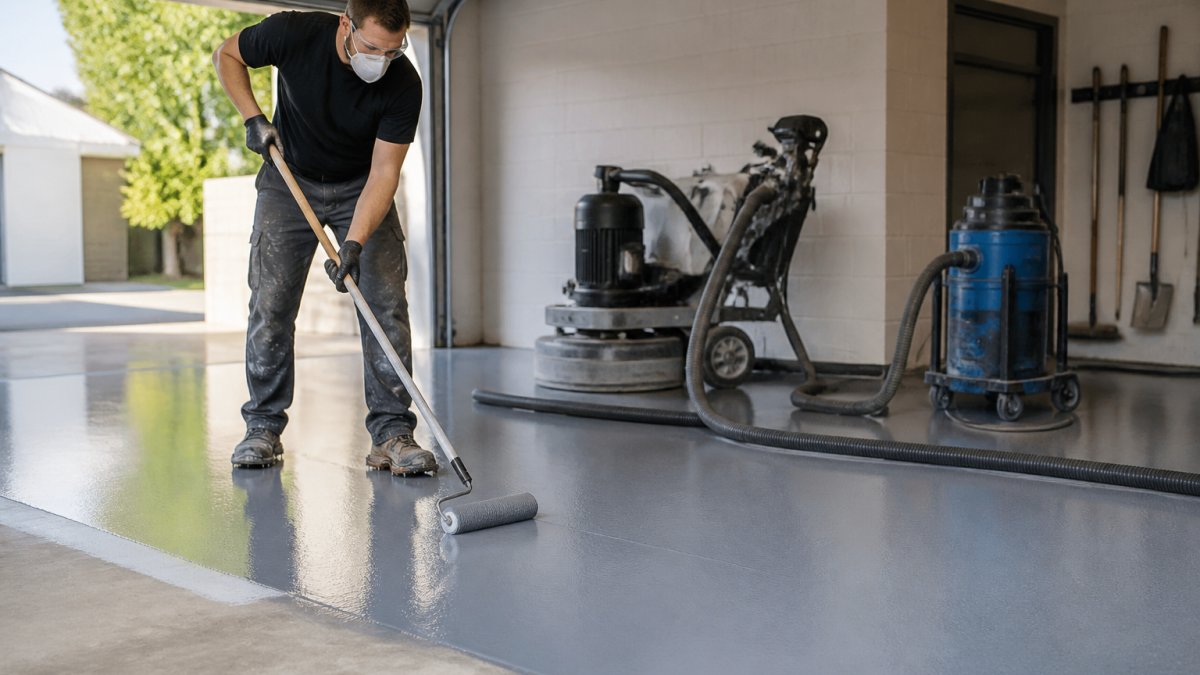
A typical sequence looks like this:
Most homeowners can walk on the floor within 24 hours and park on it after several days, depending on temperature and humidity. Cooler weather extends curing.
The DIY epoxy kit versus professional application decision comes down to how much prep you can genuinely do yourself. A kit saves on labour, but surface preparation determines whether the coating survives.
| Factor | DIY Epoxy Kit | Professional Application |
|---|---|---|
| Material cost | Lower per square metre | Included in quote |
| Labour | Your own time | Trained applicators |
| Surface prep | Often limited to etching | Diamond grinding and testing |
| Finish consistency | Variable | Uniform |
| Warranty | None | Workmanship guarantee |
For a small, sound, indoor slab, a DIY kit can work well. For cracked, oil-stained, or moisture-affected concrete, professional preparation is not optional. Spray Pave Pro handles the full process, from high-pressure cleaning and crack repair through to the final coat, backed by more than 23 years of resurfacing experience and a 100% satisfaction guarantee.
Most guides treat maintenance, repair and climate as afterthoughts. In practice these three factors decide whether a coating still performs in year eight, and they're where epoxy and penetrating sealers diverge most sharply.
Epoxy floors clean easily with a pH-neutral cleaner and a mop. Abrasion resistance holds up in high-traffic areas, and surface hardness resists hot tyre pickup better than most alternatives. Avoid acidic cleaners, which dull the finish, and abrasive pads on gloss surfaces.
A penetrating sealer is lower-effort day to day but is a consumable: it wears out of the pores and needs periodic reapplication to keep repelling water and salts.
Repairability is a genuine weak point for epoxy, and the mechanism matters more than the verdict.
The practical rule: epoxy rewards you with a harder, longer-lasting surface but punishes localised damage with visible repairs. Sealer is easier to touch up but needs touching up more often.
Climate affects epoxy and sealers differently, and the failure modes are not the same.
UV exposure. Intense sun yellows standard epoxy over time.
Moisture vapour transmission. This is the single biggest climate-related risk for epoxy.
Temperature swings and freeze-thaw. Where freeze-thaw cycles are regular, water trapped in surface pores expands as it freezes, cracking concrete and lifting coatings at the edges.
A lightly used residential garage and a workshop taking daily chemical spills and rolling loads need different systems. Climate matters too: a humid coastal slab and a frost-prone inland slab present different risks. The right question isn't 'which coating is best' but 'which coating suits this slab, this use and this climate', the question a properly scoped quote should answer.
The epoxy flooring cost per square meter review always circles back to one question: what is your floor actually going to be used for?
At Spray Pave Pro, we've spent over 23 years resurfacing concrete across residential and commercial properties, from high-pressure cleaning and crack repair to epoxy flooring and professional sealing.
Get a free quote from Spray Pave Pro and find out exactly what your floor needs before you commit to a coating.
It depends on what you need. A penetrating sealer soaks into the concrete pores and protects against moisture and stains but adds no surface thickness. Epoxy creates a film-forming layer that resists impact, chemicals and hot tire pickup. For a garage that sees vehicle traffic, oil spills and heavy use, epoxy offers better abrasion resistance and long-term value. For a low-traffic patio, a sealer may be enough.
The main risks are poor surface preparation and moisture vapor transmission. If the substrate is not properly prepared through diamond grinding, the coating can delaminate within months. Fresh concrete needs a curing time of 28 days before coating. Epoxy also becomes slippery when wet unless a slip coefficient additive or decorative flake is used. UV stability is another concern for outdoor areas, as standard epoxy yellows in direct sunlight.
Pricing depends on the system specified, substrate condition and site access. A basic epoxy resin coating sits at the lower end, while 100% solids systems and decorative chip finishes cost more due to material quality and application complexity. Because every slab differs, most installers provide a site-specific quote. Request a free quote from a specialist to get an accurate figure for your floor area and surface preparation needs.
Polyaspartic coatings cure faster and resist UV yellowing better than standard epoxy, making them a strong option for outdoor slabs. 100% solids epoxy systems offer superior impact resistance and zero VOC content for high-traffic areas. Decorative chip systems combine durability with slip resistance. The best choice depends on your climate exposure, traffic load and whether you need a fast return to service.
DIY epoxy kits cost less in materials but require significant manual preparation, including acid etching or diamond grinding, and careful mixing. Common mistakes include inadequate surface preparation, applying too thin, and coating damp concrete. Professional application ensures correct substrate assessment, moisture testing and even coverage. If your slab has cracks, hydrostatic pressure issues or heavy oil staining, professional installation is worth the investment.
A note on pricing: Every slab is different. Epoxy flooring cost depends on area, substrate condition, preparation required, and finish chosen. Spray Pave Pro provides project-specific quotes rather than flat rates, so you get an accurate figure for your actual floor.
