
Last Updated: October 12, 2026
Learning how to remove spray paint concrete is essential, and ambiguity about the coating type is the single biggest reason DIY removal jobs go wrong.
Start with a physical inspection. You are looking for four clues: colour, thickness, texture, and how the material fails when you scratch it.
A simple field test separates the three most common cases. Scratch a hidden corner with a fingernail. If it chips, it is paint. If it stretches or smears, it is adhesive. If nothing happens and water beads on it, it is a sealer.
Age changes the answer too. Fresh spray paint (under a year) still contains enough solvent to respond quickly to a chemical stripper. Old spray paint (five years or more) has fully cured and cross-linked, and often needs mechanical abrasion or a combination approach.
Once you know what you are dealing with, the rest of the job becomes a choice between chemical softening and mechanical abrasion, and that choice depends as much on the concrete as on the coating.
Two families of removal exist: chemical (solvents and strippers that soften the coating) and mechanical (grinding, sanding, scarifying, and pressure washing that physically strip it). Most real jobs use both, but the right starting point depends less on the paint and more on the concrete underneath it.
Chemical removal works by breaking the bond between the coating and the substrate. It is gentle on the concrete, effective on thin and moderately aged films, and slow. Solvent-based strippers need 15 minutes to several hours of dwell time, good ventilation, and nitrile gloves, latex breaks down on contact with most solvents.
Mechanical removal works by cutting, abrading, or blasting the coating away. It is fast, works on almost any coating, and carries the highest risk of surface damage. Grinding and scarifying remove a thin layer of the concrete itself, which changes the surface profile.
Match the method to the surface before you match it to the paint:
| Concrete condition | Safest first method | Method to avoid | Why |
|---|---|---|---|
| Porous or unsealed | Chemical stripper, then light scraping | Aggressive grinding | Open pores let solvent work, but grinding tears the surface profile |
| Sealed or polished | Chemical stripper formulated for sealers | Pressure washing at high PSI | Sealer holds paint tightly; high pressure can strip the finish unevenly |
| Stamped or decorative | Hand scraping and chemical softeners | Scarifying and coarse grinding | Texture and pattern are easily destroyed by abrasion |
| Cracked or damaged | Low-pressure washing and hand tools | Grinding over cracks | Vibration widens existing cracks and can spall edges |
| New concrete (under 12 months) | Chemical stripper only | Any mechanical abrasion | Young concrete is still curing and is easily marked |
A practical selection order for most spray paint jobs:
Never strip your entire driveway or patio without testing first. A small test patch saves you from expensive mistakes.
Pick a corner or hidden area to test your method for how to remove spray paint concrete. Apply your chosen removal method exactly as you plan to use it on the full surface. Wait 24 hours. Inspect the results carefully.
Look for these signs:
If the test area looks good, you're ready to proceed. If it failed, adjust your approach before continuing. This one step prevents wasting time and money on the wrong technique.
The test also tells you how long the full job will take. If a small area took longer than expected, budget extra time. If it was faster, you might finish sooner.
Safe handling of chemical strippers and solvents provides guidance on protective measures during testing and full removal work.
Once you've tested your method, it's time to apply the stripper. Work in sections. Don't try to do the entire surface at once.
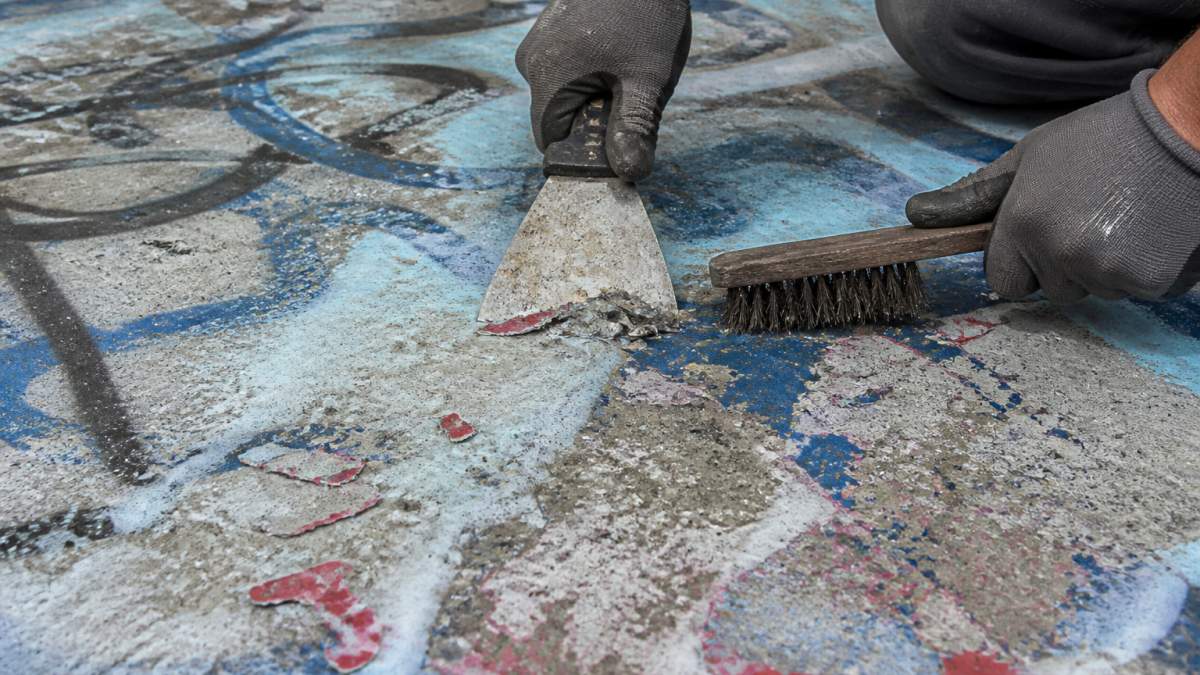
Pour the stripper onto the concrete and spread it evenly with a brush or roller. Follow the product instructions for how long to let it sit. Most strippers need 15 minutes to several hours to soften the paint.
Once the paint is soft, scraping begins. Use a putty knife, chisel, or wire brush. Push firmly but don't gouge the concrete. Work at an angle to lift the paint rather than dig downward.
Here's the step-by-step process:
The key is patience. Rushing leads to damaged concrete. If the paint isn't lifting easily, apply more stripper and wait longer.
When chemical strippers don't work or the paint is extremely thick, mechanical methods take over. These techniques physically remove the coating layer by layer.
Grinding uses a concrete grinder to cut through stubborn paint and coatings. It's powerful but noisy and dusty.
Sanding works on lighter coatings. A floor sander removes the top layer gradually. It's quieter than grinding and creates fine dust rather than heavy debris.
Scarifying uses a machine with multiple cutting heads to break up and loosen the coating. It's aggressive and effective on thick, adhesive residue. Like grinding, it requires skill to avoid surface damage.
For old spray paint on concrete, grinding or scarifying usually works best. Here's why: spray paint often bonds tightly to the surface. Chemical strippers alone won't budge it.
Safety matters here. Wear a dust mask rated for fine particles. Use eye protection. Ensure proper ventilation. If you're not confident, bring in a professional.
After chemical or mechanical removal, pressure washing cleans the surface and removes loose residue. It's also useful as a final step to prepare the concrete for resealing or repainting.
Use 2000-3000 PSI (pounds per square inch) for most concrete. Too much pressure damages the surface. Too little won't clean effectively. Start at a distance and move closer if needed.
Keep the nozzle moving. Don't hold it in one spot. Work in sections, overlapping slightly as you go. Rinse thoroughly to remove all chemical residue and dust.
For sealed or decorative concrete, use lower pressure (1500-2000 PSI) to avoid stripping the finish. Test a small area first.
Here's what to watch for:
After pressure washing, let the concrete dry completely before moving to the next step. This usually takes 24-48 hours depending on weather.
If your concrete is sealed, you need to remove that sealer before applying new paint or coating. Sealer prevents new products from bonding properly.
The challenge: removing sealer without damaging the concrete underneath. This requires the right approach for your specific sealer type.
Acrylic sealers (the most common type) respond well to chemical strippers or grinding. Apply a sealer stripper, wait, then scrape or wash away the softened material.
Epoxy or polyurethane sealers are tougher. These often need grinding or scarifying to break through. Chemical strippers may not work well enough.
Test your sealer with a chemical stripper first. If it doesn't soften within the recommended time, switch to mechanical removal. Trying to force a chemical method on a tough sealer wastes time.
After sealer removal, pressure wash thoroughly. The concrete must be completely clean and bare before you apply new coating. Any remaining sealer residue will cause adhesion problems.
Chemical strippers contain strong solvents. Improper handling causes skin irritation, respiratory problems, and environmental damage. Mechanical removal creates dust that damages lungs. This work requires respect for safety.
Always wear:
Ensure good ventilation. Work outdoors when possible. If indoors, open all doors and windows. Use fans to push fumes out.
Dispose of chemical waste properly. Don't pour stripper down drains. Contact your local council for hazardous waste disposal options. Hazardous waste disposal guidelines outlines safe handling for Western Australia. Many councils accept chemical waste at transfer stations.
When to call a professional:
At Spray Pave Pro, we handle difficult removal jobs regularly. Our team has the equipment, experience, and safety protocols to do the work correctly.
Chemical strippers designed for concrete coatings, mechanical methods like grinding and pressure washing, or a combination of both work best. The right choice depends on the paint type, concrete finish, and how long the spray paint has been in place. Always test your chosen method on a small area first to avoid surface damage.
Yes, if you use the correct method for your concrete type and condition. Chemical strippers are gentler on sealed or decorative concrete, while mechanical removal like grinding works well on porous surfaces. Pressure washing is effective but can erode softer concrete. Test a small patch to confirm the method won't damage your specific concrete before treating the entire area.
Pressure washing can remove spray paint, especially if the coating is already loose or peeling. High pressure (3000+ PSI) is most effective, but it risks damaging softer concrete or pushing water into cracks. It works best as a final rinse after chemical treatment or mechanical removal, rather than as a standalone method for stubborn paint.
Hire a professional if the spray paint covers a large area, the concrete is sealed or decorative, or you're concerned about surface damage. Professionals have access to industrial-grade strippers and equipment. They also manage safety and environmental precautions properly.
Ready to restore your concrete? If removal reveals damage or you want a professional finish, Spray Pave Pro can help. We've transformed thousands of Perth driveways, patios, and pool areas over 23 years. Our team handles everything from surface prep to final sealing. Safe work practices for concrete removal ensures your project meets current standards. Get a free quote today and see what's possible for your property.
