
Last Updated: October 9, 2026
Choosing the best non slip pool deck coatings in Perth starts with what each system does underfoot. This guide from Spray Pave Pro compares the realistic options for local pool surrounds, from epoxy and acrylic to spray-on resurfacing and penetrating sealers.
Pool surrounds face constant water, harsh UV, and pool chemicals. Add bare feet and wet tiles, and grip becomes a safety issue, not a cosmetic one. The wrong product either turns slick when wet or feels like sandpaper underfoot.
Below, we break down how we assess each option, what creates traction, and the trade-offs between comfort, cost, and service life.
Quick picks at a glance:
| Coating system | Best for | Grip when wet | Barefoot comfort |
|---|---|---|---|
| Spray-on resurfacing | Most residential pool decks | High with aggregate | Good to very good |
| Epoxy with grip additive | High-traffic commercial areas | Very high | Moderate |
| Acrylic sealer with texture | Budget refreshes | Moderate | Good |
| Penetrating sealer | Protecting sound concrete | Low (needs additive) | Excellent |
We judge every pool deck coating on five criteria: wet slip resistance, durability under UV and chlorine, barefoot comfort, surface preparation, and long-term maintenance. A finish that grips well but shreds feet or chalks within a season fails.
Slip resistance is the first filter: how a coating performs on a genuinely wet surface, not a damp one, because that is what causes falls.
Durability comes next. A coating has to hold colour and texture through summer sun, splash-out, and cleaning.
Comfort matters more than most guides admit. A finish that feels abrasive gets avoided, and a deck nobody walks on barefoot has failed at its main job.
Finally, we weigh preparation and maintenance. Some coatings demand near-perfect concrete and long curing windows; others tolerate weathered slabs. The right choice depends on the deck you actually have.
Grip comes from texture, not coating chemistry alone. An anti-slip coating for concrete holds a rough profile at the surface so water drains away from the contact point underfoot.
Three things create that profile:
What most guides miss is that texture is a dial, not a switch. Too little and the deck stays slippery when wet; too much and it becomes uncomfortable and traps dirt. The skill is matching texture to how the deck is used.
Slip resistance is expressed as a wet slip rating, tested with standard pendulum or ramp methods. A higher rating means more grip. For pool surrounds, you want a finish that holds its rating after repeated wetting and cleaning, because texture that wears flat loses grip quietly.
Non-slip pool deck resurfacing covers four families: epoxy, acrylic, spray-on cementitious resurfacing, and penetrating sealers. Each suits a different deck, budget, and tolerance for downtime.
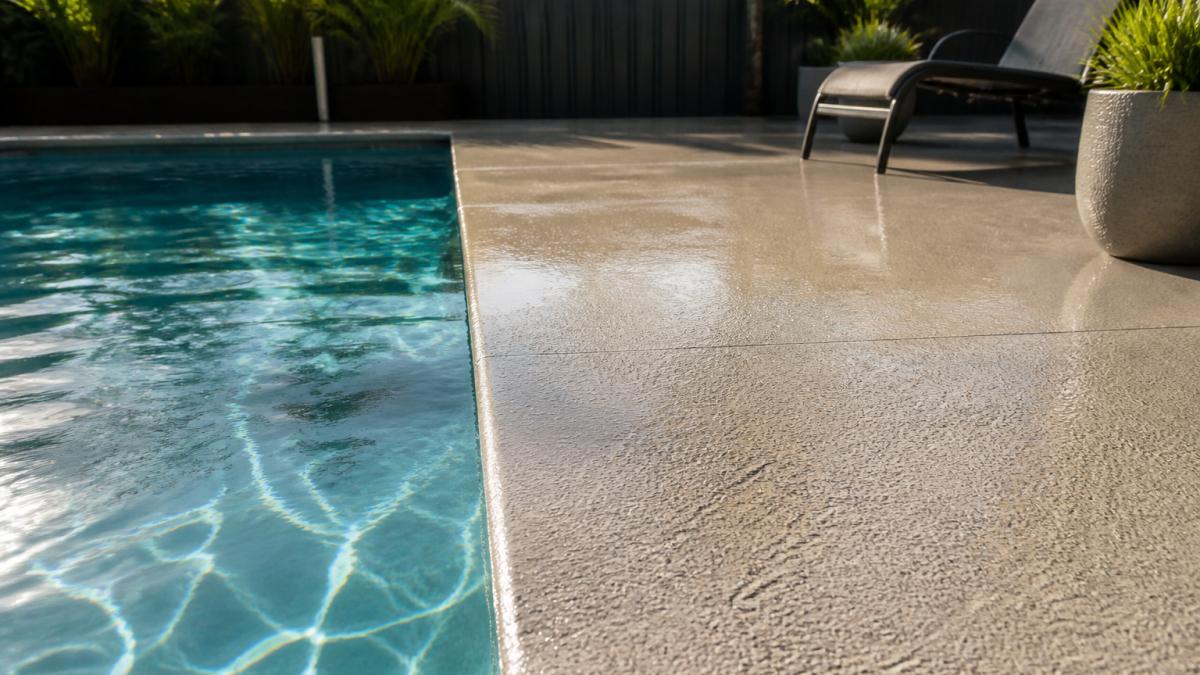
| Option | Grip level | Durability | Best surface | Barefoot comfort | Typical prep |
|---|---|---|---|---|---|
| Epoxy with grip additive | Very high | High | Sound, dry concrete | Moderate | Grind or acid etch; moisture test |
| Acrylic sealer with texture | Moderate | Moderate | Budget refreshes | Good | Clean, dry, sound |
| Spray-on cementitious resurfacing | High | High | Cracked or stained decks | Good to very good | Repair cracks, clean, prime |
| Penetrating sealer | Low alone | High | Sound, bare concrete | Excellent | Clean, dry, no coating |
Epoxy with grip additive bonds hard and resists chemicals well, suiting commercial pool areas and heavy traffic. The trade-off: epoxy feels hard and hot underfoot and needs a sound, dry slab.
Acrylic sealers with texture are the budget option. They refresh colour and add light grip, but wear faster under UV and need recoating sooner.
Spray-on cementitious resurfacing rebuilds the surface, covering cracks and stains before a textured topcoat goes down. This is a suitable option for older pool decks because it addresses the damage rather than hiding it.
Penetrating sealers protect sound concrete without changing its look, but alone add little grip.
The right system depends on what is already underfoot:
Slip resistance is usually expressed as a wet slip rating, tested with standard pendulum or ramp methods. A higher rating means more grip. For pool surrounds, you want a finish that holds its rating even after repeated wetting and cleaning, because texture that wears flat loses grip quietly over time. Ask any contractor what wet slip rating their finish achieves and how they test it, if they cannot answer with a number and a method, they are guessing at your safety.
Pool deck sealing is the protective layer that keeps water, chlorine, and UV out of the surface. Skip it, and even a well-applied coating breaks down faster.
Sealers fall into two groups. Film-forming sealers sit on top and block water directly. Penetrating sealers soak in and repel water from within, leaving the surface breathable. Around a pool, the choice affects how the deck looks and handles constant wetting.
Sealing too early or over a damp slab can lead to trapped moisture pushing the sealer off from underneath, causing the finish to fail within a season. Preparation and correct curing time matter as much as the product.
Maintenance is straightforward once sealed. Regular cleaning with a mild solution and a soft broom keeps texture clear of dirt and algae, which causes most slippery patches.
Pool deck coating durability comes down to how a finish handles three stresses at once: foot traffic, relentless sun, and pool chemicals. A coating that resists one but not the others will not last. Below, what each stress does and what determines how long a finish survives.
Sun breaks down binders in cheaper coatings, causing fading, chalking, and lost texture. UV-stable systems hold colour and grip far longer, which is why they are often preferred for west and north-facing decks that experience significant afternoon sun. Chalking is not just cosmetic, the chalk is binder leaving the surface, and grip goes with it.
Splash-out carries chlorine and salt onto the deck, and over time these attack weaker coatings. Chemical-resistant finishes cope better, but still need the right sealer underneath. Salt is relentless on coastal decks, accelerating breakdown of any coating not fully cured and properly sealed.
Texture that flattens under foot traffic loses grip without looking worn, which is why it's important to consider how a finish holds its profile over time. A coating that keeps its texture through several summers beats one that looks good on day one.
Four factors drive how long a pool deck coating lasts:
A realistic installation follows a clear sequence: assess and repair the concrete, clean and prepare the surface, apply the base and texture, then seal and cure. Preparation and curing matter as much as the product, sealing too early or over a damp slab can lead to the finish failing within a season. A realistic timeline keeps disruption short without cutting the steps that make the finish last.
Barefoot comfort and grip pull in opposite directions. More texture means more traction, but past a point it feels rough and holds dirt. The best pool deck finishes find the middle ground.
Consider the trade-offs:
Pricing depends on deck size, concrete condition, and the system you choose. We quote each job individually rather than publishing a flat rate, because a small sound deck and a large cracked one are completely different projects. Ask for a written quote stating the system, preparation, and expected service life.
A pool deck that turns slippery when wet is a safety problem, not just an eyesore, and patching it with the wrong product only delays the real fix. Our team handles spray-on resurfacing, epoxy flooring, and professional sealing, all tailored to your deck and budget.
It depends on how the deck is used. Epoxy with an aggregate broadcast gives strong grip and handles pool chemicals well, while acrylic and spray-on systems suit decks that need to stay cooler underfoot. The deciding factors are wet slip resistance, barefoot comfort and how much sun the surface gets. A specialist can assess your concrete and recommend a system rather than a generic product.
Sealing is what protects the coating and the concrete beneath it from water, pool chemicals and UV. An unsealed deck absorbs chlorinated splash-out and breaks down faster, and stains set in more easily. A quality pool deck sealing layer also makes cleaning simpler because the surface stays non-porous. Resealing intervals vary by product and foot traffic, so ask your installer for a realistic schedule.
In most cases yes. Non-slip pool deck resurfacing can go over sound existing concrete, provided cracks and loose material are repaired first and the surface is properly prepared. Preparation is what stops a new coating peeling like the last one. Deep structural cracks may need patching before coating. An on-site assessment will confirm whether resurfacing is suitable or whether sections need replacing.
Look at four things: adhesion to the prepared substrate, coating thickness, UV stability and chemical resistance to chlorine and salt. Pool deck coating durability also depends on texture, because heavy aggregate wears down faster under constant foot traffic. Ask how long the system is expected to last in full sun and how often it needs resealing, then weigh that against the upfront cost.
Sweep or hose the deck regularly to stop grit grinding into the texture, and clean spills before they set. Mild detergent and a soft broom handle most marks without damaging the finish. Avoid harsh acid washes, which strip sealers and dull the aggregate. Reapply sealer when water stops beading on the surface, and keep pool chemical splash-out rinsed away to protect the coating.
